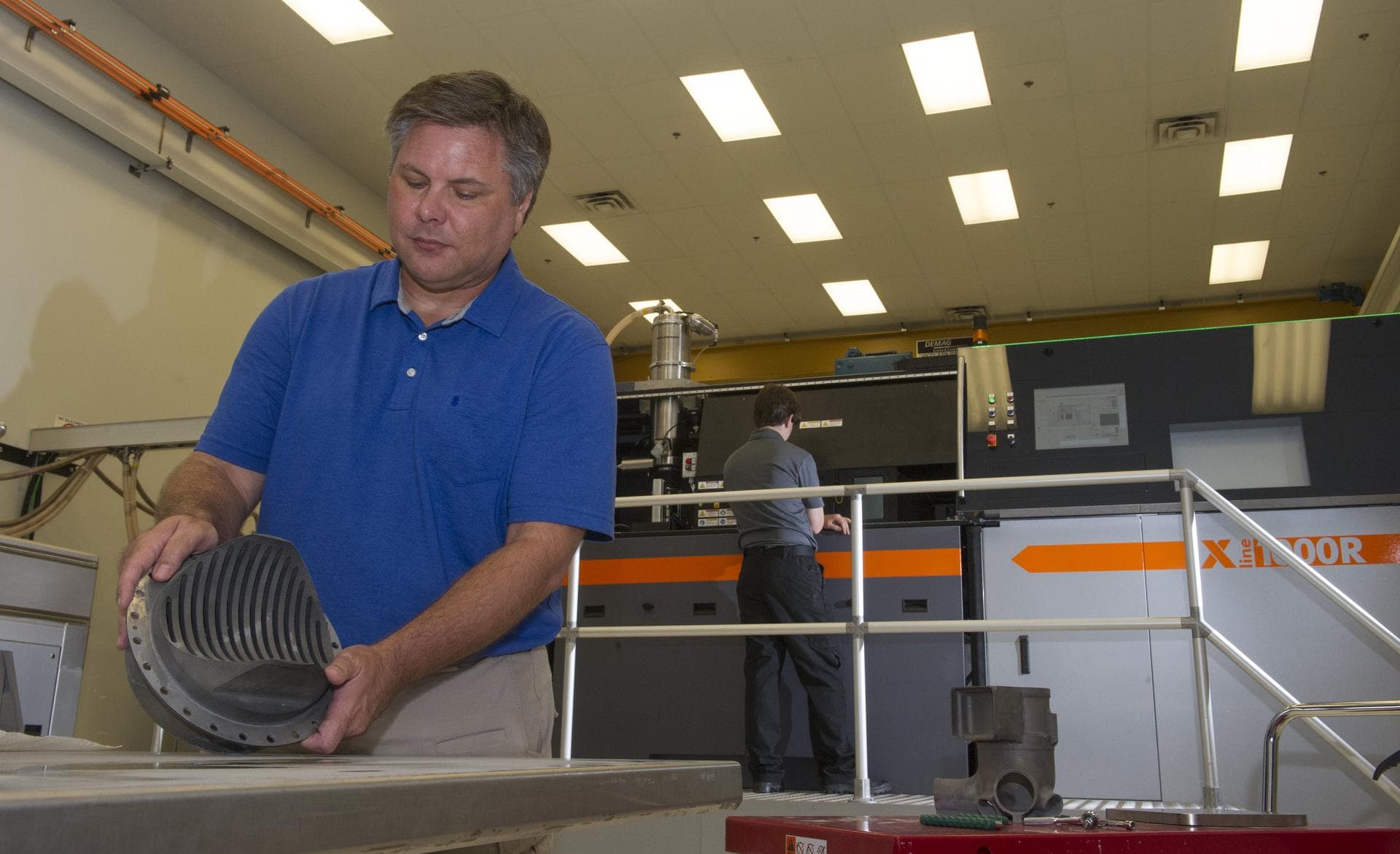
3D printing services for pumps and impellers get bought when the wheel is obsolete, when the quantity is one, or when the hydraulics are still changing and the test rig is booked for next month. The vane profile is almost never the hard part — CAD and a powder bed will reproduce a closed impeller that casting needs a core to make. What decides whether the part works is everything that happens after the build: surface finish inside the passages, powder that never came out, porosity under pressure, and a wheel that was never balanced. This guide covers which process suits which pump job, the materials worth asking for, the finishing operations that belong on the purchase order, and what to send a shop so the first quote is a real one. When you are ready to shortlist, start with the 3D printing provider directory.
Four Jobs, Four Different Purchases
| What you need | Usual route | Why print it |
|---|---|---|
| Obsolete or orphaned impeller | Metal powder bed fusion in 316L or 17-4 PH, reverse-engineered from the worn wheel | The pump is down, the OEM is gone, and a pattern no longer exists |
| Hydraulic development wheel | Polymer — SLS nylon, or stereolithography for a clear test loop | Three vane designs on the rig this month instead of one next quarter |
| Low-volume or special-duty part | Metal powder bed fusion, then finished and balanced | Tens of parts in an alloy nobody keeps patterns for |
| Casing, volute or diffuser | Printed casting pattern or sand cores, cast conventionally | Thick, heavy and bigger than any build envelope — print the pattern, not the part |
Those are four different suppliers as often as they are four different processes. Rows one and three are work for a metal bureau with heat treatment, a mill and a balancing machine on site — see metal 3D printing services for what that supply chain looks like. Row two is a fast polymer shop. Row four belongs to a foundry with a printer in front of it, which is the arrangement described in 3D printing services for investment casting patterns and 3D printing services for sand casting patterns.
Why the Closed Impeller Is the Case That Pays
An open impeller — bare vanes on a hub — can be machined from solid on a five-axis mill, and for a one-off that is frequently the cheaper answer. The economics change on a closed wheel, where a shroud covers the vanes and the flow passages become internal tunnels that curve as they go. Conventionally that needs a casting with cores, which needs a pattern and a pattern maker, which is six to twelve weeks and a tooling bill before anyone has pumped anything.
Powder bed fusion builds the passages and the shroud in one piece because the unfused powder supports them. That is the whole value proposition for pump work: geometry you cannot reach with a cutter, without tooling. It also creates the two problems the rest of this article is about — nobody can polish inside those passages, and the powder that supported them has to come back out of them.
Semi-open wheels sit in between and are worth asking about. If the duty allows a wear ring and an adjustable front clearance instead of a full shroud, the part gets easier to finish, easier to inspect and cheaper to build.
Materials Worth Asking For
| Material | Where it belongs | What to watch |
|---|---|---|
| 316L stainless | The default for water, mild chemicals and general process duty | Soft; poor against abrasive solids; readily available everywhere |
| 17-4 PH stainless | Higher strength and better erosion resistance, heat treated after build | Specify the condition (H900, H1025) — as-built is not a heat treatment |
| Inconel 625 / 718 | Hot, sour or corrosive service; high tip speeds | Expensive, slow to build, hard to machine afterwards |
| AlSi10Mg | Light development wheels, air movers, rig hardware | Not a pumped-liquid material in most process environments |
| PA12 / PA11 (SLS, MJF) | Low-head blowers, fans, development impellers, wear rings | Absorbs moisture and swells; check chemical compatibility before it sees solvent |
| Polypropylene, PEEK, PPS | Chemically aggressive duty in polymer | Limited bureau availability; ask what they have actually run |
| TPU | Diaphragms, seals, flexible impellers, gaskets | See flexible and TPU 3D printing services |
Duplex and super duplex come up constantly in pump enquiries and are much thinner on the ground in powder than 316L or 17-4 PH. If your specification names one, ask for it by name early rather than discovering at quote stage that the shop intends to substitute. The same caution applies to anything running hot — high-temperature 3D printing services covers the polymer end of that, and anything above it is a nickel alloy conversation.
For the parts around the wheel, polymer is often the right answer where metal is not: nylon wear rings and bushings, printed spacers and shaft guards, TPU gaskets, and clear volutes for flow visualisation. SLS 3D printing services and multi jet fusion 3D printing services cover the two usual nylon routes.
The Four Operations That Belong on the Purchase Order
A quote for "a printed 316L impeller" that lists only the build is not a quote for a working pump part. Four operations decide whether it runs.
Stress relief and heat treatment. Metal powder bed fusion leaves residual stress that will move the part when it comes off the plate. Stress relief happens before removal; 17-4 PH then needs its actual age-hardening cycle. Ask for the condition on the certificate, not just the alloy.
Passage smoothing. As-built roughness of roughly 10 to 25 microns Ra is fine on an external flange and expensive on an internal flow passage. On a small, high-speed wheel it costs head and efficiency directly, and nobody is getting a polishing head inside a shrouded impeller. The real options are abrasive flow machining, chemical or electrochemical smoothing, and tumbling for the accessible surfaces. 3D printing post-processing and finishing services covers the processes; the question for the shop is which ones they own versus subcontract.
Machining of the fits. The bore, the keyway, the shaft taper, the wear-ring faces and the shroud faces all need cutting. As-built tolerances are nowhere near a shaft fit — see tolerances and accuracy in 3D printing for the envelopes you can plan against. The usual approach is to build the bore undersize with machining stock and finish it on a lathe.
Dynamic balancing. Specify a balance grade — G6.3 for general service, G2.5 for higher speeds — and confirm who performs it. An unbalanced wheel is not a cosmetic defect; it loads the bearings and the seal every revolution, and it is the fastest way to turn a successful print into a warranty argument.
Pressure, Porosity and Powder
Three failure modes are specific to this class of part.
Internal porosity. Powder bed fusion parts are dense, not perfectly dense. For a wet-end part under pressure, or anything fatigue-critical at speed, hot isostatic pressing closes internal voids and is standard practice on serious rotating hardware. It costs money and a week, and it is the difference between a part that passes a hydrotest and one that weeps. Why 3D printed parts leak is the polymer-side version of the same physics and is worth reading before anyone argues that a print is watertight by default.
Trapped powder. Every shrouded impeller is a powder trap. The passages must be drained and verified — by weight against the model, by borescope, or by CT on parts that justify it. Loose powder is contamination in the process fluid and unbalance in the wheel, and it is not the kind of defect that shows up on a dimensional report.
Erosion and cavitation. Printing does not change what the fluid does to the metal. If the existing wheel failed by abrasion from solids or by cavitation damage at the vane inlet, a printed replacement in the same alloy fails the same way on the same schedule. That is a materials and a duty-point conversation, and it is the one worth having before the order rather than after — the same argument that runs through 3D printing services for mining and heavy equipment.
How to Spec It So the First Quote Is Real
Send a STEP file rather than a mesh wherever one exists (STL vs STEP files), and send the duty with it:
- Flow, head and rpm at the duty point, plus the fluid, its temperature, its solids content and its pH
- Pump make, model and frame; casing bore; wear-ring arrangement and clearances
- Shaft diameter, key or taper, direction of rotation, and the retaining hardware
- Alloy and heat-treated condition, with any required material certification
- Balance grade, surface-finish expectation inside the passages, and any pressure test
- Whether the part is a like-for-like replacement or a re-rate
If there is no model, the worn wheel plus the casing is better evidence than anything else you can send — 3D printing services without a CAD file covers how shops handle that, and 3D printing replacement and spare parts is the companion piece on the obsolete-part workflow generally. Budget reverse-engineering time on the quote; scan data is a starting point, not a solid model with clean vane surfaces.
How much does 3D printing cost covers the general shape of a quote. For pump work the three drivers that move it most are alloy, build height, and how much of the finishing list above is included — low-volume 3D printing services covers where batching several wheels in one build starts paying.
What Separates a Good Provider Here
A shop that has made rotating wet-end parts before asks about rpm, fluid and solids before it asks for a file. It names the build orientation and where the supports land, because a support scar inside a flow passage is a permanent surface defect. It quotes the heat-treated condition rather than the alloy alone. It says how powder removal is verified. It has a balancing machine, or it names the firm that does. And it will tell you when your open impeller should simply be cut from billet instead.
Ask three shops the same six duty questions and compare the replies. The one that asks what the casing bore is has replaced an impeller before. How to choose a 3D printing service covers the general qualifying criteria; the pump-specific one is whether they talk about the finished wheel or only about the build.
When Not to Print It
- The impeller is a stocked spare. If the OEM still sells it, buy it. Nothing printed competes with an existing casting pattern.
- An open impeller that a mill can reach. Five-axis machining from billet gives a better surface, known material properties and no powder to remove. See CNC machining vs 3D printing.
- A large cast-iron volute. Too big, too thick and too cheap to cast. Print the pattern and let the foundry do the rest.
- Hundreds of identical wheels. That is a casting programme, not an additive one.
Printing wins when the wheel is unavailable, unusual, urgent or still changing — which describes most of the pump work that reaches a service bureau.
Get Your Pump Parts Quoted
Settle four things before you ask for a price: the alloy and condition, the finishing inside the passages, who machines the fits, and who balances the wheel. Every meaningful difference between two quotes for the same impeller comes from those four lines.
Browse 3D printing providers and filter for shops running metal powder bed fusion with machining and heat treatment in house rather than printing alone. For a part that spins in a fluid, the operations after the build are the purchase.
Related Resources
- Metal 3D Printing Services — the process, the alloys and what the supply chain looks like
- 3D Printing Services for Heat Exchangers and Manifolds — the static half of the same fluid system
- 3D Printing Services for Gears and Drive Components — the other rotating-hardware purchase
- 3D Printing Services for Marine and Boat Parts — seawater duty and the materials it forces
- 3D Printing Services for Oil and Gas Equipment — certification and sour-service requirements
- 3D Printing Services for HVAC and Plumbing Parts — the building-services end of pumped systems
- Functional and End-Use 3D Printed Parts — what qualifies a printed part for service
- Browse 3D Printing Providers — send the job out
Hero photo by Emmett Given, NASA / MSFC (public domain).