Finding the right 3D printing service is not just about who has the lowest price. The wrong provider can cost you time, money, and parts that fail on the first use. This guide walks you through every factor that matters when evaluating a 3D printing service — technology, materials, quality, lead time, and pricing.
This post contains affiliate links. If you purchase through these links, 3D Prototyping Hub may earn a small commission at no extra cost to you.
This post also contains Amazon affiliate links. As an Amazon Associate I earn from qualifying purchases.
1. Start With the Technology, Not the Price
The biggest mistake buyers make is leading with cost. Technology determines what your part can look like, how strong it will be, and whether it can actually be printed at all.
The three most common technologies you'll encounter:
FDM (Fused Deposition Modeling) — The workhorse. Layers of melted thermoplastic are deposited line by line. Great for functional prototypes, jigs, fixtures, and low-detail parts. Visible layer lines on the surface. Best for PLA, ABS, PETG, Nylon, TPU. For teams exploring in-house FDM capability at a consumer price point, the Creality Ender 3 remains one of the most widely adopted entry-level FDM platforms.
SLA (Stereolithography) — Resin is cured by UV light. Exceptional surface finish and fine detail. Common for dental, jewelry, display models, and engineering prototypes where aesthetics matter. More brittle than FDM unless you use engineering resins.
SLS (Selective Laser Sintering) — Nylon powder fused by a laser. No support structures needed, which allows complex geometries. Strong, functional parts. Used in automotive, aerospace, and medical device prototyping.
DMLS/SLM (Metal Printing) — Powder metal fused by a laser. Titanium, Inconel, stainless steel, aluminum. Expensive but produces production-grade metal parts. Lead times are longer.
Rule of thumb: If you need a concept model or prototype for fit-check, FDM is usually sufficient. If you need fine detail or smooth surfaces, SLA. If you need strong, complex geometry without supports, SLS. If it needs to be metal, DMLS.
2. Match Materials to the Application
Technology and material are linked, but not the same choice. Within each technology, material selection significantly affects mechanical properties.
For FDM, important distinctions:
- PLA — Easy to print, brittle under impact, degrades in heat above 60°C. Good for display models.
- ABS — Better impact resistance, heat resistant to ~100°C, but warps without a heated enclosure.
- PETG — Good balance of strength, flexibility, and printability. Often the right choice for mechanical parts.
- Nylon — Excellent wear resistance and chemical resistance. Used in functional gears and fasteners.
- TPU/TPE — Flexible elastomers. Gaskets, grips, flexible hinges.
When requesting a quote, include your application requirements — operating temperature, load-bearing requirements, chemical exposure, UV exposure — not just the material name. A good provider will advise if your specified material is the right choice.
3. Evaluate Quality Before Committing to a Volume Order
Never run a production batch with a new provider without first ordering a qualification part. A qualification part is a small, inexpensive run — ideally including your most geometrically complex feature — to verify the provider can actually meet your tolerances and surface finish requirements.
What to look for in a qualification run:
- Dimensional accuracy — Measure critical dimensions against your CAD model. Does the part match?
- Surface finish — Appropriate for your application? SLA should be smooth; FDM layer lines should be consistent.
- Support removal — Are support witness marks acceptable? Are internal channels clear?
- Warping and delamination — Any signs of poor adhesion or thermal warping on flat surfaces?
A provider who produces a flawless qualification part the first time, without needing revisions, is a good sign. A provider who needs three rounds to hit basic tolerances should raise concerns for volume orders.
4. Understand Lead Time vs. Rush Fees
Standard lead time for most consumer and professional 3D printing services is 3–7 business days. Rush services exist but carry a 25–50% premium and sometimes result in lower quality.
Questions to ask before ordering:
- What is your standard lead time for my quantity?
- Do you offer rush processing, and what does it cost?
- At what point in the order process do you start the clock on lead time?
- How do you handle reprints if a part fails quality inspection?
Watch for services that quote fast but don't disclose their QC process. A 24-hour turnaround means nothing if 30% of parts need reprints.
5. Get at Least Three Quotes
Pricing varies significantly between providers — sometimes by 200–300% for identical geometry and material. The difference is often equipment, overhead, and whether they're running industrial-grade machines or consumer-grade printers.
When you request multiple quotes:
- Send the exact same STL file and requirements to each provider
- Specify material, layer height (if applicable), infill (for FDM), and finish requirements
- Ask for a line-item breakdown — part cost, support removal, post-processing, shipping
The cheapest quote is not always the best. Weight price against the provider's track record with your specific technology.
6. Check Certifications for Regulated Industries
If your parts will be used in medical devices, aerospace, automotive, or food contact applications, ask specifically about:
- ISO 9001 — Quality management system certification
- AS9100 — Aerospace quality standard
- ISO 13485 — Medical device manufacturing
- ITAR compliance — Required if parts have defense applications
Most local and regional 3D printing services won't have these certifications. For regulated applications, you need a specialized provider.
Finding Verified Providers
The fastest way to find a vetted 3D printing service in your region is to search the 3D Prototyping Hub directory. Providers are organized by state, city, and service type, with direct quote request submission — no hunting through Google and hoping the email goes to the right person.
Start with your geography. A local provider you can visit in person is almost always worth considering for complex or high-stakes projects, even if an online service is slightly cheaper.
Before You Choose a Service
- Compare the make-vs-buy math: How Much Does 3D Printing Cost?
- If a desktop machine would cover it: Best FDM Printers Under $500 (2026) · Best 3D Printers for Small Business (2026)
- Comparing processes first: SLA vs FDM · Injection Molding vs 3D Printing
- Ready to get quotes: Browse verified providers
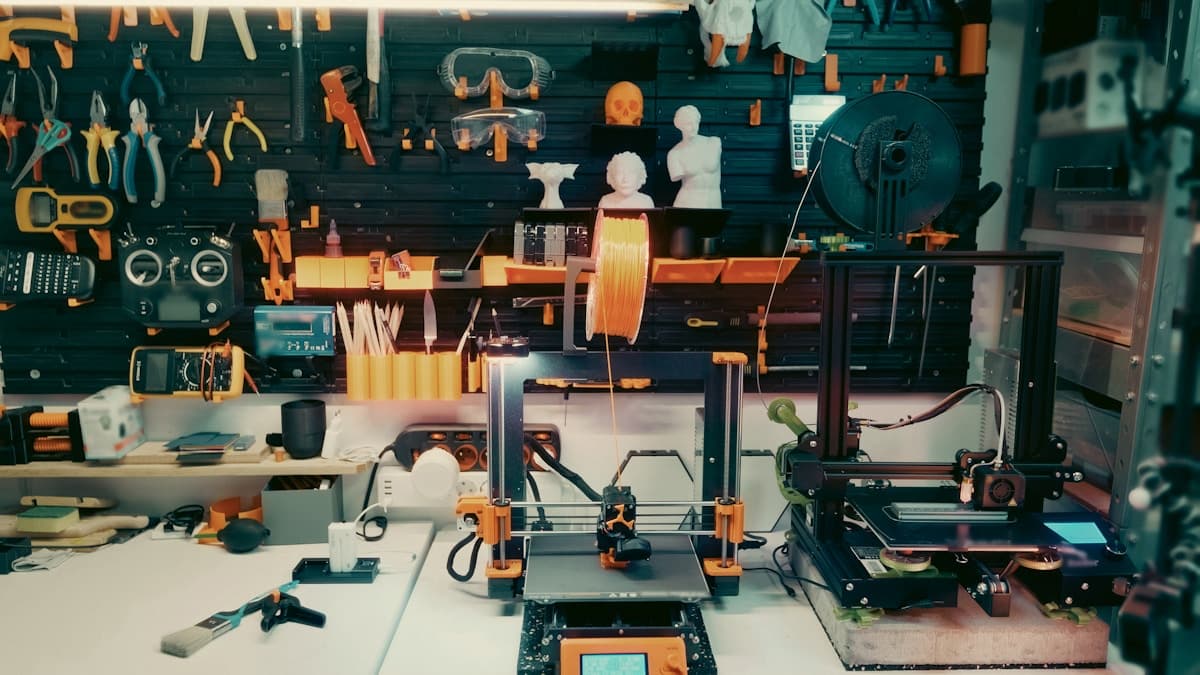
Hero photo by Jakub Żerdzicki via Unsplash.