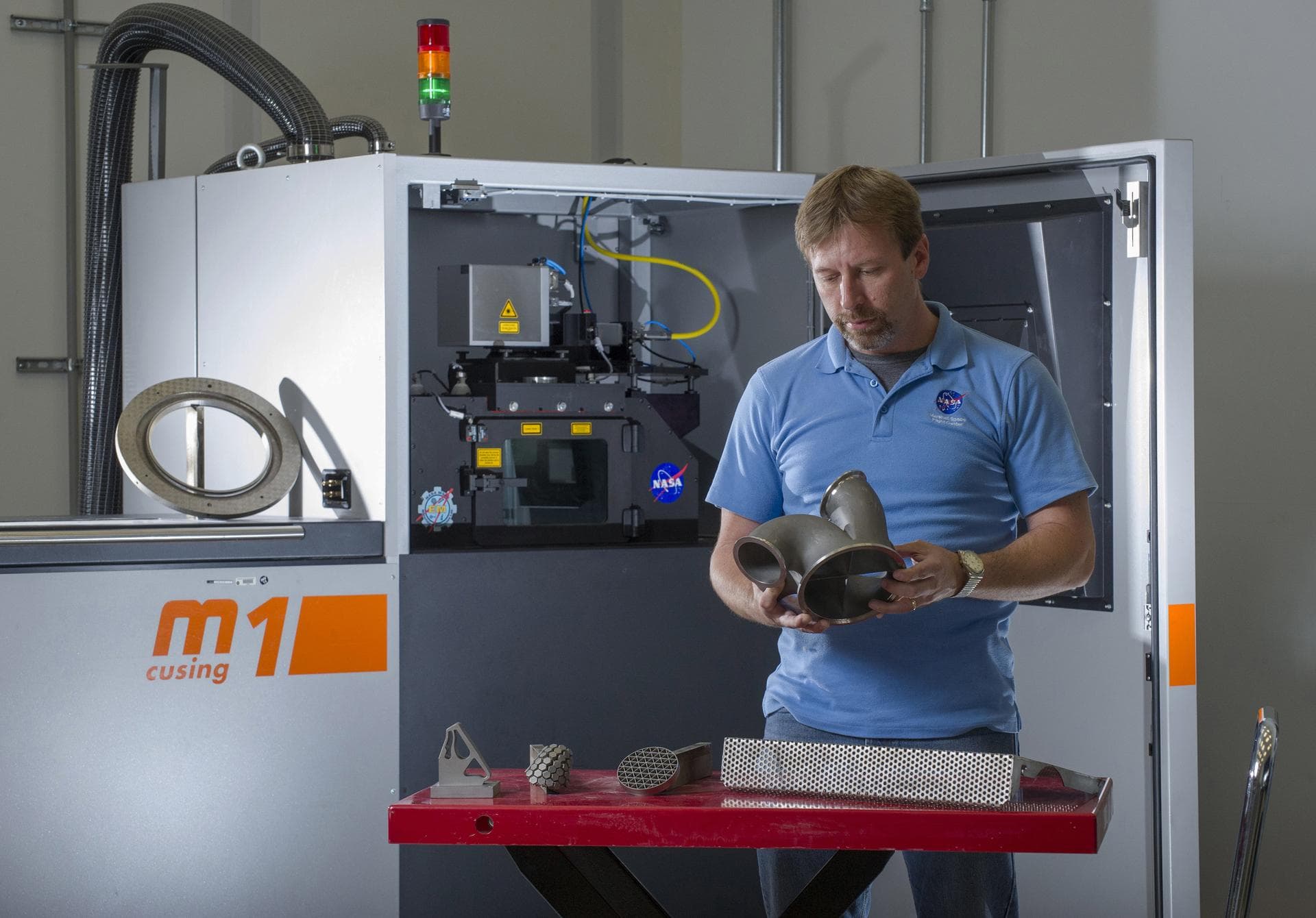
3D printing services for heat exchangers and manifolds are bought for one reason: the part has internal geometry that no other process can make in one piece. A manifold that would be six drilled blocks, four plugged cross-holes and twelve fittings becomes a single body. A cold plate that would be a brazed stack becomes a solid block with a lattice core. The savings are not in the printing — printing is the expensive part — they are in the joints, the fittings and the leak paths that no longer exist. This guide covers which process suits which duty, the design rules that decide whether your channels print at all, why trapped powder is the defect that matters most, and what to put in a request so the first quote is a real one. When you are ready to shortlist shops, start with the 3D printing provider directory.
Four Things Buyers Are Actually Ordering
"A printed manifold" covers four jobs with different economics and different providers.
| What you need | Typical route | Why print it |
|---|---|---|
| Fit-and-flow prototype | SLS or MJF nylon, sometimes SLA | Prove routing, port positions and envelope in days, before anyone commits to metal |
| Hydraulic or pneumatic manifold | Laser powder bed fusion in 316L, AlSi10Mg or Inconel | Consolidate an assembly, delete cross-hole plugs, cut mass and leak paths |
| Compact heat exchanger or cold plate | Powder bed fusion in aluminium or copper alloy | Surface area per unit volume that stacked plates cannot reach |
| Conformal cooling insert for tooling | Powder bed fusion in tool steel, then machined | Cooling channels that follow the cavity instead of being drilled straight |
The first row is a different purchase from the other three. A nylon prototype manifold is a geometry check and a conversation piece for a design review — it is not a pressure part and should never be quoted as one. The other three are engineered metal components where the process, the heat treatment and the inspection matter as much as the shape. Most of the directory's shops can do the first. A much smaller set can do the rest, which is the single most useful thing to know before you start sending files out.
The Design Rules That Decide Whether It Prints
Every layer in powder bed fusion needs material beneath it, and almost every problem with printed flow hardware traces back to that one fact.
Round horizontal channels sag. A vertical bore builds its own walls and comes out clean. A horizontal bore has an unsupported roof, and past roughly 8 to 10 mm diameter that roof droops, roughens and occasionally collapses. Redrawing the section as a teardrop or a diamond turns the roof into a self-supporting peak and costs nothing in CAD. This is the most common single fix applied to a customer manifold model.
Supports inside a closed channel cannot be removed. If the geometry needs internal supports, the part is unmakeable as drawn, because nobody can reach in to break them off. Self-supporting sections are not a refinement here, they are the requirement.
Wall thickness is a pressure decision, not a printing one. Around 1 mm is printable; what you need between a channel and the outside world comes from the working pressure, the alloy, the safety factor and whether the part is cycled. Decide it with a stress calculation, then check it against the process minimum, not the other way around.
Every channel needs at least two openings and no dead ends. This is a cleaning rule and it drives the whole layout. Blind pockets and long serpentine runs with one entry are where powder stays.
Put machining stock on every sealing surface. Port faces, O-ring grooves and threads get printed oversize and finished conventionally. Tolerances and accuracy in 3D printing sets the expectation for the as-built surfaces, and nothing in that range seals on its own.
Powder Removal Is the Whole Game
For a solid bracket, depowdering is housekeeping. For a manifold, it is the defect mode. Loose powder in an internal passage does not stay put — it migrates downstream into a valve, a pump or an injector, and the part passes every visual inspection on the way out of the door.
Partially sintered powder is worse, because it is stuck to the channel wall and no amount of shaking moves it. It also leaves the bore rougher than the process minimum, which matters for pressure drop: as-built internal surfaces around 10 to 25 microns Ra behave hydraulically like a much smaller pipe, and a heat exchanger specified on clean-tube numbers will under-deliver.
Ask the provider three things, and treat vague answers as the answer:
- How do you clean the internal passages? Vibration and compressed air for simple runs; abrasive flow machining or chemical polishing for channels that have to be smooth as well as empty.
- How do you verify they are clean? CT scanning is the strongest evidence and shows trapped powder and internal porosity in the same scan. Mass against CAD-predicted weight, borescope inspection and a recorded flush-and-flow test are a reasonable tier below it.
- What goes on the certificate? Flow rate at a stated pressure is a number you can hold them to. "Cleaned and inspected" is not.
3D printing post-processing and finishing services covers the wider finishing menu, and if the part has to be watertight rather than merely solid, why 3D printed parts leak explains what actually causes the failure in both polymer and metal parts.
Pressure, Heat Treatment and Paperwork
A printed pressure-containing part is a materials job as much as a geometry job.
Stress relief is not optional. Powder bed fusion leaves substantial residual stress, and a manifold cut off the build plate without stress relief will move. It is a standard step in any competent shop's flow; confirm it is in the quote.
HIP for cyclic duty. Hot isostatic pressing closes internal porosity and lifts fatigue performance toward wrought values. For a static low-pressure part it is often unnecessary; for anything that cycles, it usually is not.
Proof test the part, not a sample. Hydrostatic or pneumatic proof testing on each unit is normal for pressure hardware, alongside witness coupons printed in the same build for tensile and density.
Certification is still immature, and be honest with yourself about it. Code acceptance of additively manufactured pressure parts is advancing but is not the settled ground that a catalogue component sits on. If your part lives inside a coded system, bring that constraint to the provider at the quote stage rather than at inspection. 3D printing service certifications covers what the common approvals do and do not cover, and the same problem shapes the sector work in aerospace parts and oil and gas equipment.
For high-temperature duty in nickel alloys and the material choices behind it, high-temperature 3D printing services is the companion read.
What Drives the Quote
- Height in the build, not volume. Powder bed fusion is priced largely by build time, and build time tracks the Z height of the part. A manifold laid flat can cost materially less than the same manifold stood upright — and may print worse. The orientation argument is a real engineering trade, and a good provider will show you both.
- Alloy. Aluminium and 316L at the bottom; nickel alloys, tool steel, copper and titanium escalate sharply.
- Support volume and support access. Supports that are hard to reach are hand labour, and hand labour is the line item that varies most between shops.
- Internal cleaning and verification. CT scanning is a real cost. So is abrasive flow machining. Both are worth naming explicitly so quotes are comparable.
- Post-machining. Seal faces, ports and threads, plus the fixturing to hold an awkward printed body.
- Heat treatment and HIP. Batched, so quantity moves the per-part number more than you would expect.
- Testing and documentation. Proof test, material certs, dimensional report, traceability. On regulated work this can approach the cost of the part.
How much 3D printing costs covers the general pricing model, and it is always worth pricing the printed route against CNC machining — a manifold that is genuinely just a drilled block is cheaper and faster as a drilled block, and saying so is the mark of an honest provider.
How to Spec the Job
Send this, and the first number back will be the real one:
- STEP geometry, with the internal volume modelled as solid material removal rather than as a surface body.
- Working and proof pressure, the fluid, and the operating temperature range. These choose the alloy before anything else does.
- Which surfaces seal, marked on a drawing with the stock you expect to be left for machining.
- Minimum channel size you are willing to accept, so the provider can tell you whether they can clean it.
- Cleanliness requirement, as a standard or a particle count if you have one, and the verification method you want.
- Quantity and expected annual quantity. One prototype and fifty a year are different conversations about heat treatment batching.
- Whether the part is inside a coded system, up front.
- Flow performance targets, including pressure drop, if the geometry is yours to optimise. Several shops will counter-propose a better internal layout, and that is the value you are buying.
If the model is not ready to send, how to prepare files for a 3D printing quote covers formats, units and the one-paragraph brief that turns a vague request into a same-day price.
Qualifying a Provider
Have you printed internal flow passages before, and how did you verify them? The tell is whether they raise powder removal before you do. A shop that quotes a manifold without mentioning cleaning has not built one that mattered.
Will you review my channel geometry and tell me what you would change? You want the teardrop conversation to come from them. If the quote arrives with no design feedback on a part full of horizontal round bores, they intend to print it exactly as drawn.
Do you machine in house? Printed body, machined seal faces, one point of responsibility. Split that across two vendors and the datum argument is yours to referee.
What does your pressure testing and certification package look like? Ask for a redacted example. The document either exists or it does not.
How to choose a 3D printing service covers the general checklist; the four above are the ones specific to flow hardware.
When Not to Print It
Three honest cases where this is the wrong route:
- A commodity duty with a catalogue answer. A standard plate heat exchanger off a shelf is vastly cheaper and already certified. Print when the envelope, the fluid or the temperature rules the catalogue out.
- A manifold that is genuinely a drilled block. Straight crossing bores in a rectangular body is what a machining centre is for. See CNC machining vs 3D printing.
- Hundreds of identical low-pressure polymer manifolds. At that quantity tooling wins; a printed part never gets cheaper per unit. Low-volume 3D printing services covers where the crossover sits.
And if the part is a chunky cast-alloy body with simple internal passages, the pattern route may still beat both — 3D printing services for investment casting patterns covers that comparison.
Get Flow Hardware Quoted
Settle four things before you ask for a price: the pressure, the fluid, the alloy, and how clean the inside has to be. Everything on the quote follows from those answers, and a request missing them gets a number that will change later.
Browse 3D printing providers and filter for metal powder bed fusion rather than printing generally — this is work for a shop with a metal machine, a furnace and a mill, not for the cheapest printer on the list. Ask three, send the same four answers to all of them, and watch for the one that asks how you intend to get the powder out.
Related Resources
- Metal 3D Printing Services — the process hub behind every metal option here
- Why 3D Printed Parts Leak — the failure mode flow hardware exists to avoid
- High-Temperature 3D Printing Services — nickel alloys and hot-section duty
- 3D Printing Services for HVAC and Plumbing Parts — the lower-pressure, higher-volume end of fluid handling
- SLS 3D Printing Services — the usual route for a nylon fit-and-flow prototype
- Rapid Tooling Services — where conformal cooling inserts fit in a tooling programme
- Browse 3D Printing Providers — send the job out
Hero photo by Emmett Given, NASA / MSFC (public domain).