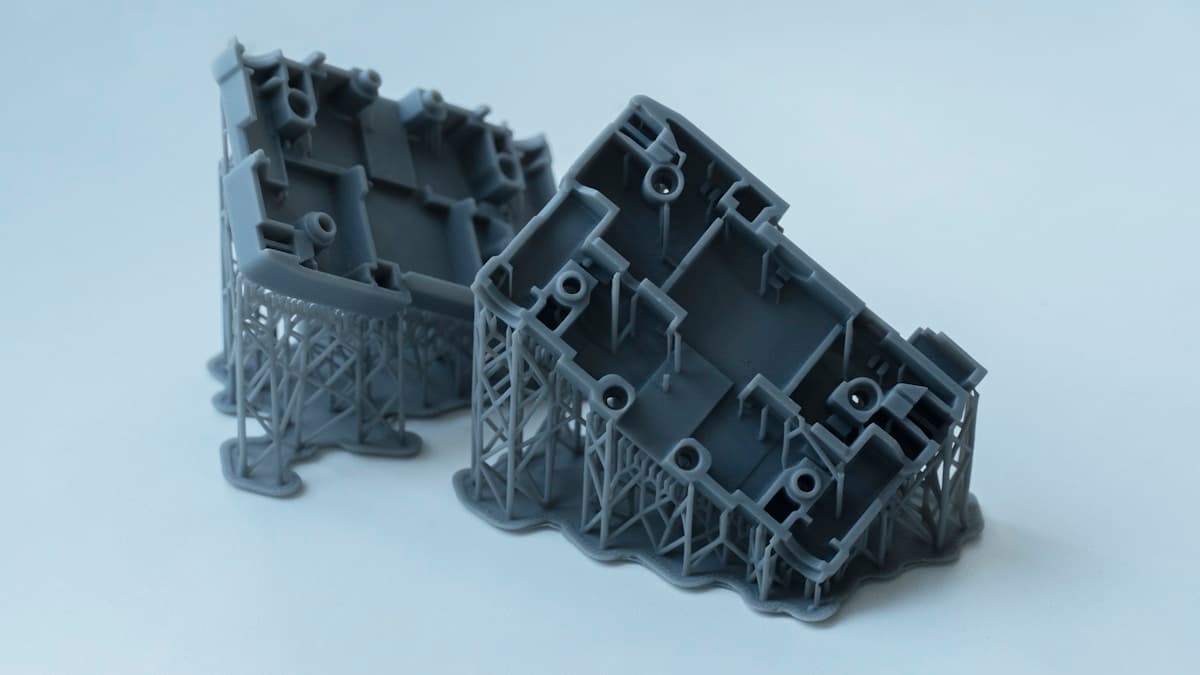
Metal 3D printing turns a CAD file into a fully dense metal part — a real, load-bearing component, not a model. It opens up geometry that machining can't produce and removes the tooling cost of casting, which is why aerospace, medical, motorsport, and tooling teams now rely on it for production, not just prototypes. It is also several times more expensive than plastic printing, so the goal of this guide is simple: help you decide whether metal is actually the right call, and if it is, source a provider and get an accurate quote. Start by browsing 3D printing providers and filtering for metal capability.
How Metal 3D Printing Works
Most production metal printing uses powder-bed fusion, where a laser or electron beam selectively melts metal powder layer by layer to build a fully dense part. The two names you'll see most often — DMLS (Direct Metal Laser Sintering) and SLM (Selective Laser Melting) — refer to laser-based variants of the same basic powder-bed fusion process; the distinction is largely a matter of machine vendor and how the powder fuses. The result is a part with mechanical properties close to wrought metal after heat treatment.
There are two other processes worth knowing:
- Binder jetting — A binder is printed onto metal powder to form a "green" part, which is then sintered in a furnace. It's faster and cheaper per part at volume, but parts shrink during sintering and can be less dense unless fully sintered or infiltrated. Good for larger quantities of smaller parts where ultimate strength isn't critical.
- Directed energy deposition (DED) — Metal is melted as it's deposited, used for large parts, repairs, and adding features to existing components rather than fine-detail printing.
For most buyers ordering functional metal parts, you'll be quoting DMLS/SLM. Knowing the process name on your quote helps you compare apples to apples.
What Metal 3D Printing Is Good For
Metal additive earns its premium in specific situations. It's the right call when:
- The geometry is impossible to machine. Conformal cooling channels inside an injection-mold insert, internal lattices for lightweighting, or topology-optimized organic shapes that no tool can reach.
- You need one part, or a handful. No tooling means no minimum order penalty. For a single bracket or a five-off batch, printing skips the casting tooling cost entirely.
- Lightweighting matters. Aerospace and motorsport teams use printing to consolidate assemblies into a single lighter part and to remove material where it isn't needed.
- The alloy is specialized. Titanium and Inconel parts that would be slow and expensive to machine from billet can be printed near-net-shape, cutting material waste.
If your part is a simple block, plate, or rotational shape in a common alloy, CNC machining is almost always cheaper, faster, and more precise. Metal printing isn't a default — it's a tool for the jobs machining can't do well.
Metal vs. Plastic vs. Machining
Before you pay for metal, make sure you actually need it. A surprising amount of work that lands on metal-printing quote forms would be better served another way:
| Approach | Best for | Relative cost | Lead time |
|---|---|---|---|
| Plastic printing (FDM/SLA/SLS) | Form, fit, and many functional parts | $ | Days |
| Metal 3D printing (DMLS/SLM) | Complex geometry, specialized alloys, low quantity | $$$$ | 1–3 weeks |
| CNC machining | Simple-to-moderate geometry, tight tolerances, volume | $$ | Days to weeks |
| Casting | High volume of the same metal part | $$ (after tooling) | Weeks (tooling) |
The most common mistake is jumping to metal for a part that only needs to look or fit like the final component. Validate form and fit in plastic first — it's a fraction of the cost. Many teams print a plastic version to confirm the design, then order the metal part once the geometry is locked. For choosing between plastic processes, SLA vs. FDM Printing Explained covers the trade-offs.
What Metal 3D Printing Costs
There's no flat rate — cost is driven by a handful of factors:
- Part volume and bounding box. Bigger parts use more powder and more machine time, the two largest cost drivers.
- Material. Stainless and aluminum are the most economical; titanium, Inconel, and cobalt-chrome cost considerably more.
- Support structures. Overhangs require supports that consume material and demand manual removal afterward — a real labor cost in metal.
- Post-processing. Heat treatment (often mandatory for full properties), surface finishing, and finish-machining of critical surfaces all add cost.
- Tolerances and certification. Tight tolerances mean post-machining; regulated industries require material and process documentation that carries a premium.
As a rough orientation: small simple parts often start around $200–500, mid-complexity functional parts commonly land in the $500–2,500 range, and large or titanium parts run well into the thousands. Treat those as starting points, not quotes. The only reliable number is a real quote on your actual file.
How to Choose a Metal 3D Printing Provider
Confirm the process and the exact alloy. "Metal printing" isn't one thing. Verify the provider runs DMLS/SLM (or binder jetting, if that fits) and stocks the specific alloy you need — 316L stainless behaves very differently from Ti-6Al-4V.
Ask about post-processing as part of the quote. A raw printed part usually isn't finished. Clarify whether heat treatment, support removal, surface finishing, and any finish-machining are included, or whether you're receiving an as-built part that needs more work.
Check certifications if you're in a regulated industry. Aerospace (AS9100), medical (ISO 13485), and similar work require documented material traceability and process control. Confirm this before you send geometry — it's not something to discover after the part ships.
Get the design rules. Good metal providers will share guidance on minimum wall thickness, supported angles, and how to orient your part to minimize supports and cost. If a shop won't engage on design-for-additive, that's a signal.
Quote the same file to two or three providers. Metal pricing varies even more than plastic because post-processing assumptions differ. Comparing identical geometry is the only way to know you're getting a fair number. How to Choose a 3D Printing Service covers the full vetting process, and much of it applies directly to metal.
Validate in Plastic First
The cheapest insurance against an expensive metal mistake is a plastic test print. Before you commit a design to DMLS, print it in PLA or PETG to check fit, clearances, and assembly. Catching an interference problem on a $5 plastic part is far better than discovering it on a $1,500 titanium one.
It won't replace a metal bureau for the final part — but it will stop you paying for metal twice.
Order Metal Parts From a Provider
When your design is locked and you've confirmed metal is the right process, browse the directory, filter for providers with metal capability, and submit your CAD file to two or three that run the process and alloy you need. Compare quotes on the same geometry, confirm post-processing and certification, and choose on capability and total delivered cost — not just the headline price. Run a shop that offers metal 3D printing and aren't listed yet? Claim your listing to start receiving quote requests from buyers who need it.
Related Resources
- How to Choose a 3D Printing Service — evaluation criteria for any provider
- SLA vs. FDM Printing Explained — validate in the right plastic process first
- 3D Printing Services for Product Development Teams — where metal fits in an iteration workflow
- Browse 3D Printing Providers — find metal capability near you or nationwide
Hero photo by EnCata PD on Unsplash.