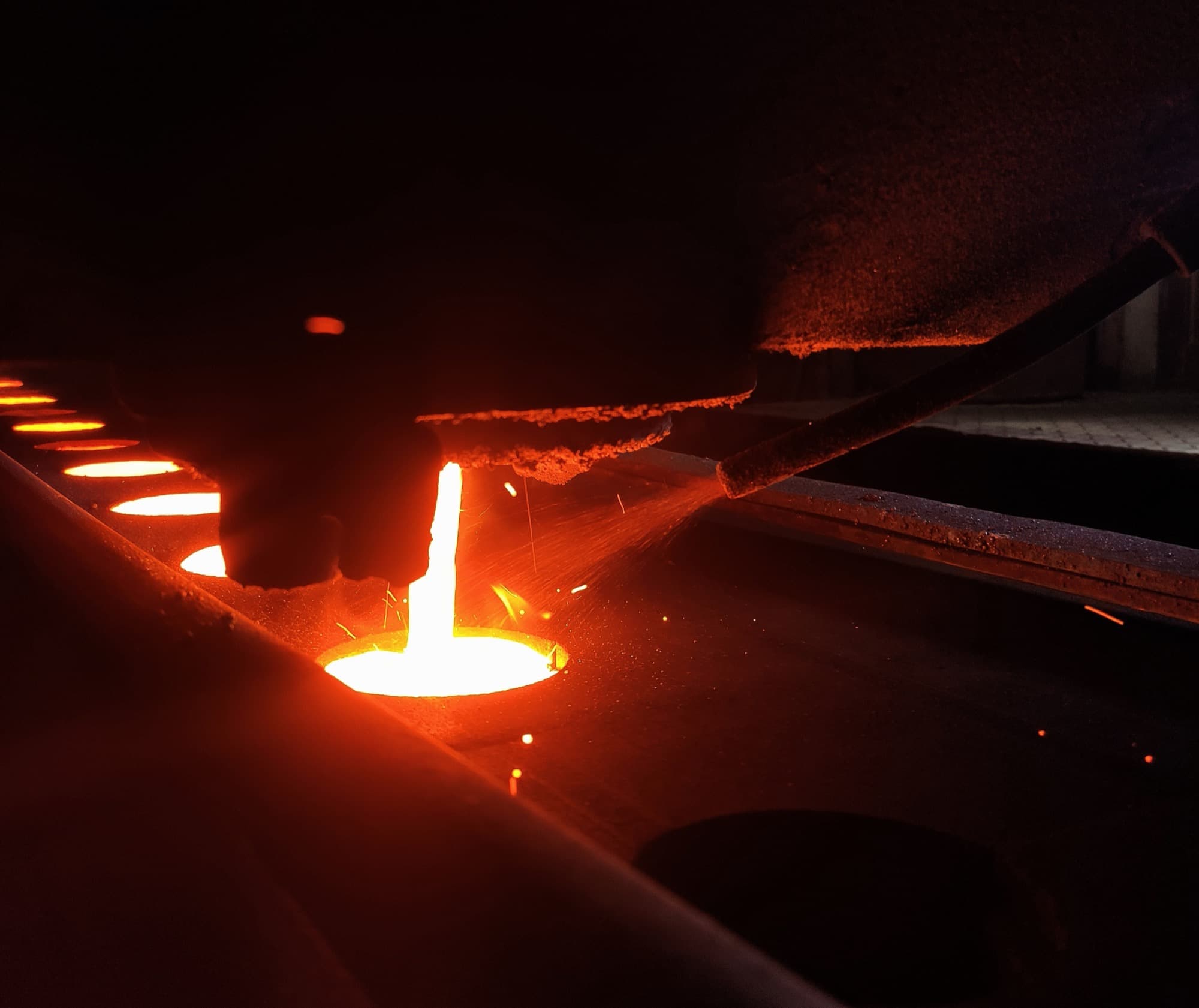
3D printing services for sand casting patterns exist because the pattern shop is usually the slowest and least flexible part of getting a casting made. A machined aluminum pattern and core box is weeks of lead time and four figures before a single mold is rammed, and it is the wrong thing to buy while the geometry is still moving. Printing that tooling — or skipping it and printing the mold itself — turns a six-week tooling decision into a three-day one, which is why most job shops and prototype foundries now quote both routes. This guide covers what actually gets printed for a foundry, the allowances that have to be in the file before anyone prints anything, how many castings a plastic pattern is good for, and what to put in front of a provider to get a real number back. When you are ready to shortlist shops, start with the 3D printing provider directory.
Two Different Things You Can Buy
Foundry buyers routinely conflate these, and they have different economics.
| Route | What you receive | Where it wins |
|---|---|---|
| Printed pattern equipment | A pattern, core boxes and often a match plate, in plastic, that your foundry uses to make molds conventionally | You want more than a handful of castings, or your foundry already has the molding capacity and just needs tooling |
| Printed sand molds and cores | The bonded-sand mold halves and cores themselves, ready to close and pour — no pattern anywhere in the process | One to five castings, geometry with cores that would be miserable to assemble, or a design still changing between pours |
The first is tooling and amortizes. The second is a consumable and does not. Most projects start on the second and move to the first once the geometry stops changing — a sequence worth planning for, because it changes what you ask for in the CAD.
What Actually Gets Printed
Loose patterns and match plates. The core of the work. A printed pattern can be a single loose piece for hand molding, split on the parting line, or mounted either side of a plate for flask work. Printed patterns are usually made hollow with a sparse infill and a thick shell, which is why they cost a fraction of a solid machined equivalent and weigh almost nothing on a large flask.
Core boxes. Often the better half of the deal. Core boxes are fiddly, low-volume and expensive to machine, and they are geometrically simple enough that printing them is easy. Plenty of shops print the core boxes and machine the pattern.
Gating, runners and risers. Cheap to print, cheap to change, and the fastest way to trial a gating scheme before committing it to a match plate. If your foundry wants to iterate on feeding, printed gating is the least painful way to do it.
Molds and cores in bonded sand. Binder jetting prints silica or ceramic sand with a furan or phenolic binder, layer by layer, producing a mold you close and pour directly. Covered in its own section below.
Investment casting patterns at industrial scale. Printed patterns for shell investment work — hollow to keep the shell from cracking during burnout, in materials formulated to leave no ash. The bench-jewelry version of the same idea is covered in 3D printing services for jewelry and casting patterns; the industrial version is the same physics at ten times the size.
Molding aids. Follow boards, sweep templates, core setting fixtures, strike-off gauges. Small, unglamorous, and frequently the thing that actually speeds a job up — the same argument made in 3D printing services for jigs, fixtures and manufacturing aids.
The Allowances Have to Be in the File
The part model is not the pattern model. This is where most first-time orders go wrong, and no print shop can catch it for you.
Shrink. Metal contracts as it solidifies and cools, so the pattern is deliberately oversize. Roughly 0.8–1.0% for gray iron, 1.0–1.6% for aluminum, 1.3–1.6% for copper alloys, 1.6–2.6% for carbon and stainless steel — confirm the number with the foundry that will pour it, because their figure reflects their own experience with that alloy and section thickness. Then agree in writing who applies it. A file scaled twice produces a casting that looks right and fits nothing.
Draft. A pattern has to come out of the sand. One to three degrees on vertical faces is normal, more on deep pockets and anything the molder cannot rap loose easily. Printed patterns are less forgiving here than wood, because plastic scuffs rather than compresses.
Machining stock. Add material anywhere a dimension matters: 1.5–3 mm on small aluminum work, 3–6 mm on medium iron and steel, more on large castings and on surfaces that sit under the cope where inclusions collect.
Fillets and radii. Sharp internal corners cause hot spots and shrinkage porosity. Generous fillets cost nothing in a printed pattern and improve the casting.
Core prints. The pattern needs the extra features that locate and support each core in the mold. They are not part of the finished casting, so they will not be in the part model, and they have to be added deliberately.
Design for 3D printing guidelines covers the printing side of the geometry, and tolerances and accuracy in 3D printing sets expectations for the pattern itself — though as the FAQ notes, the casting process, not the pattern, sets what the finished part can hold.
Materials, Sealing and How Many Pulls You Get
| Pattern material | Realistic service life | When to specify it |
|---|---|---|
| PLA, sealed | Tens of pulls, low hundreds if treated well | The default for no-bake and prototype work — stiff, stable, cheap, prints large parts flat |
| PETG | Similar to PLA, tougher on thin features | Patterns with slender projections that snap in handling |
| ABS or ASA | Low hundreds of pulls | Repeated stripping, heavy sanding and filling, or patterns that live in a warm shop |
| Nylon and carbon-filled grades | Hundreds of pulls | Thin walls, high-wear edges, patterns that get abused |
| SLA resin | Tens of pulls, best surface | Small, high-detail patterns and core boxes where finish matters more than toughness |
| Printed master, cast in urethane | Hundreds to low thousands | You need production-grade pattern equipment and the geometry is settled |
Sealing decides more than the polymer does. Layer lines hold damp sand and tear on the pull, so the standard treatment is two or three coats of filler primer or epoxy, sanded back between coats, then wax. Ask whether the quote includes it; a bare printed pattern is a semi-finished item, and a shop that has done foundry work before will offer sealing without being asked.
Large patterns bring their own constraint — bed size. A flask-sized pattern is a large-format 3D printing job, or it is printed in sections and bonded, which is normal practice and perfectly sound if the joints are placed away from critical surfaces.
When to Print the Mold Instead
Binder-jet sand printing removes the pattern from the process entirely. The machine prints bonded sand directly, so the rules change:
- No draft required. Nothing has to be pulled out of anything.
- No parting line constraint. Undercuts that would need a loose piece or a separate core in conventional molding just get printed.
- Cores integrated. Internal passages that would be four cores glued into a jig arrive as one printed package, correctly located.
- Days, not weeks. Files to poured casting inside a week is routine at shops that run it.
- Size range is wide. From boxes not much bigger than a shoebox to machines that build several meters long, which is how one-off pump housings and engine blocks get made.
The cost sits in the sand volume, so a chunky part is expensive per casting and stays expensive on the tenth one. Surface finish is a little coarser than a good green-sand mold, and the accuracy is casting accuracy, not machine accuracy. Where it is unbeatable is a complex one-off, a design that will change after the first pour, and any part where the coring would otherwise dominate the job.
What Drives the Quote
- Bounding box before volume. Machine time scales with the space the pattern occupies. A hollow pattern and a solid one of the same size cost more alike than you would expect.
- Split, or one piece. A cope-and-drag split with alignment features is two prints, fitting work and hardware.
- Core boxes. Each one is a separate piece of tooling. Count them honestly before comparing quotes — this is the single most common reason two quotes for the "same" job differ.
- Sealing and finishing. Priming, sanding, filling and waxing is hand labor and is often a third of the price of a printed pattern.
- Mounting hardware. Match plates, bushings, pins, lifting points and dowels are real parts with real cost.
- Who applies the shrink. If the shop scales and re-checks the model, that is CAD time and it belongs on the quote.
- Sectioning and bonding. A pattern larger than the bed costs extra for the joint work, not just the extra print time.
How much 3D printing costs covers the general pricing model, and it is worth pricing a printed pattern against rapid tooling services and against CNC machining for the same part — for a simple shape in modest quantities, a machined pattern is sometimes still the right answer.
How to Spec the Job
Send this and the first quote will be the real one:
- STEP geometry, plus the part model separately. The shop needs solids to add draft, thicken a wall or split a pattern. Send both the pattern model and the finished-part model if you have them, and say which is which.
- The alloy. It sets the shrink factor and nothing else in the file makes sense without it.
- Whether shrink is already applied. In writing, on the order. This one line prevents the most expensive mistake in the whole process.
- The molding method — no-bake, hand-rammed green sand, shell, or an automatic line — and the number of castings you expect. Together these choose the pattern material.
- Split line and core count, or a note asking the shop to propose them.
- Machining stock and datums, marked up on a drawing or an annotated screenshot rather than described in an email.
- Sealed and waxed, or as-printed. Say it explicitly; the difference is large and quotes vary on the assumption.
- Delivery point. Many buyers have the pattern shipped directly to the foundry. Say so, and give the foundry's contact — it removes a week.
If you are working from a legacy casting with no model at all, the route in is scanning rather than modeling from scratch: 3D scanning services for reverse engineering covers capturing an existing part, and the same approach solves the discontinued-casting problem described in 3D printed replacement and spare parts.
Qualifying a Provider
Four questions separate a shop that has done foundry work from one that will print your file exactly as sent:
Have you made pattern equipment before? The tell is whether they ask about the alloy and the molding method unprompted. A shop that quotes a pattern without asking either has not made one.
Do you seal and wax, and is it in this price? A pattern is a finished tool, not a print. If sealing is not on the quote, the quote is not comparable to one where it is.
How large can you print in one piece, and how do you section beyond it? Ask where they would put the joints on your specific geometry. The answer tells you whether they are thinking about the pull.
Can you print bonded sand, or do you partner for it? Useful even if you want a pattern today, because the first article is often better made as a printed mold while the design settles. A shop that can do both will tell you honestly which one your quantity justifies.
How to choose a 3D printing service covers the wider checklist — turnaround, NDAs, in-house versus subcontracted.
Start With the First Article
The lowest-risk way in is to print the mold for casting number one, not the pattern. You get a real casting in a real alloy inside a couple of weeks, the foundry sees how the metal fills and feeds, and the design changes that always follow the first pour cost nothing but a re-print. Commit to pattern equipment after that, with the gating already proven and the shrink factor confirmed against a casting you have measured rather than a table you read.
If the quantity is clearly there from the start — a spare part you will pour every year, a housing going into low-volume production — skip straight to a printed pattern and a printed core box, and budget for the sealing.
Get Foundry Tooling Quoted
Decide first which of the two routes your quantity justifies, then settle the alloy and who applies the shrink. Those three answers determine everything else on the quote.
Browse 3D printing providers to find shops that take pattern work, or start with Ohio providers if you are near the Midwest casting belt, where a lot of this capacity sits alongside the foundries themselves. Ask two or three, and pay attention to which of them asks you about the molding method — that question is the whole qualification.
Related Resources
- Metal 3D Printing Services — when to print the metal part directly instead of casting it
- 3D Printing Services for Jewelry and Casting Patterns — the same pattern logic at bench scale
- Rapid Tooling Services — printed and bridge tooling for molding processes
- Injection Molding vs 3D Printing — where the volume crossover sits for plastics
- 3D Printing Services for Oil and Gas Equipment — a sector that leans heavily on cast components
- 3D Printing Services in Ohio — the Midwest supply base
- Browse 3D Printing Providers — send the job out
Hero photo by Sm faysal via Wikimedia Commons, licensed CC BY-SA 4.0.