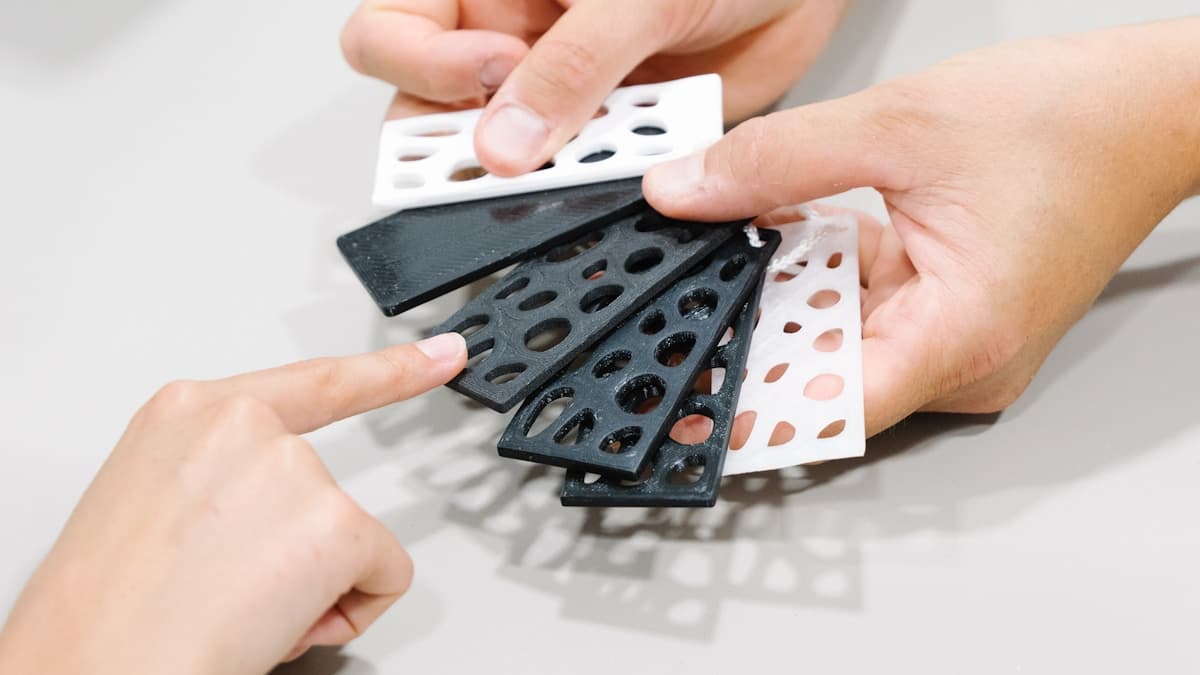
Most people first meet 3D printing as a way to make prototypes — a rough part to check fit and form before committing to "real" manufacturing. But the processes and materials available from a modern service bureau now produce parts that are the real manufacturing: gears, brackets, housings, ducting, manifolds, jigs, and fixtures that go into shipping products and live on production floors.
Functional and end-use 3D printed parts are components designed to survive real mechanical loads, heat, and repeated use — not just to look like the final part. This guide covers which processes and materials hold up, what it costs, the design details that decide whether a part works or fails, and how to brief a provider so you get parts you can actually put into service.
Prototype vs. Functional vs. End-Use — Why the Distinction Matters
These three terms drive the entire quote, so be explicit about which one you need:
- Prototype — proves fit, form, or appearance. Often FDM in PLA or PETG. Cheap and fast; not built to last.
- Functional part — must withstand mechanical stress, repeated handling, or moderate heat: a working jig, a test bracket, a snap-fit enclosure.
- End-use part — goes into a finished product or stays in service indefinitely. Demands consistent material properties, tight process control, and often documentation.
A provider quotes very differently depending on which you ask for. Tell them up front: "this is an end-use bracket that sees 40°C and a 5kg static load," not just "I need a bracket printed."
Choosing the Process for Functional Work
Not every process makes a load-bearing part. Match the job to the technology:
| Process |
Best for |
Strength notes |
| SLS (nylon powder) |
Brackets, housings, ducting, low-volume production |
Strong, isotropic, no support marks — the workhorse for functional polymer parts |
| MJF (Multi Jet Fusion) |
Similar to SLS, finer detail, consistent batches |
Dense, durable nylon; excellent for repeat production |
| Carbon-fiber FDM |
Stiff structural brackets, fixtures, tooling |
Very high stiffness-to-weight; reinforced filament |
| Metal DMLS |
Load-bearing metal parts, heat, certification |
Aluminum, stainless, titanium — true metal strength |
| Standard FDM |
Light-duty functional parts, jigs |
Adequate in PETG/ABS/nylon; weakest along layer lines |
For most functional polymer parts, SLS 3D printing services are the default — strong nylon parts with full design freedom and no support structures. When the part must be metal-grade, look at metal 3D printing services. When stiffness-to-weight is the priority, carbon fiber 3D printing is purpose-built for structural brackets and fixtures.
Material Selection: Match the Load, Not the Label
There is no single "strongest" material — there is the right material for your load case:
- PA12 nylon (SLS/MJF) — the all-rounder: tough, chemically resistant, dimensionally stable. Most functional brackets and housings start here.
- Glass-filled nylon (PA12 GF) — added stiffness and heat resistance for structural parts, fixtures, and gears under moderate load.
- Carbon-fiber nylon — maximum stiffness-to-weight for jigs, tooling, and brackets that must not flex.
- TPU — flexible, abrasion-resistant parts: gaskets, grips, vibration dampers.
- Metal (aluminum / stainless / titanium) — when the part must carry real structural load, resist heat, or meet certification.
State the operating environment in your brief: peak load, temperature, chemical exposure, UV, and expected cycles. That single sentence is what lets a provider recommend the right grade instead of guessing.
Design Details That Decide Whether the Part Works
Functional parts fail for predictable reasons. Address these before you order:
- Print orientation and layer direction. A printed part is weakest along its layer lines. Tell the provider where peak loads act so they orient the part to run stress across layers. For a critical part, ask how they plan to orient it.
- Wall thickness and infill. Thin walls and low infill save money but cut strength. For load-bearing parts, specify solid or high-infill regions where the stress concentrates.
- Tolerances on mating features. Snap fits, press fits, threaded inserts, and bearing seats need called-out tolerances. Most processes hold roughly ±0.3%; if a feature is tighter than that, flag it for post-machining.
- Threads and inserts. Printed threads wear quickly. For repeated assembly, design for heat-set threaded inserts and say so.
- Stress concentrations. Sharp internal corners crack. Add fillets at load-bearing junctions.
What Functional Parts Cost
Polymer functional parts typically run $20–200 each, with metal starting around $150+. The biggest cost lever is quantity: bureaus nest many parts into one SLS or MJF build, so the per-part price drops sharply from 1 to 10 to 100 units. For a full breakdown of how pricing works, see how much 3D printing costs.
The strategic comparison is against injection molding. For roughly 10–500 parts, 3D printing usually wins on total cost and lead time because there is no tooling to pay for. Once volume is high and the design is frozen, molding's per-part economics take over. This is exactly the low-volume production sweet spot where 3D printing replaces tooling entirely.
How to Order Functional Parts That Actually Work
- Send a STEP file, not just an STL. A STEP file preserves the true geometry and is easier to adjust for manufacturability. (See STL vs. STEP files for why this matters.)
- Write a one-line spec. Load, temperature, environment, quantity, and which features are critical.
- Quote two or three providers. Browse the 3D Prototyping Hub directory and send the same file and brief to a few bureaus that list SLS, MJF, carbon-fiber, or metal capability.
- Ask about orientation and material grade. A provider that asks you about load direction is the one to trust. If you're unsure how to compare responses, our guide to choosing a 3D printing service lays out the criteria.
Ready to order functional parts? Submit your project through the directory and get matched with bureaus that produce end-use components, not just prototypes.
Hero photo by Tom Claes via Unsplash.
Ready to find a 3D printing service provider?
Browse 2,000+ verified providers across the United States and submit your quote request free.
Browse Providers