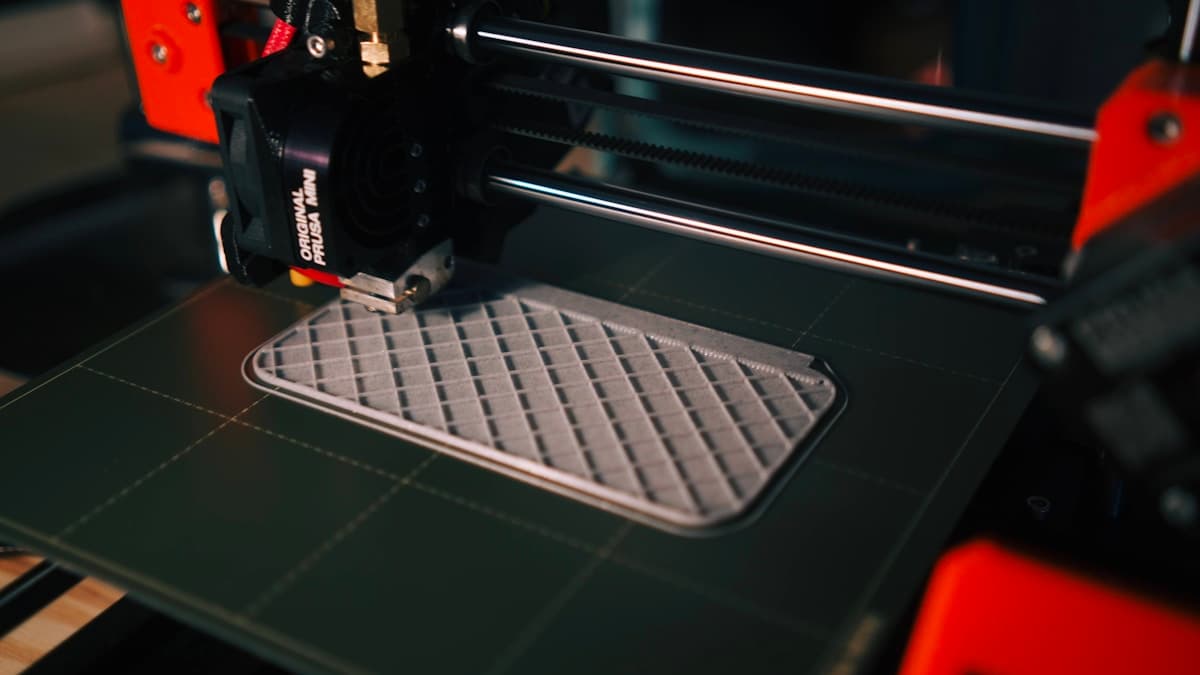
Flexible and TPU 3D printing services solve a problem rigid printing cannot touch: the part has to bend, grip, damp or seal, and nothing moulded will arrive for six weeks. Gaskets, bellows, cable strain reliefs, bumpers, tool grips, vibration isolators, protective boots and soft jaws all live in this band. The catch is that "flexible" covers materials from a stiff 95A thermoplastic to a 30A photopolymer that feels like a rubber band, and a quote written against the adjective instead of the number comes back incomparable from every shop. This guide covers what each flexible process is actually good for, the failure modes that catch buyers out, and how to write a specification a provider can price. When you are ready to source, browse the 3D printing provider directory.
The Four Routes to a Flexible Part
| Route | Typical hardness | Best for | Watch for |
|---|---|---|---|
| FDM in TPU filament | 85A–95A, down to ~70A on direct-drive machines | One-offs, large simple parts, grips, bumpers, strain reliefs | Slow to print; layer lines sit across sealing faces; support marks show badly on soft material |
| Powder bed (MJF / SLS) in TPU | 88A–95A | Lattices, internal channels, undercuts, repeatable batches | Parts are slightly porous and grey; setup cost means it only beats FDM above a handful of parts |
| Photopolymer elastomer | 30A–70A | Soft-touch overmoulds, fine-detail seals, cushioning studies, hand models | Lowest tear strength of the four, poor compression recovery, degrades under UV and heat — a display and fit material |
| Cast silicone or urethane from a printed mould | 10A–80A, your choice | Real silicone properties, short runs of identical parts, anything certified | Two steps and two lead times, but the only route to genuine silicone and to published material data |
Most jobs resolve to the first two. If you are new to the process families behind them, FDM 3D printing services and SLS 3D printing services cover the mechanics, and multi-jet fusion 3D printing services covers the powder-bed route most shops actually run TPU on.
The fourth row deserves more attention than it gets. A printed elastomer approximates rubber; cast silicone is rubber, with a datasheet, a cure schedule and a compression-set figure you can design against. Urethane casting vs 3D printing lays out where that crossover sits, and for twenty-plus identical soft parts it usually sits in casting's favour.
Shore Hardness Is the Spec, Not the Adjective
Every conversation about a flexible part should start with a number on a scale.
Shore A runs from soft to firm across the elastomer range: a 30A part deforms under thumb pressure, 70A is a comfortable grip, 85A is a shoe sole, and 95A is stiff enough that a thick section barely moves. Shore D picks up above that, and the scales overlap confusingly — 60D is harder than 95A, which trips up more specifications than any other single fact in this area.
Two practical riders. First, geometry changes perceived hardness more than the material does: a 95A TPU part with 2 mm walls and 20% gyroid infill will feel softer than a solid 85A part of the same shape, because the structure is doing the compliance rather than the polymer. Service bureaux exploit this deliberately, and it means you should state the function — "must compress 3 mm under 20 N" — rather than only the durometer, where you can. Second, FDM shops are limited by what the extruder can push; below about 85A a soft filament buckles in a Bowden path, so very soft FDM parts need a direct-drive machine and a slow profile. That constraint is the same one described in why TPU and flexible filament jam in the extruder, and it is why a shop may quote your 70A part on powder bed instead.
Where Flexible Printing Earns Its Place — And Where It Doesn't
It earns it on geometry you cannot buy. A bellows with a specific convolute profile, a gasket for a flange nobody makes a stock seal for, a strain relief moulded to a particular connector, a soft jaw that matches a casting. One part, no tool, days instead of weeks.
It also earns it on tuned stiffness. Lattice structures in powder-bed TPU let you vary compliance zone by zone across a single part — stiffer under a mounting boss, softer across a contact face — which no single moulded durometer can express.
It does not earn it in three places worth naming before you order:
Sustained static seals. Printed elastomers take a permanent compression set quickly. A gasket clamped in a flange loses thickness, loses sealing force, and starts weeping — on a timescale of weeks, not years. Print it to prove the groove and the fit, then source the production seal moulded or die-cut.
Pressure-tight powder-bed parts. MJF and SLS parts are built from fused powder and retain some microporosity. For a soft pneumatic or fluid part that matters: specify infiltration or a sealing coat, or expect weeping at pressure.
Anything at volume. Flexible printing is expensive per part and does not improve with quantity the way moulding does. Injection molding vs 3D printing covers the crossover, and low-volume 3D printing services covers the band below it honestly.
How Flexible Parts Get Priced
The drivers are not the ones buyers expect.
Machine time dominates. TPU prints slowly on FDM — the extruder has to advance a soft material without compressing it into a spring — so a part that runs four hours in PLA may run ten or twelve in TPU. On powder bed, pricing is driven by the height of the build and how much of the chamber your parts occupy, so flat parts nested in a batch cost far less per unit than one tall part alone.
Infill is not a lever here. On a rigid prototype a shop will drop infill to save money. On a soft part the infill is the mechanical property, so it cannot be thinned without changing the part. Expect less flexibility in the quote than you are used to.
Material costs more. TPU filament and TPU powder both sit above their rigid equivalents, and used elastomer powder is less tolerant of high refresh ratios than nylon.
Finishing is a real line item. Support removal on soft material is slow and leaves marks, and raw powder-bed TPU is grey and matte, so dyeing is common. See post-processing and finishing services before assuming a cosmetic part arrives cosmetic. For the whole cost picture, how much does 3D printing cost covers the drivers once rather than per project.
How to Spec a Flexible Part
Give a hardness and a scale. "Shore 85A" — not "soft", not "rubbery", not "flexible".
State the function the compliance serves. Seal, damp, grip, protect, or allow travel. A shop that knows the part is a vibration mount will propose a different material and a different wall thickness than one told only "flexible".
Say whether it is loaded continuously. This single line decides whether the shop warns you about compression set or lets you discover it.
Tolerance only what can be measured, and say how. A soft part deflects under a caliper. Dimension the sealing face and the locating bore; leave the rest nominal. Tolerances and accuracy in 3D printing is the right read before you put a number on a drawing you cannot check on arrival.
Send a solid model. STEP lets the shop thicken a wall or adjust a clearance without guessing — STL vs STEP files for 3D printing, then how to prepare your files for a 3D printing quote, which is the fastest read in the archive for lowering a price.
Name the chemicals and the temperature. Polyester-based and polyether-based TPUs behave differently in water, oil and fuel, and both soften well below the service temperature of a rigid engineering plastic. How to choose a 3D printing material covers the trade-offs across the whole shelf.
Qualifying a Provider
Five questions, before the order:
- Which flexible materials do you run in-house, and at what hardness? A shop with one 95A filament will quote your 70A grip in it and call it flexible.
- Do you run TPU on powder bed, or only FDM? This determines whether lattices and internal channels are on the table at all.
- Can you seal or infiltrate a powder-bed part? Ask before you design a pressurised soft part.
- How do you handle supports on soft material? Soluble supports, careful orientation, or "you will see marks" — all three are honest answers; silence is not.
- Will you print one before the batch? A single part that confirms hardness in the hand is the cheapest insurance in a soft-part project.
Flexible work clusters where sealing and vibration work clusters, which in the US means automotive and heavy equipment — see 3D printing services in Michigan or go straight to the Michigan provider directory. You do not need a local shop, but one that already quotes gaskets and boots will ask you the right questions unprompted. The adjacent application briefs worth skimming are 3D printing services for automotive parts and 3D printing services for electronics enclosures, where most sealing and strain-relief parts originate.
Get Your Flexible Part Quoted
Start with the one part that answers a real question — the gasket, not the whole assembly — and send the same brief to two or three shops with the hardness, the function, the loading and the date named. Browse 3D printing providers and compare what they ask you back; the shops that want to know whether the part is clamped continuously are the ones that will quote it correctly. If the answer turns out to be a moulded or cast part after all, you will have found that out for the price of one print rather than one tool.
Related Resources
- Functional and End-Use 3D Printed Parts — when a printed part is the final part
- Urethane Casting vs 3D Printing — the route to short runs of real rubber
- How to Choose a 3D Printing Material — the full material shelf in one place
- Multi Jet Fusion 3D Printing Services — the powder-bed route for TPU lattices
- Why TPU and Flexible Filament Jam in the Extruder — the machine-side constraint behind the quote
- How Much Does 3D Printing Cost? — the cost drivers behind your quote
- Browse 3D Printing Providers — send the part out
Hero photo: Kadir Celep via Unsplash.