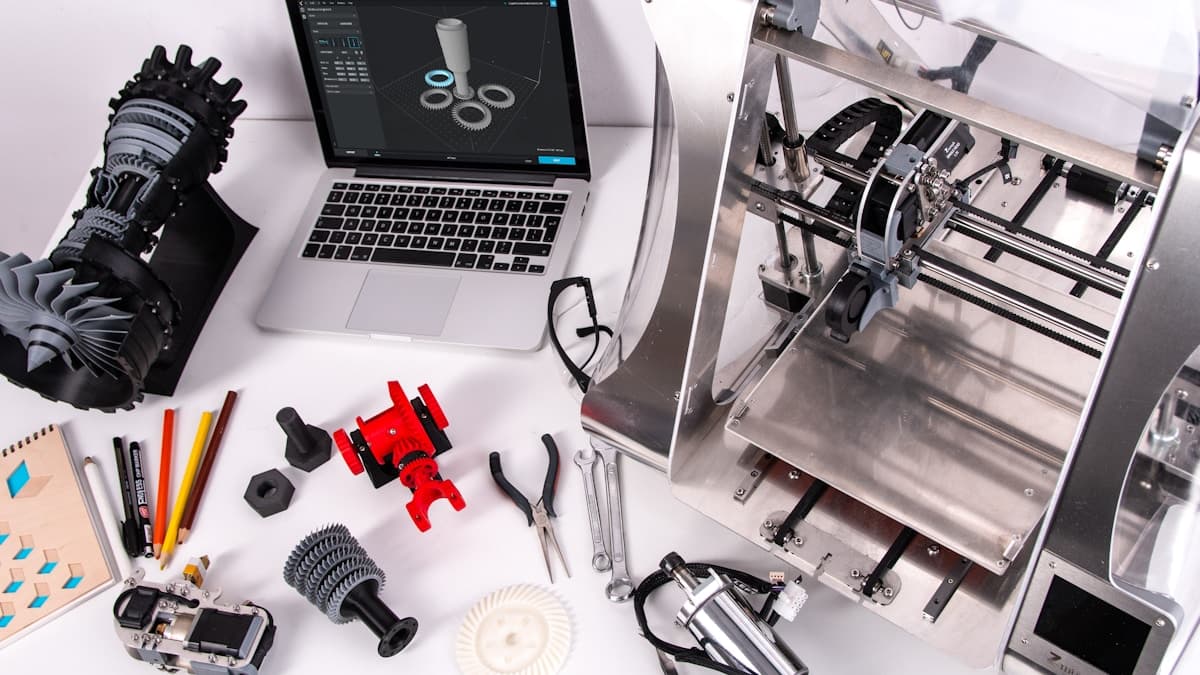
3D printing services for gears and drive components get bought for three reasons: the gear is obsolete and nobody sells it, the quantity is too small to cut steel for, or the drive is still being designed and the next revision is due on Thursday. All three are real jobs, and all three go wrong in the same place — a part that looks correct, meshes on the bench, and then runs hot, grows backlash and rounds its teeth off in a fortnight. This guide covers which process suits which job, the material and geometry decisions that actually decide service life, what to put in a request so the first quote is a real one, and the cases where a catalogue gear beats anything printed. When you are ready to shortlist shops, start with the 3D printing provider directory.
Four Jobs, Four Different Purchases
"A printed gear" covers four jobs with different economics and, more importantly, different providers.
| What you need | Usual route | Why print it |
|---|---|---|
| Motion prototype | Fused filament in PLA or PETG | Confirm ratios, centre distances and packaging in days, before anything is committed |
| Obsolete replacement gear | Sintered nylon (SLS or MJF), reverse-engineered from the broken part | The machine is down and the OEM part has not existed since 2009 |
| Low-volume production drive part | PA12, PA11 or carbon-filled nylon, powder bed fusion | Hundreds, not tens of thousands — tooling never pays back |
| High-torque gear or sprocket | Metal powder bed fusion, then heat treated and machined | A geometry or a lead time that hobbing cannot serve |
The first row is a different purchase from the other three. A PLA gear is a geometry check — it will mesh, it will prove your ratio, and it will creep under its own holding torque in a warm room. Do not let it get quoted as a service part. Rows two and three are where most of the directory's shops earn their money, and row four is work for a metal shop with a furnace and a mill attached — see metal 3D printing services for what that supply chain looks like.
Material Decides Service Life, Not Tooth Count
Plastic gears have been engineered for eighty years, almost all of them in moulded acetal and nylon. Printing changes how the part is made, not what the material has to survive.
| Material | Where it belongs | What to watch |
|---|---|---|
| PLA | Fit and ratio checks only | Creeps under constant load; softens near 60 °C; a warm enclosure is enough |
| PETG / ABS / ASA | Light duty, low speed | PETG is tough but a poor bearing surface; ABS and ASA hold heat better than both |
| PA12 / PA11 (SLS, MJF) | The default for anything that turns under load | Absorbs moisture and swells; tough and notch tolerant; wears well against steel |
| Carbon-filled nylon | Stiff, hot, high-torque plastic duty | Abrasive — run it against metal, not against another plastic gear |
| Printed metal (17-4 PH, 316L, tool steel) | High torque, high cycle | As-built flanks are too rough to run; budget for finishing |
The material people ask for and cannot get is acetal. It is the classic gear plastic, and it is close to unprintable at service quality — it barely sticks to itself, warps badly, and almost no bureau will quote it. If a shop offers you a printed acetal gear, ask what they have run and for how long. How to choose a 3D printing material covers the wider trade space, and carbon fiber 3D printing services covers the filled grades in detail.
One thing that catches buyers out every time: the failure mode for a plastic gear is usually thermal, not mechanical. Polymers conduct heat poorly, so the energy lost at the tooth flank stays at the tooth flank. A gear that is comfortable at 30 per cent duty will soften and deform at 100 per cent duty with the same torque on the drawing. Why 3D printed gears wear out walks through what that looks like on a part you can hold.
The Geometry Rules That Decide Whether It Meshes
Four decisions matter more than everything else on the drawing.
Tooth size against process resolution. Module 1 is about the floor for fused filament and module 0.8 for sintered nylon. At module 1 with a 0.4 mm nozzle you have three or four beads across the tooth root, and the involute flank is an approximation of a curve rather than the curve. Fine-pitch gearing is a cutting job.
Build orientation, which is not a detail. Print a spur gear lying flat, with its axis vertical. Every tooth is then built from stacked layers loaded in their own plane, which is the strong direction. Stand the same gear on edge so the layers run across the tooth roots and you have built a row of teeth pre-scored along their weakest line. Ask the provider to state the orientation on the quote; a shop that will not is nesting for machine throughput, not for your part.
Backlash, deliberately generous. Printed gears come out slightly fat, and nylon ones keep growing as they pick up humidity. Design in more backlash than a moulded pair would need — thin the teeth or open the centre distance — because a mesh that is perfect on day one binds and overheats on day forty. Tolerances and accuracy in 3D printing has the accuracy envelopes to plan against.
The bore and the hub. This is where most printed drive parts actually fail. A printed bore is not a press fit, a printed keyway is not a keyway, and a grub screw tightened into plastic strips its thread the second time somebody services the machine — see why 3D printed threads strip. Print the bore undersize and have it reamed, or design around a steel hub or a knurled insert and let the printed part carry only the teeth.
Helical gears print well. Worm wheels do not — a real worm wheel gets its throat form from the hob that cuts it, and a printed one is a visually convincing approximation that contacts on a line instead of a patch. Budget for it to run hot and wear fast.
How Pricing Works
Nobody can quote a gear from a photograph, but the drivers are predictable:
- Process and machine time. Powder bed fusion is priced on the volume your parts occupy in the build, so a batch of twelve gears nests far better per unit than one gear on its own. Ask for the batch price even if you only need one today.
- Material grade. PA12 is the baseline; filled grades and metal powders step up sharply.
- Secondary operations. Reaming the bore, cutting the keyway, heat treating metal, finishing flanks. This is the single biggest reason two quotes differ by half.
- Inspection. Most printing bureaus own calipers, not gear metrology. If you need a tooth form checked, say so up front — it may route the job to a different shop.
- File preparation. If you are handing over a broken part rather than a model, somebody has to derive the gear data. That is engineering time and it belongs on the quote.
How much does 3D printing cost covers the general shape of a quote, and low-volume 3D printing services covers where batching starts paying.
How to Spec It So the First Quote Is Real
Send a STEP file, not just an STL — a mesh throws away the involute definition and the shop cannot adjust tooth thickness without it (STL vs STEP files). Alongside it, send the gear data and the duty:
- Tooth count, module or diametral pitch, pressure angle, face width, helix angle and hand
- Bore diameter and tolerance, keyway or flat dimensions, hub style
- Centre distance and the mating gear's material
- Torque, rpm, duty cycle, direction and whether it reverses
- Ambient temperature, lubrication, and anything it will be splashed with
If the gear is obsolete and there is no model, the broken part is better evidence than a scan. Count the teeth, measure the outside diameter, measure the face width and bring the mating gear. A scanner will capture the hub and web faithfully and will not give you a clean flank — why 3D scans don't work in CAD explains why, and 3D printing services without a CAD file covers how shops handle it. For the wider replacement-part workflow, 3D printing replacement and spare parts is the companion piece, and how to prepare files for a 3D printing quote is worth five minutes before you send anything.
What Separates a Good Provider Here
A shop that has made drive parts before behaves differently on the phone. It asks for rpm and duty before it asks for a file. It names a build orientation. It tells you the bore will be machined rather than letting you discover it. It dries nylon before building and bags parts dry on dispatch. It declines to quote PLA for a service gear instead of taking the order. And it will say plainly when your part should be cut rather than printed.
Ask three shops the same five duty questions and compare what comes back. The one that asks what the gear mates with is the one that has replaced a gear before. How to choose a 3D printing service covers the general qualifying criteria; the gear-specific one is simply whether they talk about the mesh or only about the print.
When Not to Print It
Three honest cases where this is the wrong route:
- The gear is in a catalogue. Stock spur gears in acetal and steel are sold by the thousand in standard modules and bores. If yours is standard, buy it — nothing printed will be cheaper or better.
- High torque, continuous duty, steel. That is a hobbing and grinding job. See CNC machining vs 3D printing for where the crossover sits.
- Thousands of identical plastic gears. Moulding wins decisively at volume; a printed part never gets cheaper per unit. Injection molding vs 3D printing has the break-even reasoning.
Printing wins when the part is unavailable, unusual, urgent, or still changing — which is most of the drive work that reaches a service bureau.
Get Your Drive Parts Quoted
Settle four things before you ask for a price: the gear data, the duty, the bore, and who machines it. Everything on the quote follows from those, and a request missing them gets a number that changes later.
Browse 3D printing providers and filter for shops running powder bed fusion in nylon rather than desktop filament machines alone — for a part that turns under load, the process is the decision. Send the same duty questions to three of them and watch for the one that asks about the mating gear.
Related Resources
- Why 3D Printed Gears Wear Out — the failure mode this whole purchase exists to avoid
- 3D Printing Replacement and Spare Parts — the obsolete-part workflow end to end
- SLS 3D Printing Services — the usual route for a nylon gear
- Multi Jet Fusion 3D Printing Services — the other powder bed option, and how it differs
- Functional and End-Use 3D Printed Parts — what qualifies a printed part for service
- 3D Printing Services for Conveyor and Material Handling Parts — sprockets, rollers and the drives they sit in
- 3D Printing Services for Robotics Parts — the adjacent motion-hardware cluster
- Browse 3D Printing Providers — send the job out
Hero photo by ZMorph All-in-One 3D Printers.