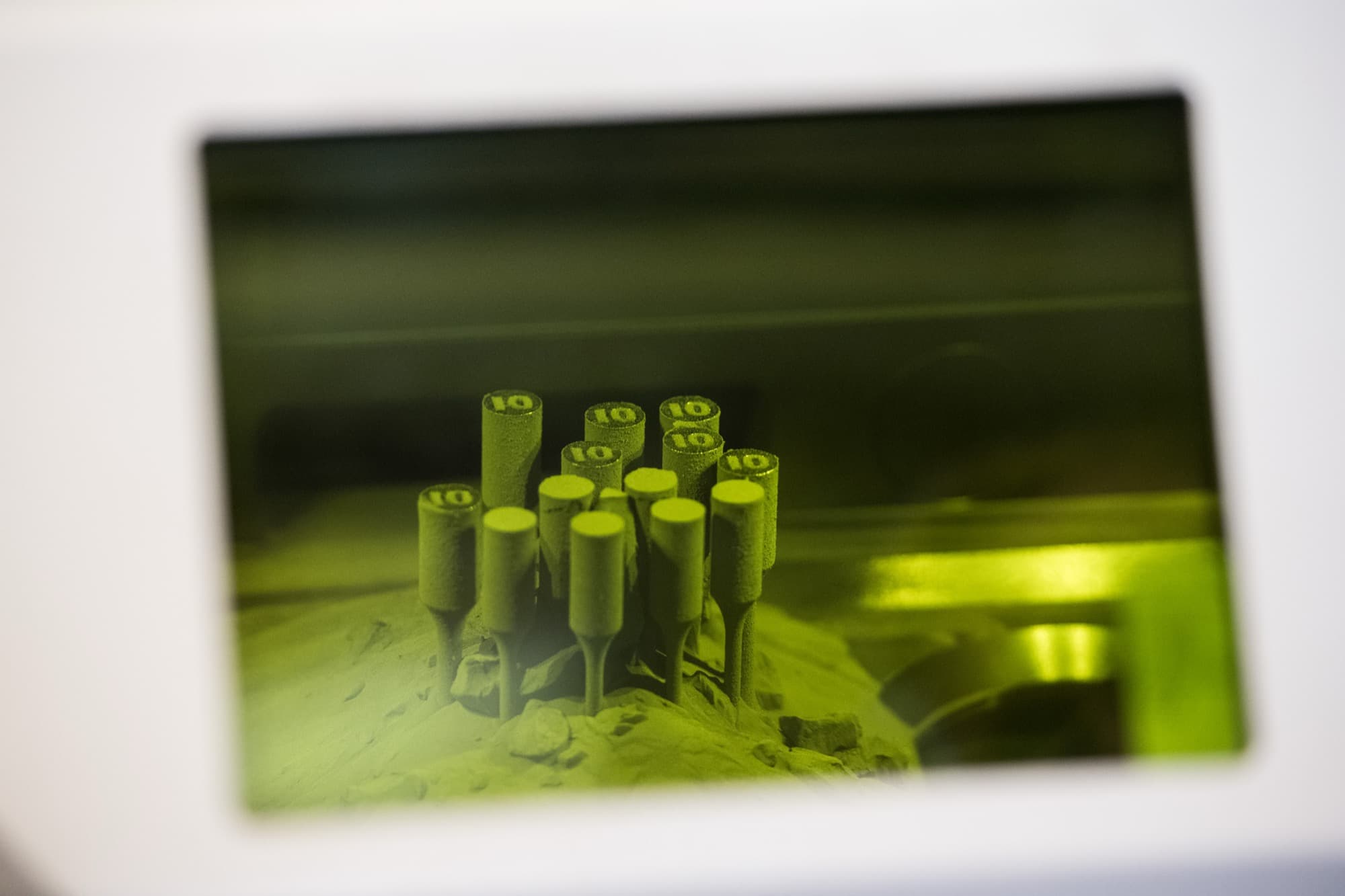
3D printing services for oil and gas equipment get bought for two very different jobs, and confusing them wastes months. One buyer needs a protective cover, a lifting aid or a fit-check model at the yard by Friday and can order it from almost any competent shop. The other needs a flow-wetted component that will sit in sour, chloride-rich fluid at temperature and pressure for years, and is buying a qualified process and a documentation package far more than a printed part. This guide covers where additive genuinely earns its place in the field, which materials survive the environment, what the qualification route actually asks for, and how to spec the job so the first quote is a real number. Start with the 3D printing provider directory when you are ready to put work out.
The Environment Is the Specification
In most industries you pick a material for load and temperature. In oil and gas the fluid decides first, and it is unforgiving in ways that catch new buyers out.
- Hydrogen sulphide. Sour service brings sulphide stress cracking, and material selection falls under NACE MR0175 / ISO 15156 — a hardness and chemistry envelope, not a suggestion.
- Chlorides. Produced water and completion brines attack stainless steels that behave perfectly in a test lab. Pitting and crevice corrosion resistance matters more than tensile strength.
- CO₂ and acid treatments. Sweet corrosion plus periodic acid stimulation is a different problem again from sour service.
- Temperature and pressure. Downhole is routinely 150 °C and above; surface pressure ratings run to 15,000 psi and beyond.
- Rapid gas decompression. Gas dissolves into polymers and elastomers under pressure and tears them apart on the way out. It is the reason a printed polymer seal is rarely a drop-in for a moulded one.
Write the environment into the enquiry before the geometry. A shop that quotes on a STEP file alone is quoting a shape, not a part.
Where Additive Actually Earns Its Place
Three buckets, in descending order of how much work really goes through them.
Shop, yard and wellsite aids. Lifting and handling aids, thread and flange protectors, alignment and assembly fixtures, gauge and panel mounts, cable and hose routing, tool holders, training cutaways, sand-control and manifold mock-ups for a job walk. Cheap, fast, no approval route, and this is where most real additive volume in the industry sits. 3D printing for jigs, fixtures and manufacturing aids covers the design rules that keep a printed tool honest through a shift.
Functional polymer parts on surface equipment. Bushings, wear pads, spacers, insulators, guards, non-pressure housings, chemical-injection hardware, instrument enclosures. Real parts doing real work, in engineering polymers, with no code implications. Functional and end-use 3D printed parts covers the general crossover from prototype to production.
Metal components for flow-wetted and downhole hardware. Manifold and flow-control bodies with internal passages, chokes and nozzles, sensor and gauge housings, downhole tool components, obsolete spares for legacy equipment. This is where the qualification work lives, and where the payback is highest when the geometry genuinely earns it.
Polymers That Survive the Field
The material list is short, and the machines that run it are a real supplier filter.
| Material | Where it belongs | Watch out for |
|---|---|---|
| PEEK / PEKK | Downhole seals, backup rings, bushings, insulators | Needs a high-temperature chambered machine; few shops run it |
| PPS | Chemically aggressive surface service | Narrower supplier list than PEEK |
| Carbon-fibre nylon | Stiff surface brackets, fixtures, wear parts | Absorbs moisture; dries and stores like a technical material |
| Glass-filled nylon (SLS/MJF) | Housings, ducts, complex non-pressure parts | Isotropy is good, chemical resistance is fluid-specific |
| PLA / ABS / PETG | Shop aids, mock-ups, training models | Not a field material. Ever. |
Carbon-fibre 3D printing services covers the filled-polymer route, and how to choose a 3D printing material the wider selection logic. If the part goes anywhere near produced fluid, ask for chemical compatibility evidence for your fluid, not a general resistance chart.
Metal AM and the Qualification Route
Metal laser powder-bed fusion is what makes the industry pay attention, and the reasons are the same as everywhere else: internal passages no cutter can reach, consolidated assemblies with fewer leak paths, and on-demand replacement of parts whose tooling no longer exists.
The alloys that carry oilfield work are 316L for general corrosion service, 17-4PH for strength where the environment allows it, Inconel 625 for corrosion resistance in aggressive fluid, and Inconel 718 where you need strength and corrosion resistance together. Metal 3D printing services covers the process in general terms.
Two things separate this from ordering a printed bracket.
There is a specification for it. API 20S covers additively manufactured metallic components for the petroleum and natural gas industry, grading them by criticality and setting what evidence each grade requires; DNV-ST-B203 plays a similar role for offshore and maritime work. Ask which the shop works to and which grade level they have actually delivered. "We have printed Inconel before" is not an answer to that question.
The finishing chain is most of the part. Stress relief on the plate, removal, support removal, hot isostatic pressing to close internal porosity, heat treatment to the specified condition, machining of every sealing and mating face, positive material identification, and volumetric inspection — typically CT — on anything critical. Post-processing and finishing services covers the chain, and tolerances and accuracy in 3D printing what to expect before machining.
The honest test is the same one that applies everywhere: if you could machine the part from bar or billet without much argument, machine it. Additive earns its place on geometry a cutter cannot reach, on consolidated assemblies, and on parts you can no longer buy.
Obsolete Spares and Long-Tail Inventory
Producing assets outlive their supply chains. A twenty-five-year-old pump, compressor skid or wellhead needs a component whose tooling was scrapped, in a quantity of four, against a minimum order of two hundred.
The workable pattern is to scan the surviving part, rebuild it as clean parametric CAD rather than printing the scan mesh, requalify it for its actual duty, and print on demand. Start with non-pressure items — handwheels, guards, sleeves, bushings, panel and gauge hardware, wear parts — because they carry the least approval weight and still remove real downtime. The same logic drives 3D printed replacement and spare parts in other industries; energy just has longer service lives and slower supply chains.
Process by Job
| Job | Sensible route | Why |
|---|---|---|
| Yard aids, protectors, handling fixtures | FDM in engineering thermoplastic | Cheapest fast route at real size and stiffness |
| Large mock-ups, skid and manifold layout models | Large-format printing | Full-scale fit checks before steel is cut |
| Housings, ducts, complex non-pressure parts | SLS or MJF nylon | No supports inside passages, consistent part-to-part |
| Downhole polymer components | PEEK on a high-temperature machine | The only common polymer route to that environment |
| Flow-wetted and pressure-adjacent metal parts | Metal powder-bed fusion | The only additive route to a genuine metal part |
| Repeat runs above roughly a few hundred | Rapid tooling into moulding | Additive loses on unit cost before it loses on capability |
Low-volume 3D printing services covers where that last crossover actually sits for your quantity.
How to Spec the Job
Send these and the quote comes back as a number rather than a range:
- The service environment, in the first line. Fluid composition, H₂S partial pressure if sour, chlorides, temperature, pressure, and whether the part is pressure-containing. This determines everything downstream.
- STEP geometry, not just STL, with a drawing flagging critical dimensions, datums and sealing surfaces individually.
- Material by grade and the specification it must meet — "Inconel 625 to the MR0175 requirement for this service", not "a corrosion-resistant alloy".
- Post-processing and who owns each step — HIP, heat-treat condition, machined features, surface finish, NDT.
- Documentation required — material certs, lot traceability, coupon results, PMI, inspection reports. This is a cost line, and leaving it out is why the second quote is higher than the first.
- Quantity now and later. Four now and possibly four hundred later is a different process recommendation.
How to prepare files for a 3D printing quote covers the general submission.
Qualifying a Provider
Four questions sort a shortlist quickly.
Which processes are genuinely in-house? Brokering powder-bed or heat-treatment work to a partner is common and not disqualifying, but it changes lead time, confidentiality exposure and who owns a defect.
Have you delivered to API 20S or DNV-ST-B203, and at which grade? A shop that has will answer with a grade level and a part. A shop that has not will answer in general terms about capability.
How do you control powder lots and reuse? Virgin-versus-reused powder policy is a real property variable in this industry, not a formality, and the answer tells you more about a metal shop than its machine list does.
Who sees the geometry? Completion and tool designs are competitive assets. NDAs and IP protection with 3D printing services covers the agreement to have in place before the first file moves; the industrial buyer's guide covers capability tiers more broadly.
Get Oilfield Parts Quoted
Classify the part first — shop aid, functional polymer, or flow-wetted metal — because that single answer sets your material, your supplier list, your documentation bill and your schedule. Then send the environment, the STEP geometry, the material specification and the documentation you need, and ask for the finishing chain to be itemised.
Browse 3D printing providers to find shops that take energy work, or start near the supply base: Texas providers and the Houston service cluster, Oklahoma providers for the Mid-Continent, or Louisiana providers for Gulf Coast and offshore support. Ask two or three — the spread in what they ask you about fluid, hardness and traceability tells you more about capability than the spread in their prices does.
Related Resources
- Metal 3D Printing Services — the process behind flow-wetted and downhole hardware
- 3D Printing Services for Aerospace Parts — the other heavily qualified vertical, and a useful comparison
- 3D Printed Replacement and Spare Parts — the obsolete-inventory case in general
- Functional and End-Use 3D Printed Parts — when parts stop being prototypes
- How Much Does 3D Printing Cost — the general pricing model
- 3D Printing Services in Texas and in Houston — the largest energy supply base in the directory
- Browse 3D Printing Providers — send the job out
Hero photo by René Volfík.