3D printing services for data center and telecom parts get bought for a narrow and very practical reason: the rack is standardised and the things you need to put in it are not. A 19-inch cabinet is one of the most rigidly dimensioned objects in commercial engineering, and the moment you mount something that was not designed for it — a legacy chassis, a media converter, a battery shelf, somebody's 1U appliance in a half-depth cabinet — you need a part that nobody sells. The same is true on the telecom side, where a working exchange or a tower site runs equipment whose spare plastics went out of production a decade ago. This guide covers which of those parts suit a printing service, the fire and airflow constraints that decide material before anything else does, where the hard line sits, and what to send so the first quote is real. When you are ready, start with the 3D printing provider directory.
What Actually Gets Printed in a Rack
Sort the job list by whether the part carries load or carries air. Those two axes decide more than size or material.
| Part | Typical process | Why it prints well |
|---|---|---|
| Blanking panels, airflow baffles, containment fillers | Sintered nylon; large format filament | Odd gaps between mismatched gear; no stock size fits |
| Cable combs, fingers, bend-radius guides, fiber spools | Filament (PETG, ASA) or sintered nylon | Dozens of small bespoke shapes, no load |
| Keystone blanks, port blockers, patch panel adapters | Filament or MJF | High count, trivial geometry, instantly available |
| Rack ears, 0U/1U adapters, PDU and shelf mounts | Sintered nylon, PA-CF | Locating hardware against rails that take the weight |
| Obsolete faceplates, bezels, card guides, ejector levers, fan tray handles | Sintered nylon | Discontinued; reverse engineered from the original |
| Outside plant: cable grommets, mount shims, cover and radome mock-ups | ASA, PA | Weather-exposed, low volume, site-specific |
| Install tooling: drill templates, splice tray jigs, labeling guides | Filament | Shop-floor and field tooling, replaced freely |
The last row is quietly the highest-value one for a field crew, and it is ordinary fixture work — 3D printing services for jigs, fixtures and manufacturing aids covers that class on its own terms. Everything above the line is standard functional-parts work; functional and end-use 3D printed parts sets out what qualifies a printed part for live service rather than a bench.
Fire and Smoke Decide the Material Before Anything Else
In most industries the flame question arrives late, after fit and cost. Here it arrives first, and getting it wrong is the one failure that gets a part pulled out of a cabinet by somebody else.
Two things are worth separating. A plenum or air-handling space is a code question, not a shopping question. Where a raised floor or a ceiling void moves conditioned air, products installed in it are generally expected to meet UL 2043 for heat and visible smoke release, and NFPA 75 governs fire protection for IT equipment areas more broadly. That is a test on a finished product. Ask your authority having jurisdiction, and in a colocation facility ask the operator too, because their rules are frequently stricter than code and are the ones that get enforced on a walkthrough.
A material rating is not a part rating. UL 94 V-0 belongs to a tested specimen at a stated thickness, colour and process. Your printed part is anisotropic, contains voids between beads or partially fused powder, and is often thinner than the bar that was tested. Buying flame-retardant feedstock does not transfer the rating — it opens the conversation. 3D printing service certifications covers what a shop's own accreditations do and do not cover, which is the question sitting underneath this one.
| Material | Where it belongs | What to watch |
|---|---|---|
| PA12 (SLS / MJF) | Panels, guides, adapters, obsolete plastics | Tough, no support scars, good dimensional stability |
| ASA | Outside plant, cabinets in daylight, tower hardware | Holds up under UV where ABS yellows |
| PETG | Cable management and blanks in an ordinary room | Cheap and fine; no flame credential at all |
| Flame-retardant PC | Where a flame requirement is real | Fewer suppliers; demands a capable shop |
| PEI (ULTEM 9085), PEEK | Air-handling spaces and high-spec sites | Several times the cost; ask who will accept it |
| PA-CF, PC-CF | Stiff isolated brackets and jigs | Electrically conductive — never near exposed contacts |
| PLA | Mock-ups on a bench, nothing else | Softens around 60 °C; a hot aisle reaches it |
How to choose a 3D printing material covers the wider trade space, and high-temperature 3D printing services covers the grades above polycarbonate when a site genuinely needs them.
Airflow Is the Job, So the Part Has to Actually Seal
A blanking panel is not decorative. It exists to stop hot exhaust recirculating to the intake side, and a panel that bows 4 mm in the middle has stopped doing its job while still looking installed.
The dimensions are unforgiving and worth writing on the drawing rather than assuming: a 19-inch panel is 482.6 mm wide, one rack unit is 44.45 mm, and the mounting holes within a U are spaced 0.5, 0.625 and 0.625 inches under EIA-310. Half a millimetre of accumulated error across that span turns into a panel that will not drop between two pieces of installed equipment.
Three practical consequences:
- Span beats strength. The failure mode on a long thin part is bowing, not breaking. Design a rib along the back face, or split a full-width panel into two halves that each span less.
- Warp is a process choice. A 482 mm filament-printed part in a material that shrinks will not stay flat. Sintered nylon is flatter at that size; so is a shorter part.
- Print orientation changes the fit. The flat dimension and the stacked dimension do not come out identically on any process. Say which faces mate.
Tolerances and accuracy in 3D printing sets realistic expectations here, and why 3D printed parts fail when you scale them up is worth five minutes before you take a working 1U prototype to a 6U panel. If the part is large enough that no desktop machine will hold it, large-format 3D printing services is the right starting point.
Heat, Load and the Two Slow Failures
Both of the slow failures in a rack look fine on installation day.
Heat. A hot aisle is routinely above what people assume, and the exhaust face of a dense chassis is hotter again. PLA softens around 60 °C and has no place in a live cabinet. PETG is acceptable in an ordinary conditioned room and nothing more. If the part sits downstream of a power supply or a high-draw chassis, specify from the real local temperature, not the room's setpoint.
Load. Printed polymers creep — they deform slowly under sustained stress, and heat accelerates it. A bracket holding four kilos passes every test you can run in an afternoon and sags over the following year. The rule that keeps this safe is simple: printed parts locate, guide, cover, route and fill; metal carries weight. A printed adapter that positions a chassis against metal rails is good engineering. A printed shelf is not.
Telecom MRO: Parts Nobody Sells Anymore
This is the application that justifies the whole category for a lot of operators. Equipment stays in service long after its spare plastics are discontinued, and the failures are almost always the plastic ones — latches, ejector levers, card guides, fan tray handles, bezels, dust caps, the clip that holds a door closed.
The route is reverse engineering rather than design: scan the original or a good broken one, rebuild the features that matter in CAD, print in sintered nylon. Best 3D scanning services for reverse engineering covers the capture half, and 3D printing services for replacement and spare parts covers the general case. One warning that catches people: a scan reproduces a worn part faithfully, wear included. Say which dimensions are functional — the ones that mate, latch or locate — so somebody corrects them deliberately rather than copying a decade of abrasion.
Two constraints travel with this work. If the equipment sits inside a listed assembly you intend to keep listed, a substituted part may invalidate that, which is a question for the listing body and not for your print shop. And if the geometry is somebody else's intellectual property, that is a real exposure — 3D printing services and NDA / IP protection covers handling files you do not own before they go out to a vendor.
What to Send So the First Quote Is Real
Data center and telecom jobs stall on details nobody thinks to include.
- The rack units and the real dimensions. 482.6 mm and 44.45 mm per U, plus the actual gap you measured, not the one the spec sheet implies.
- Whether the part sits in a plenum or air-handling space, and who is going to accept it — the AHJ, the colo operator, or both.
- The flame requirement, stated as a standard rather than "fireproof".
- The maximum local temperature, measured at the part, not the room setpoint.
- Whether it touches exposed electronics, which is the only thing that makes ESD a requirement.
- What carries the load. Name the metal that takes the weight, so nobody quotes you a plastic one.
- How many, and when the second batch lands. Forty keystone blanks nest into a single sintered build; four do not, and the per-part price reflects that.
If there is no CAD at all, that is a normal starting point rather than a blocker — 3D printing services without a CAD file covers what a shop can work from.
What Separates a Good Provider Here
A shop that has done rack work asks whether the space is plenum-rated before it asks for your file. It says plainly that a V-0 feedstock does not make a V-0 part. It offers one panel before forty. It asks what the part mounts to and what takes the weight. And it tells you when a part should be sheet metal instead, which is the most useful thing a provider can say.
Send the same drawing and the same questions to three shops and compare the answers rather than the prices. How to choose a 3D printing service covers the general criteria; the data center one is whether the fire and load questions come up unprompted.
Where the Line Is
- Fine: blanking panels and baffles, cable management of every kind, keystone and port blanks, patch and adapter plates, rack ears and locating adapters, obsolete non-structural plastics, outside-plant covers and shims, install jigs and drill templates, enclosure mock-ups before sheet metal.
- Not fine: anything carrying equipment weight, anything in an air-handling space without an accepted rating, anything that is part of a listed assembly you need to keep listed, grounding and bonding hardware, and anything in a current-carrying path.
Metal parts in this environment are generally better machined or folded than printed — CNC machining vs 3D printing covers where that line falls. For adjacent environments with the same contamination and airflow discipline, 3D printing services for semiconductor and cleanroom parts is the closer fit, and for product-level housings rather than rack hardware, 3D printing services for electronics enclosures covers the design rules.
Get Your Rack or Site Part Quoted
Settle four things before you ask for a price: whether the location is an air-handling space, the maximum temperature at the part, whether anything about the part carries load, and how many you need now against later. Every line on the quote follows from those four answers.
Browse 3D printing providers and favour shops that raise the plenum and load questions before they open your file. Order one part first — on a run of identical panels or blanks, a single sample costs almost nothing and settles every fit question in one trip to the cabinet.
Related Resources
- 3D Printing Services for Electronics Enclosures — housings for the boards rather than the rack
- 3D Printing Services for Semiconductor and Cleanroom Parts — the same discipline about airflow and contamination
- 3D Printing Services for Replacement and Spare Parts — the general obsolete-part case
- Best 3D Scanning Services for Reverse Engineering — capturing a part with no drawings
- Large-Format 3D Printing Services — when the panel is wider than the machine
- Low-Volume 3D Printing Services — where a run of forty stops being prototyping
- How Much Does 3D Printing Cost — the general shape of a quote
- Browse 3D Printing Providers — send the job out
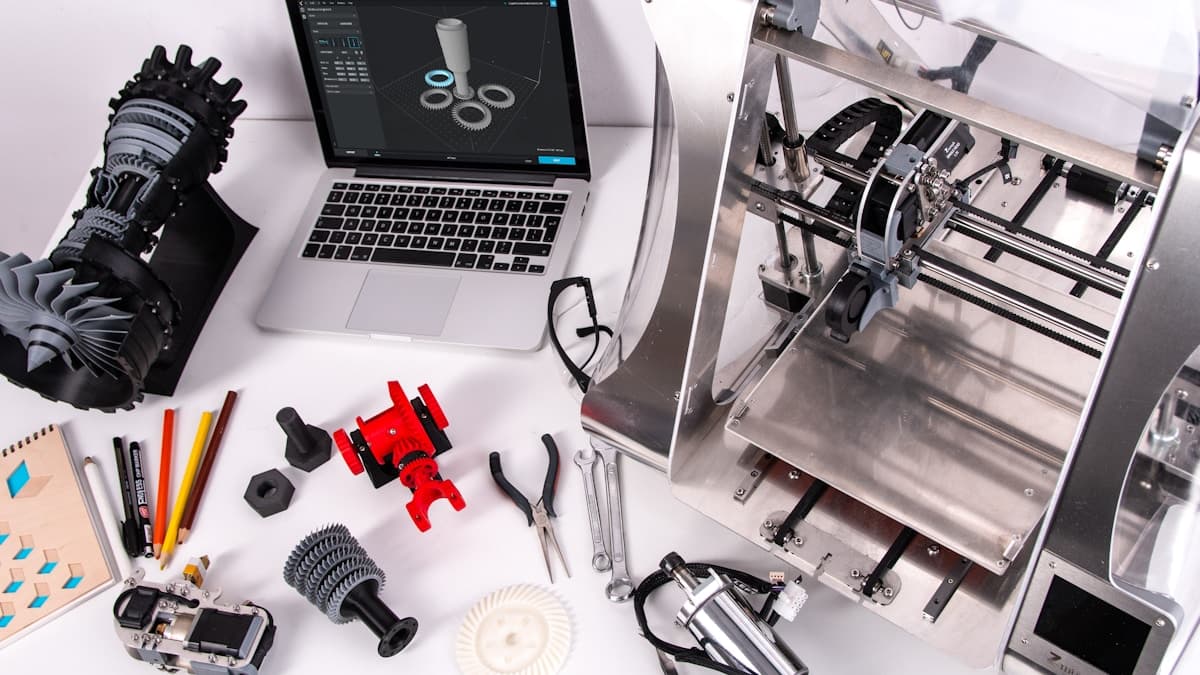
Hero photo by ZMorph All-in-One 3D Printers.