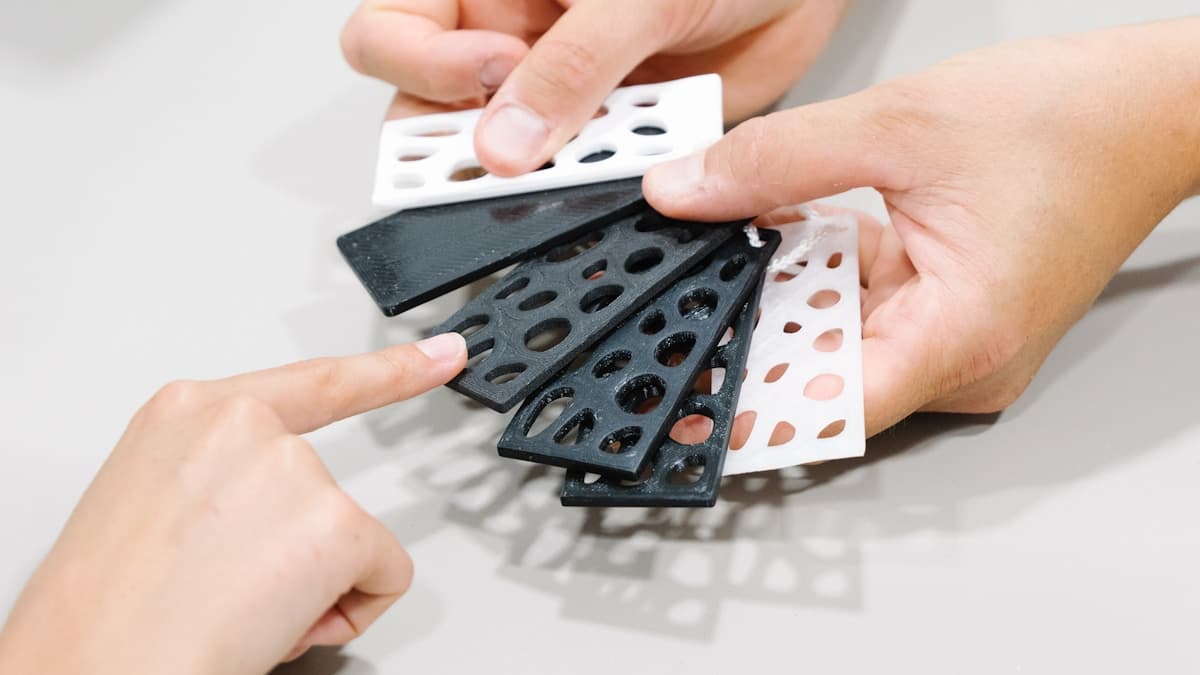
3D printing services for semiconductor and cleanroom parts cover a category of work that rarely appears in a capital budget and never stops being needed: the fixtures, carriers, guards and hand tools that keep a fab, a lab or a medical-device cleanroom running. None of it is product. All of it is on the critical path when a tool is down, a new process needs a nest, or a technician is holding a substrate in a way that will eventually drop one. Printing suits the work because quantities are small, revisions are frequent and the geometry is specific to your equipment. What makes it different from ordinary printed tooling is that the environment has rules — static, particles, chemistry and cleanliness — and those rules pick the material long before anyone thinks about strength. This guide covers what gets printed, the four constraints that decide the material, how to pick a process, and what to put in a request so a provider can quote it properly. When you are ready to source, browse the 3D printing provider directory.
What Gets Printed
Handling and carrier fixtures. Nests, trays, boats and transport carriers that hold a wafer, substrate, lens, sensor or assembly at exactly one orientation. This is the highest-value category because the geometry is unique to your part and the alternative is a technician improvising.
ESD-safe jigs and hand tools. Tweezermates, alignment guides, board supports, screwdriver stand-offs, probe holders — anything that touches a static-sensitive device. The requirement here is electrical before it is mechanical.
Tool-change and maintenance aids. Alignment gauges, purge blocks, gasket guides, lift and support brackets used during preventive maintenance. These often exist to make a two-person job a one-person job.
Equipment covers, ducting and guards. Splash shields, cable management, panel blanks, small ducting adapters and covers over a modified tool. Bulky, low-stress, and expensive to machine for what they do.
Legacy spare parts. A discontinued plastic bracket on a twenty-year-old tool that the OEM no longer sells. Scan it, model it, print it — the same route as any other replacement and spare parts job, just with a cleanroom material requirement attached.
Where Printing Is Not the Answer
Being clear about the boundary is what makes the rest of this usable.
Anything in a process chamber at temperature. Plasma, high vacuum at heat, and any surface in the deposition or etch path belong to specialist ceramics and machined metals, not to a printed polymer.
Critical flatness over a long span. A printed plate 400 mm across will not hold flatness the way ground stock will. If a fixture is a datum, machine it.
Certified traceable stock. When quality requires material traceable to a specific lot and specification, a printed part complicates the paperwork rather than the physics. Some providers can supply certificates and some cannot — ask before you design around it.
High-purity wet chemistry contact. Long-duration immersion in aggressive baths is a fluoropolymer job. Printed PVDF and PP handle splash and short exposure; they are not a substitute for a machined PTFE or PFA vessel.
The Four Constraints That Pick the Material
Static. If the part will touch a wafer, a die, a bare board or a sensor, it needs a static-dissipative grade — roughly 10^6 to 10^9 ohms per square of surface resistivity. Carbon-loaded PETG, ABS, PC, PEI and nylon are all sold for this. Black plastic is not automatically dissipative, and a printed part's actual resistivity moves with wall thickness and layer contact, so state the range you need rather than trusting the colour.
Particulation. Printed surfaces are textured, and texture sheds. Layer lines, support scars, whiskers of stringing and the open porosity of unsealed SLS nylon are all particle sources. This is the constraint most often discovered after delivery, and it is controlled by finish and handling rather than by material choice alone.
Chemistry and temperature. IPA wipe-downs are routine and almost everything survives them. Solvents, acids and bake-out are a different conversation: PEEK and PEI hold their properties where PETG and ABS soften, and PVDF and PP take the wet chemistry that would craze a general-purpose plastic.
Outgassing. Only relevant near vacuum, but decisive when it is. The screen is ASTM E595 — total mass loss at or below 1%, collected volatile condensable material at or below 0.10%. PEEK and PEI do well; commodity plastics generally do not; a nylon part that has absorbed atmospheric moisture can fail on the water alone. The broader trade-offs across families are laid out in how to choose a 3D printing material.
Process Selection
| Process | Best for | Typical materials | Watch for |
|---|---|---|---|
| FDM | ESD fixtures, jigs, covers, high-temp parts in PEEK and PEI | ESD PETG/ABS/PC, PEI 9085 and 1010, PEEK, PP, PVDF | Layer valleys and stringing are particle traps — specify a fine layer height and a deburr-and-clean step |
| SLS / MJF | Durable carriers and complex geometry with no support scars | PA 11, PA 12, ESD-grade nylon | Porous and hygroscopic as printed; seal, coat or dry it before a critical space |
| SLA / resin | Smooth nests, thin detail, closed surfaces | Rigid, tough and high-temperature photopolymers | Post-cure fully — an under-cured surface stays tacky and can transfer residue |
| Metal | Chamber-adjacent brackets, manifolds, hardware | Stainless, aluminium, titanium | Cost and lead time step up sharply; see metal 3D printing services |
For most fab tooling the honest answer is FDM in the right grade. FDM printing services reach the engineering polymers this environment needs — the same shops that run PEEK and PEI for aerospace brackets run them for fixtures — and the geometry rarely demands more. Multi Jet Fusion earns its place when a carrier needs to survive years of handling and has features no printer can support cleanly.
Cleanliness Is a Line Item, Not an Assumption
A shop that does not print for cleanrooms will deliver a good part in a dusty bag, and the part is then a contamination event. Specify the handling as deliberately as the geometry:
- Virgin material only, no reground or reclaimed powder, if the part enters a controlled space.
- No silicone and no talc anywhere in release agents, finishing or packaging. Silicone contamination is a recurring headache in fabs and it travels.
- Deburr, wash and IPA wipe after finishing, with supports fully removed rather than clipped flush.
- Double bag, inner bag sealed in as clean an area as the shop has, ESD bags for dissipative parts.
- Ask what else runs on that machine. A printer that ran carbon-filled nylon last week leaves residue, and a shop that answers the question precisely is telling you something useful about the rest of its process.
Sealing and smoothing options — vapour smoothing, sanding and sealing, conformal coating — are covered in post-processing and finishing services. For a part in a critical space they are not cosmetic, they are the particulation control.
Tolerances, First Articles and Revisions
Printed tooling is dimensionally good, not precise, and the gap between those words is where first articles fail. Printed holes come out undersized, large flat spans bow slightly, and every process carries its own bias — the realistic numbers per process are in tolerances and accuracy in 3D printing. Design the clearance in rather than expecting nominal, dimension from a single datum face instead of chaining features, and mark the two or three dimensions that genuinely matter so the shop knows where to spend its attention. Then order the first article on its own. Fixtures are iterative by nature: revision one teaches you something about how a technician actually holds the part, and the value of printing is that revision two ships this week rather than next month.
What to Send a Provider
Send a STEP file rather than a mesh, plus a short drawing marking the critical dimensions. State the ISO class the part enters and what it touches — that single sentence tells an experienced shop more than the rest of the request. Name the material by grade, not by family, and state the resistivity range if it is an ESD part. Say whether outgassing or autoclaving is in scope. Specify the cleaning and packaging steps above explicitly, because a provider will not perform them by default. Give the quantity and whether it repeats. The general file-prep steps apply here as they do to any job — see how to prepare files for a 3D printing quote.
One more thing belongs in the request: an NDA, before geometry leaves the building. A fixture is a negative of your process — a wafer nest reveals the substrate, a purge block reveals the tool. That is worth handling formally rather than assuming; see NDA and IP protection when using 3D printing services.
Get Cleanroom Tooling Quoted
Start with the parts your technicians have already improvised, because those are the ones with a proven need and a known failure. Decide for each whether it is an ESD part, a chemistry part, a heat part or just a cover — that answer picks the material and most of the cost. Browse 3D printing providers and describe the environment, what the part touches and the quantity. The questions you get back are the qualifier: a shop that asks about surface resistivity, packaging and what else runs on the machine prints for controlled environments, and a shop that only asks for the STL does not.
Related Resources
- 3D Printing Services for Jigs, Fixtures and Manufacturing Aids — the general case, without the cleanroom rules
- 3D Printing Services for Labs and Custom Labware — the adjacent brief, with wet chemistry in front
- 3D Printing Services for Electronics Housings and Cases — where ESD and enclosure design meet
- Functional and End-Use 3D Printed Parts — when a printed part becomes the tool that stays
- Low-Volume 3D Printing Services — the quantity band fab tooling lives in
- Tolerances and Accuracy in 3D Printing — what a fixture can and cannot hold
- Browse 3D Printing Providers — send the job out
Hero photo by Tom Claes via Unsplash.