Most 3D printed parts that fail do not fail because the printer was bad. They fail because the material was wrong for the job — a bracket that softened in a hot car, an outdoor housing that went chalky and cracked in a season, a functional prototype that snapped because it was printed in the cheapest thing on the shelf. Choosing a 3D printing material is the decision that most determines whether the part does what you needed, and it is usually made in about ten seconds.
This guide covers how to pick, and how to communicate the choice to a shop. When you are ready to order, the provider directory lets you filter by technology and material and send the same specification to several shops at once.
Start From the Failure Mode, Not the Material List
The useful question is not "which material is best". It is "what is most likely to destroy this part?" Answer that and the list narrows fast.
| What you are worried about |
Where to look |
| Heat — car interiors, enclosures, near motors |
ABS, ASA, polycarbonate, high-temp resin, PEEK |
| Repeated load, snapping, fatigue |
Nylon, polypropylene, SLS PA12 |
| UV and weather |
ASA, some nylons; avoid PLA and bare ABS |
| Impact |
Polycarbonate, nylon, tough resin |
| Chemical or fuel contact |
Polypropylene, nylon, PEEK — confirm case by case |
| Fine cosmetic detail |
SLA / resin, PolyJet |
| Cost and speed only |
PLA, PETG |
| Stiffness with low weight |
Carbon-fibre-filled nylon or PETG |
If the part is a shape study that will be looked at and thrown away, none of this matters and PLA is the correct, cheap answer. Be honest about which situation you are in — over-specifying a concept model wastes money just as reliably as under-specifying a functional one.
The FDM Polymers
FDM is the most widely available process and the cheapest, so this is where most orders land.
PLA is stiff, dimensionally accurate, cheap and easy to print. It also softens at low temperature — roughly 55–60 °C, which a closed car in summer will exceed — and it is brittle under impact. Excellent for visual models and fit checks. A poor choice for anything structural or warm.
PETG is the sensible default for functional parts that live indoors. Tougher than PLA, more temperature tolerant, chemically decent, and still cheap. It is slightly less dimensionally crisp and it absorbs moisture, but for most brackets, housings and fixtures it is the right first answer.
ABS and ASA handle heat better and can be vapour-smoothed to a glossy finish. ASA is the outdoor version — it holds up to UV where ABS yellows and embrittles. Both need an enclosed printer and both warp if the shop is casual about it, which is a reason to ask whether the provider runs enclosed machines.
Nylon (PA) is the workhorse for parts that must survive. Tough, wear-resistant, good fatigue life, naturally slippery — the right call for living hinges, gears, clips and anything that flexes repeatedly. Its weakness is water: nylon absorbs moisture aggressively and prints badly when wet.
Polycarbonate is the high-temperature, high-impact option in FDM. Strong and heat resistant, but demanding to print and prone to warping and layer separation in inexperienced hands.
Carbon-fibre-filled grades add stiffness and dimensional stability to nylon or PETG at the cost of brittleness and abrasiveness — they chew through standard nozzles. Worth it for stiff, light, dimensionally stable parts; not a general upgrade. Carbon fibre 3D printing services covers where it genuinely pays.
TPU and flexibles cover gaskets, bumpers, grips and seals, specified by shore hardness rather than by name.
If you are printing it yourself. Everything above is written for specifying a material to a shop. If the part is going on your own machine, brand and grade matter too: two spools of the same polymer can differ enough to change how the part prints. Per-material guides: PLA, PETG, ABS and ASA, nylon and TPU.
Resin, SLS and Metal
Resin (SLA/DLP) buys surface finish and fine feature resolution that FDM cannot reach — small mechanical parts, dental and medical models, jewellery masters, anything cosmetic at small scale. The trade is brittleness, UV degradation over time, and mandatory post-processing. Standard, tough, high-temperature, castable and biocompatible grades all exist and are not interchangeable, so name the class, not just "resin". Resin safety and post-processing basics covers what happens after the print.
SLS nylon is the best general answer for durable functional parts with complex geometry. Because unsintered powder supports the part, there are no support structures and no witness marks, so geometry that would be impractical in FDM prints without argument. PA12 is the common grade; PA11 is tougher and more ductile; glass-filled grades add stiffness. The finish is grainy unless post-processed, minimum orders are higher, and fewer shops run it in-house. See SLS 3D printing services, and SLA vs SLS if you are deciding between the two.
Metal is its own tier — aluminium, stainless, tool steel, titanium and Inconel, quoted job by job with the longest lead times and the highest cost. It is genuinely warranted for end-use components, tooling inserts and high-temperature parts, and genuinely overkill for most prototypes. Metal 3D printing services covers when it earns its price. Because it is the capability most often subcontracted, always confirm whether the shop runs it in-house.
Moisture: The Failure Nobody Warns You About
Nylon, PETG, polycarbonate and TPU all absorb water from the air, and printing them wet produces parts that look acceptable and are not. The symptoms are surface bubbling, stringing and — the one that matters — poor layer bonding and reduced strength. Nylon can pick up enough moisture to matter within days of sitting on an open shelf.
This is one of the sharpest tells of a serious provider. Ask how engineering polymers are stored and whether material is dried before a job. A shop that answers immediately and specifically has been burned by this and fixed it. A shop that has never considered the question is a shop where your nylon part will be weaker than the datasheet says, with nothing visible to explain why.
If you are storing engineering polymers yourself, that is the job a filament dry box does, and it matters most for exactly the materials above.
How to Specify It in a Quote Request
Give the process, the polymer family and the grade — "SLS, PA12, natural" or "FDM, glass-filled nylon, black". If you do not know the grade, give the conditions instead and let the provider recommend:
- Maximum operating temperature
- Indoor or outdoor, and expected service life
- Load type — static, repeated, impact
- Chemical, fuel or solvent exposure
- Whether the finish is cosmetic or functional
- Any food-contact, skin-contact or biocompatibility requirement, stated explicitly
- Quantity now, and likely quantity later
That last point changes the recommendation more than people expect. A material that is sensible for five parts may be the wrong basis for five hundred, where injection moulding starts to win. Sending the same specification to several shops is also the only way to compare quotes meaningfully — how to prepare files for a 3D printing quote covers the rest of what to include, and how much 3D printing costs explains what drives the number that comes back.
Two Things Worth Asking Every Provider
"What would this part cost in two other materials?" Material is often the biggest single lever on price, and shops rarely volunteer the comparison. Asking frequently surfaces an option that meets the requirement for meaningfully less.
"What tolerance can you hold in this material?" Achievable tolerance is material- and process-dependent, and a number quoted for PLA does not carry over to nylon, which shrinks differently. Tolerances and accuracy in 3D printing sets realistic expectations before you put a callout on a drawing.
If the part is headed for real service rather than a design review, functional and end-use 3D printed parts covers what changes when a printed part has to last.
Get Quotes on the Material You Need
Browse the provider directory to filter by technology and material and send your specification to shops that actually run it. If you would rather start locally, the directory also breaks down by state and city — the Oregon provider listings are one example — so you can compare shops within driving distance of your part.
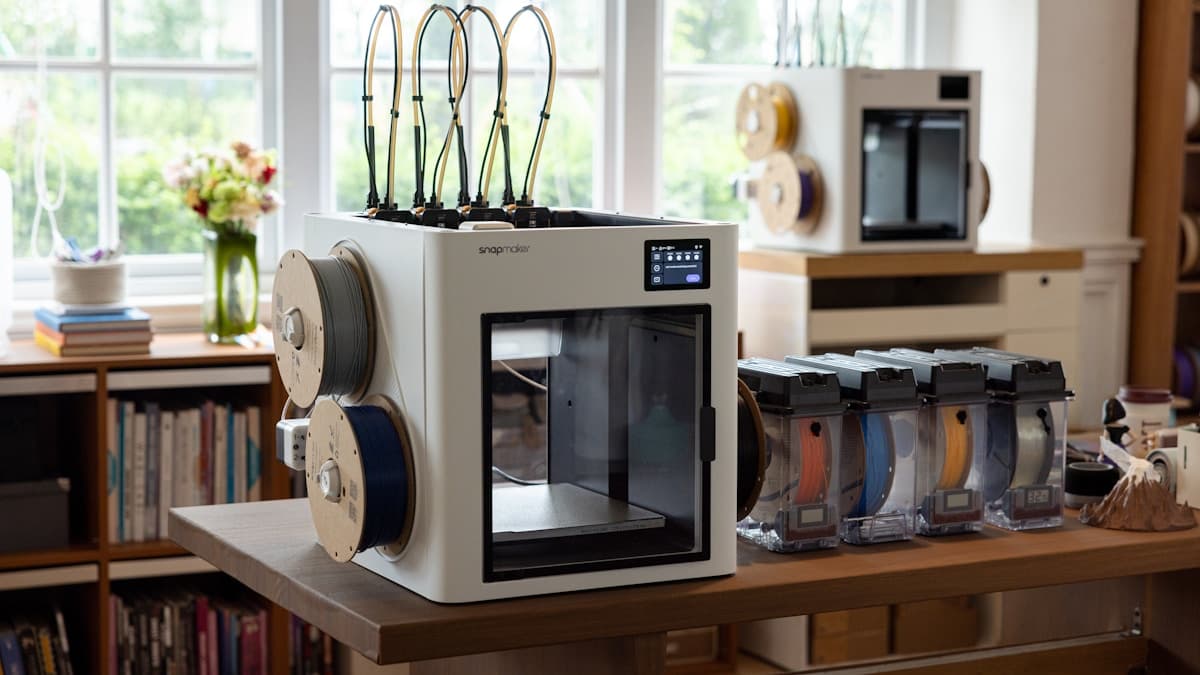
Hero photograph by Snapmaker 3D Printer via Unsplash.
Ready to find a 3D printing service provider?
Browse 2,000+ verified providers across the United States and submit your quote request free.
Browse Providers