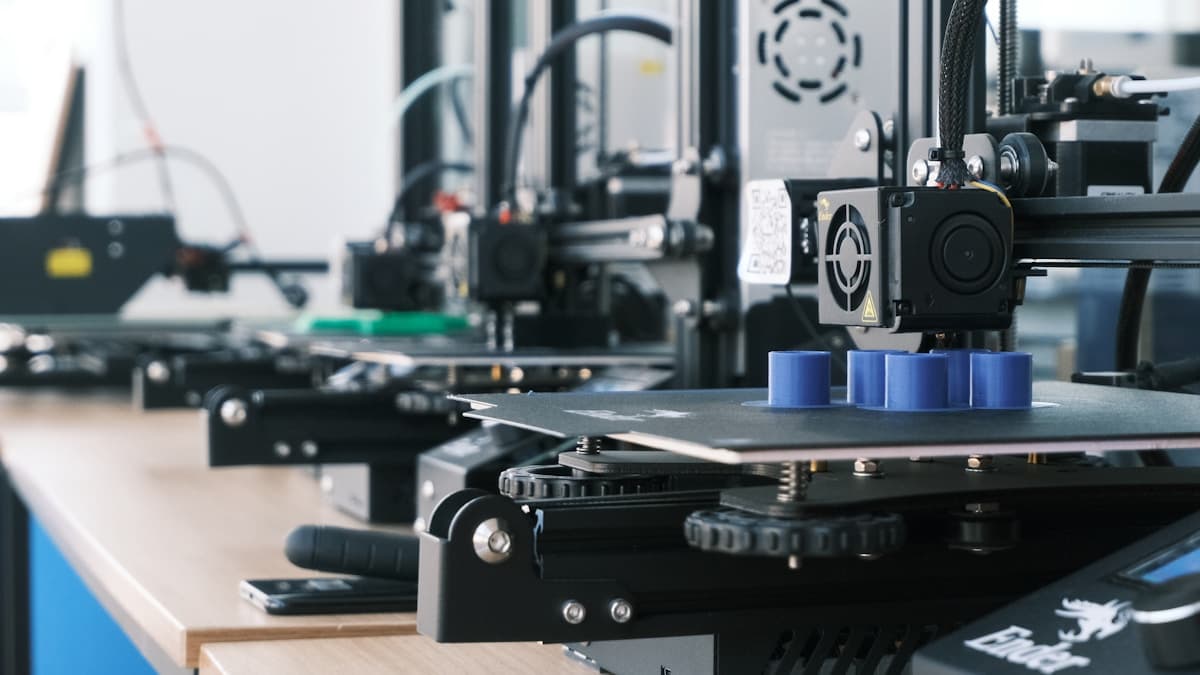
Looking for 3D printing services in Honolulu, HI? The 3D Prototyping Hub directory lists 19 providers in the city — 19 of the 21 listed anywhere in Hawaii, which makes Honolulu not just the state's biggest market but very nearly all of it. The fastest route to a quote is the Honolulu provider directory: work out what each listing actually is, then send your file to the shops that fit the part.
Here is the number that surprises people. Nineteen listings puts Honolulu level with San Francisco (19) and ahead of San Diego (17) and Seattle (15) — mainland metros several times its size. An island economy 2,400 miles from its suppliers builds more of its own small parts than a mainland city does, because the alternative is a freight wait. That fact shapes everything below.
What the 19 Honolulu Listings Actually Are
The count is real. The composition needs a warning label, and sorting the list before you send files will save you more time than anything else on this page. Three groups:
- Dedicated additive shops. Roughly six of the nineteen carry 3D in the business name — a prototyping outfit, a combined cutting-and-printing shop, a product-design and engineering firm, and a handful of smaller print operations. This is the group to start with for a part that has to fit, load or seal.
- Design, fabrication and duplication businesses. About four listings are creative-fabrication, scanning or duplication firms that print as one capability among several. Good for replicas, display work, models and anything where the geometry has to be captured before it can be made.
- Commercial print, graphics and reprographics. Around nine — established Honolulu printing, repro, imaging and business-services companies that either added 3D printing to an existing service menu or simply carry "printing" in the older, ink-on-paper sense. Honolulu has an unusually deep commercial print and repro trade for its size, because a state capital, a large military presence and a visitor industry all generate document, signage and display work. That is exactly why a 3D printing search surfaces them. Useful for models, signage components and presentation work; not the first call for a loaded bracket.
Then the number that matters most: all 19 Honolulu listings are unclaimed, and not one records a process or a material. Every entry was assembled from public sources rather than maintained by its owner, so the directory can tell you who exists and how to reach them, but not what they run.
That is less limiting than it sounds. Every one of the 19 has a phone number on file and 13 have a website, so qualifying takes an afternoon rather than a week — you will just be doing it yourself, which is why the questions further down carry the weight.
The 2,400-Mile Problem
This is the section worth reading even if you skip the rest, because in Honolulu it decides the buy.
The great majority of everything Hawaii consumes arrives through Honolulu Harbor by container ship. Mainland container service from the West Coast runs roughly five days port to port, and that is before drayage, port handling and delivery — call it a week to ten days door to door on a good run, longer if anything goes wrong. Air freight beats it and prices accordingly. For most small plastic parts, the freight costs more than the part.
Invert that and you have the local case. A bracket printed in Kalihi this afternoon is in your hands this afternoon. The same bracket ordered from a mainland bureau at a lower unit price is a week out and carries a shipping line you cannot compress. On Oahu, local printing competes on schedule rather than on unit cost, and schedule is usually what you are actually short of. Online versus local 3D printing services works through the general trade-off; in Hawaii it tilts harder toward local than anywhere else in the country.
Two practical consequences. First, the highest-value category here is replacement and obsolete parts — the $9 fitting that a mainland supplier will not ship economically, for equipment that cannot wait. Second, iteration is where the schedule saving compounds: three revisions with a local shop is a week, and three revisions with a mainland bureau is a month.
What Drives Demand Here
Honolulu is a city of roughly 350,000 on an island of about a million people, and its industrial base decides what local shops are practised at.
Pearl Harbor and the defense base. Pearl Harbor Naval Shipyard and Intermediate Maintenance Facility, Joint Base Pearl Harbor-Hickam and the commands around them form one of the largest industrial employers in the state. Ship and aircraft maintenance generates exactly the work additive is good at: handling and layup fixtures, tooling aids, instrument enclosures, protective covers and interim replacement parts for equipment whose supply chain runs through a port a Pacific crossing away. 3D printing for jigs, fixtures and manufacturing aids covers how that job normally runs.
The harbor and the marine trades. Honolulu Harbor, Keehi Lagoon, the Ala Wai and Kewalo Basin support commercial shipping, boatyards, charter and dive operators, and a commercial fishing fleet. Sensor housings, custom mounts, deck hardware, seals and replacement fittings for equipment living in salt water are steady work — see 3D printing services for marine and boat parts, and read the material section below before you specify anything that goes near the water.
The visitor industry. Hawaii's largest sector runs on display and signage components, retail and hotel fixtures, replacement fittings for equipment nobody stocks locally, and props for events and attractions. Prosaic work, consistently the fastest thing on this list to have made, and the natural fit for the commercial print and graphics group above.
Research and education. The University of Hawaii at Manoa's engineering and ocean-science programmes, the medical school in Kakaako and the clinical base around them generate lab fixtures, instrument mounts, device prototypes and anatomical models — small, precise, one-off, and usually needed this week.
Film, television and events. Hawaii's long-running production industry, anchored at the Hawaii Film Studio in Diamond Head, needs props, set dressing, camera and rigging accessories and replacement parts made overnight. A production day cannot wait on a barge. 3D printing services for cosplay props and costumes covers the same techniques the professional shops use.
Small-batch consumer products. Honolulu supports a real population of independent apparel, jewellery, surf and homeware brands making things in the tens and hundreds rather than the millions — squarely additive's economics. Low-volume 3D printing services covers where that crossover sits.
What You Can Get Printed Locally
- Functional prototypes — parts that have to fit, load or seal before you commit to tooling.
- Replacement and obsolete parts — the highest-value category in an island economy, for the reasons above.
- Jigs, fixtures and shop aids — fastest payback of anything on this list for a fabrication or maintenance operation.
- Display, signage and retail fixtures — the visitor industry's standing job, and a local specialism.
- Concept and appearance models — form studies and design reviews, usually resin for surface finish.
- Architectural and site models — a genuine market given the pace of construction in Kakaako and the urban core; 3D printing for architectural models covers what those need.
- Short production runs — realistic in the tens to low hundreds.
Processes and When to Use Each
| Process | Best for | Trade-off |
|---|---|---|
| FDM | Functional prototypes, jigs and fixtures, larger parts, engineering plastics | Visible layer lines; weaker across layers |
| SLA / resin | Fine detail, smooth surfaces, small precise parts, appearance models | More brittle; needs post-processing; costs more per part |
| SLS / MJF nylon | Durable functional parts, complex geometry, no supports needed | Grainy finish; higher minimums; almost certainly off-island |
| Metal | End-use metal components, tooling inserts, high-temperature parts | Most expensive; longest lead time; expect a Pacific round trip |
FDM and resin are what a market this size actually runs. SLS 3D printing services and metal 3D printing services are the two most likely to leave the island — worth asking about directly rather than discovering after the fact, because a subcontracted part adds two ocean crossings to your schedule. How much 3D printing costs explains what actually drives the number on a quote.
Specify for Salt, Sun and Humidity
Three things go wrong with parts made here more often than anything else, and all three are decided at the quote rather than at the printer.
Name the polymer, not just the process. "FDM" spans PLA and glass-filled nylon. PLA softens around 60°C (140°F) — less than a car parked on Ala Moana Boulevard in August — and yellows and embrittles under year-round UV. Anything living outdoors, in a vehicle, on a lanai or on a boat should be ASA, PETG, polycarbonate or a filled nylon instead. Say where the part will live when you request the quote; how to choose a 3D printing material covers the trade-offs in full.
Ask how the shop stores its filament. This matters more in Honolulu than in most mainland markets. Ambient humidity is high year-round, and nylon, PETG and TPU all absorb moisture from the air. Wet filament prints with poor layer adhesion and a rough surface, and the part then fails in the way that is hardest to diagnose from a photograph. A shop that keeps material in sealed storage or dry cabinets is telling you something real about its process control.
Design for metal fasteners near salt air. Heat-set inserts and stainless hardware in a printed body will outlast a printed thread by a wide margin. The Hawaii state guide goes further on specifying for the marine environment across the islands.
How to Qualify a Honolulu Shop
With no listing publishing process or material data, the qualifying conversation carries everything.
"What is your business, exactly?" Ask it first. It separates the additive shops from the repro, sign and business-services firms in one sentence, and neither party wastes an afternoon.
"Is that capability in-house?" Especially for nylon, metal and anything over a foot in any direction. Brokering is legitimate and common — but here it changes your lead time by weeks, not days.
"What are you printing this week?" A better question than a capability list in a market where nobody publishes one. It tells you what the machines are actually set up for.
"What tolerance can you hold on this geometry?" Additive tolerances are process-dependent and not what a machinist would assume — tolerances and accuracy in 3D printing covers what is realistic to ask for.
How to choose a 3D printing service has the full vetting checklist, how to prepare files for a 3D printing quote covers what to send, and if the deadline is genuinely tomorrow, read same-day and rush 3D printing services before you brief anyone.
Beyond Honolulu
| Market | Listed providers | Relationship to Honolulu | Directory page |
|---|---|---|---|
| Honolulu, HI | 19 | — | /providers/location/hi/honolulu |
| Aiea, HI | 1 | ~10 min up the H-1; same Oahu market | /providers/location/hi/aiea |
| Hilo, HI | 1 | Hawaii Island; interisland air or barge | /providers/location/hi/hilo |
| Los Angeles, CA | 13 | ~5h by air; the usual mainland gateway | /providers/location/ca/los-angeles |
| Seattle, WA | 15 | ~6h by air; aerospace-heavy, regular freight | /providers/location/wa/seattle |
Within Oahu, treat the Honolulu page as the island-wide list — Kapolei, Kailua, Kaneohe, Pearl City and Mililani carry no separate listings, and at island scale nothing is far enough to rule a shop out. Aiea is effectively a Honolulu suburb. Hilo is the only listing outside Oahu and the practical east-side option on Hawaii Island; if you are on Maui, Kauai, Molokai or Lanai, plan on interisland air cargo out of Daniel K. Inouye International, which is usually a same-day or next-day service and still far faster than anything from the mainland.
When the work genuinely cannot be done on Oahu — powder-bed nylon, metal, certified production — California is the deepest market on the nearest coast and the sensible first check, Los Angeles is the usual gateway, and Seattle adds an aerospace-heavy base with regular freight into Honolulu. Build the crossing into the schedule from the start rather than discovering it at the end.
Get Quotes From Honolulu Providers
Browse the Honolulu provider directory to see all 19 listed providers, work out which are genuinely additive shops, and send your part to the ones that fit it. Ask three rather than one — it is the cheapest way to find out what your part should really cost. Comparing more widely? Start from the Hawaii directory or the full provider directory.
Hero photograph by Minku Kang via Unsplash.