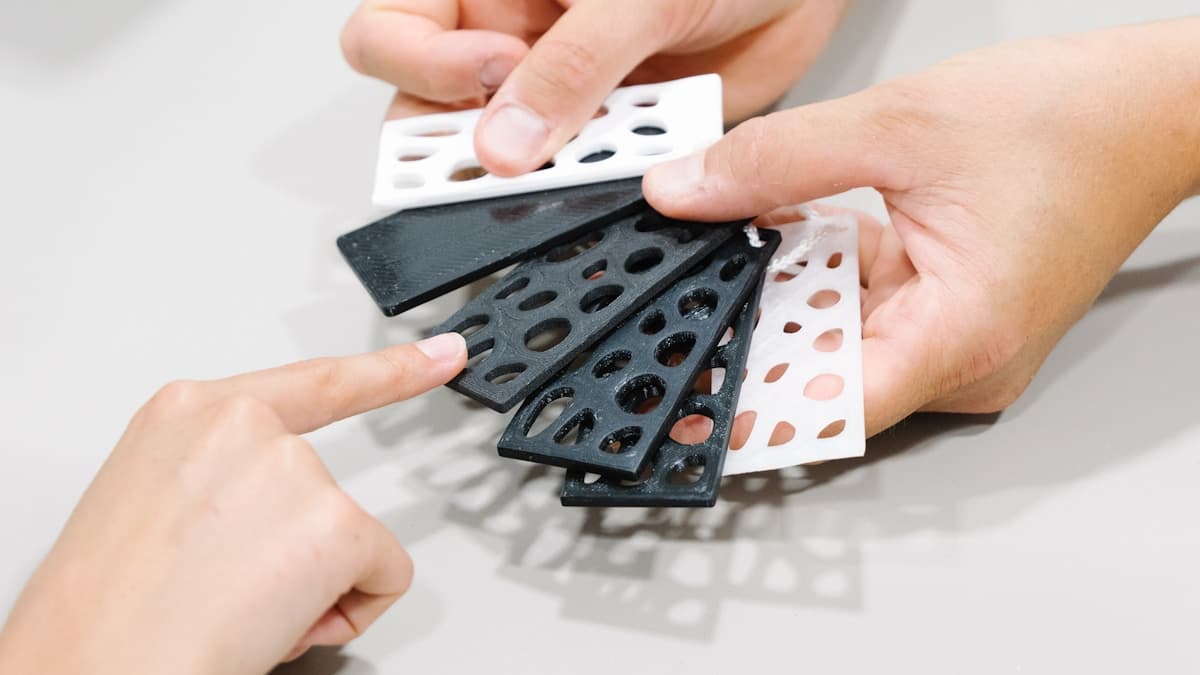
3D printing services for conveyor and material handling parts answer a narrow, expensive problem: a packaging line stops because one small polymer component broke, and the company that made it quotes six weeks. The part is rarely complicated. It is a guide, a paddle, a wear strip or a gripper finger — a piece of shaped plastic whose only job is to keep product moving in a straight line. This guide covers which of those parts are worth outsourcing to a print shop, how to pick the process and material, what to send when you have no drawing, and how to qualify a provider before the line is down rather than after. When you are ready to source, browse the 3D printing provider directory.
What Plants Actually Print
Five categories cover most of the work, and sorting a job into one settles the process and the material before price comes up.
Changeover and format parts. Star wheels, timing screws, infeed scrolls, neck grippers and bottle pucks — the parts swapped when a line switches from one container to another. These are the single best case for printing anywhere in a plant. They are geometrically specific to one package, they are ordered in quantities of a few, and the OEM prices them accordingly. When marketing changes a bottle shape, printing is often the only route to a change part that exists before the promotion is over.
Guide rails, wear strips and chute liners. The surfaces product slides against. Low load, high contact, deliberately sacrificial. Printing wins here on curved and compound geometry that would otherwise be hand-bent from stock profile and never quite fit.
End-of-arm tooling and grippers. Vacuum cup manifolds, custom jaw inserts, soft TPU finger tips for delicate product, pick heads matched to an odd carton. This overlaps directly with 3D printing services for robotics parts, and the same rule applies: printed EOAT is light, and lighter tooling means faster cycles on the same robot.
Brackets, sensor mounts and guards. Photo-eye mounts, cable management, encoder brackets, small covers. Unglamorous, constant, and the category most plants print in-house once they own a machine.
Obsolete spares. The part from a machine whose builder no longer exists or no longer stocks it. Captured by scan, rebuilt, printed — the general workflow is covered in 3D printing replacement and spare parts.
The Economics Are About Downtime, Not Part Cost
Compare the printed part to the idle line, not to the OEM invoice. A conveyor component is a low-value item guarding a high-value process, so the decision is almost always dominated by lead time and rarely by unit price.
That reframing changes what you optimise for. It makes a three-day printed part at a premium the cheaper option against a six-week OEM part at list. It makes the reverse-engineering fee worth paying once, because the file is then yours forever and the second order is print-only. And it makes a small library of validated part files — the ten components that have stopped your line before — a maintenance asset rather than an engineering project. Plants that hold those files convert a breakdown into a purchase order.
It also changes where printing loses. A part you consume by the hundred, buy from a distributor tomorrow and never modify is not a printing candidate. Being clear about that boundary is what makes the rest credible.
Process and Material Selection
| Process | Best for | Materials | Watch for |
|---|---|---|---|
| FDM | Guide rails, brackets, chute liners, larger low-load parts | PETG, ABS, ASA, PA6-CF, PC | Cheapest per volume and the easiest to get big; layer adhesion is the weak axis, so orient loads across layers, not along them |
| SLS / MJF | Star wheels, grippers, format parts, anything with living hinges or thin webs | PA 11, PA 12, PA-GF, TPU | Isotropic, no supports, excellent fatigue life — the default for a part that moves product all shift |
| SLA / DLP resin | Master patterns, high-detail fixtures, inspection gauges | Rigid and tough engineering resins | Fine detail, but most grades embrittle under UV and repeat impact — not a wear part |
| Metal powder bed | Manifolds, high-load linkages, hot-zone components | Stainless, tool steel, aluminium | Genuine capability where polymer will not do; expect a different budget and lead time entirely |
For material, the four questions that decide it are load, temperature, cleaning chemistry and whether the part touches product. Nylon in the PA 11 and PA 12 family from SLS 3D printing services is the workhorse of this application: tough, abrasion-resistant and forgiving of the repeated knocks a conveyor delivers. Reach for carbon-fibre reinforced grades when stiffness or deflection under load is the constraint, TPU when the part must grip or cushion product, and ASA over ABS anywhere sunlight reaches. The broader trade-offs are laid out in how to choose a 3D printing material.
The most common specification mistake is ordering in the material the shop quoted cheapest without stating the environment. A plant that washes down at 60°C with caustic will destroy parts that would have lasted years dry.
Food, Beverage and Pharma Lines
Most material handling in these plants is around product rather than on it, and the distinction is the whole conversation. Guide rails, change parts, pucks and brackets that steer a sealed container need no food-contact claim. Anything that touches open product does, and it needs a certified grade plus a finish that layer lines have not turned into a crevice — the requirements are set out in 3D printing services for food-safe parts.
Washdown is the other constraint, and it bites harder than most buyers expect. State the temperature, the chemistry and the frequency in the RFQ. A part that is dimensionally perfect and chemically wrong fails in a month.
What to Send
If you have CAD, send STEP rather than STL — a solid model lets the shop adjust wall thickness, add a fillet or scale a clearance without guessing. The difference is explained in STL vs STEP files.
If you have only the broken part, that is a normal order. Ship the part, plus the mating component it seats against if you can spare it, and say what failed and how. The shop scans it and rebuilds a model — and the rebuild should correct the wear, not reproduce it. The route for a plant with no drawings at all is covered in 3D printing services without a CAD file.
Either way, send the context: quantity, the container or product the part handles, line speed, wash-down regime, ambient temperature, and the date you need it. Agree tolerances explicitly on the surfaces that locate and nothing else — tolerances and accuracy in 3D printing is worth reading before you put a number on a drawing you cannot verify on receipt.
Qualifying a Provider
Ask five things, and ask them before the line is down.
- What industrial polymers do you keep in stock? In-stock PA 12 is the difference between three days and three weeks.
- Do you reverse-engineer from a sample, and who owns the resulting model? Get the answer to the second half in writing.
- What is your realistic rush turnaround, and is there a standing lane for it? A shop that quotes same-day and rush work honestly is worth more than one that quotes it optimistically.
- Can you hold the file and reprint on a phone call? Repeat orders on known parts should not need a new quote cycle.
- What is your build volume? A one-metre guide rail is a different conversation from a gripper finger, and it is better had early.
A provider who has served a plant before will answer all five quickly and will ask you about washdown without being prompted.
Get Line Parts Quoted
Start with the parts that have already stopped you. Pick the two or three components with the longest OEM lead time, have them modelled now while the line is running, and hold the files. Then send the drawings or the samples out with the container, the line speed and the cleaning regime attached. Browse 3D printing providers and ask two or three shops — the questions they ask back about wash-down chemistry and load direction will tell you which ones have done this work before.
Related Resources
- 3D Printing Services for Jigs, Fixtures and Manufacturing Aids — the workholding half of the same shop-floor brief
- 3D Printing Replacement and Spare Parts — the obsolete-part workflow in detail
- Functional and End-Use 3D Printed Parts — what separates a production part from a prototype
- 3D Printing Services for Food-Safe Parts — certification and finish for product contact
- SLS 3D Printing Services — the nylon powder process behind most change parts
- Low-Volume 3D Printing Services — costing a run of five
- Browse 3D Printing Providers — send the job out
Hero photo: Tom Claes via Unsplash.