3D printing services for food-safe parts get hired for jobs that sit awkwardly between a catalogue and a machine shop: a change part for a bottling line that the OEM no longer stocks, a portioning scoop shaped to one recipe, a guide rail for an odd container, a mould for a chocolate shell, a jig that holds product while it is weighed. The geometry is trivial to print and the compliance question is not, and the two get answered in the wrong order more often than not. This is a guide to asking the compliance question first. When you have a part in mind, the 3D printing provider directory is where to send it — but read the material section before you write the brief.
Food-Safe Is a Property of the Part, Not the Plastic
The most expensive misunderstanding in this category is short enough to state in one line: a material datasheet saying the polymer is listed for food contact tells you about the pellet, not about the object.
Between the pellet and your part sit colourant masterbatches, processing temperatures, wear from the hot end or the powder-handling system, whatever else the machine printed last week, the hands that removed supports, and a surface that is measurably rougher and more porous than any moulded equivalent. None of that is covered by the raw-material statement. Four separate things have to be true before a printed part deserves the description:
- The material is one the supplier can document for food contact under conditions matching your use — temperature, contact time, and whether the food is dry, wet, acidic or fatty.
- The build was clean — virgin material from a sealed spool or an unmixed powder lot, on a machine and hot end that will not add anything.
- The surface can be cleaned — smooth enough, and free of crevices, that a wash actually removes soil rather than pushing it into the layer lines.
- The application matches — the part is used the way the documentation assumes, and replaced on a schedule.
Miss one and the part is not unusable, but it is not food-safe either. It is a part with a known limitation, which is a perfectly workable thing to buy as long as everyone writes it down.
Where Printed Parts Legitimately Belong
Sorting the job by contact type before you sort it by process saves the whole conversation.
| Contact type | Examples | Printing verdict |
|---|---|---|
| No contact | Guards, brackets, sensor mounts, line signage, jigs and fixtures beside the line | Routine. No food-contact question at all — spec it like any other functional part |
| Indirect / splash zone | Housings above the belt, drip guides, covers | Straightforward, but it still has to survive the wash-down chemicals and pressure |
| Incidental, dry, brief | Funnels, chutes, portioning aids, packaging formers | The realistic sweet spot for polymer printing, with documented material and a replacement schedule |
| Direct, wet, warm or repeated | Product-contact surfaces on processing equipment, anything hot or fatty, anything in a CIP loop | Printed polymer is usually the wrong answer. Printed and finished 316L, or conventional manufacture |
| Single-use consumer contact | Cookie stamps, chocolate and ice moulds, cake formers | Workable with a documented material and hand-washing, and honest about a limited life |
The pattern is consistent across the food plants that use printing well. Almost all their printed parts sit in the first three rows, and the volume is in the first two. That is not a failure of the technology — it is a category where the boring applications pay for themselves quickly and the glamorous ones rarely survive an audit.
Process and Material by Job
| Job | Sensible route | Why, and what limits it |
|---|---|---|
| Dry, brief contact; moulds and formers | FDM in PLA or PETG | Cheapest and fastest; PLA softens near 55-60 °C so it is hand-wash only, PETG takes a little more heat |
| Wash-down parts, splash zone, chemical exposure | FDM in polypropylene, or MJF / SLS nylon | Real chemical and temperature resistance; nylon is porous and dyes rather than seals, so cleanability needs work |
| Complex functional parts, no supports inside channels | MJF or SLS | Tough and isotropic; ask directly about the powder refresh ratio and lot documentation |
| Product-contact surfaces on processing equipment | Metal printing in 316L, fully finished | The only route that meets sanitary surface expectations, and the finishing is most of the bill |
| Cosmetic display food props, no contact | SLA resin | Best surface by a distance, and photopolymers are the least defensible near real food |
Two judgements worth making explicitly. Photopolymer resin is the default no for anything touching food: incomplete post-curing can leave unreacted monomer, and the biocompatibility certifications that do exist are written for dental and medical use, not for a warm kitchen. Resin safety and post-processing basics covers why. And PLA is not the safe default it is assumed to be — the polymer is widely listed for food contact, but its heat and caustic tolerance rule out every commercial wash cycle, so it is a hand-wash, short-life material.
The Surface Is the Whole Argument
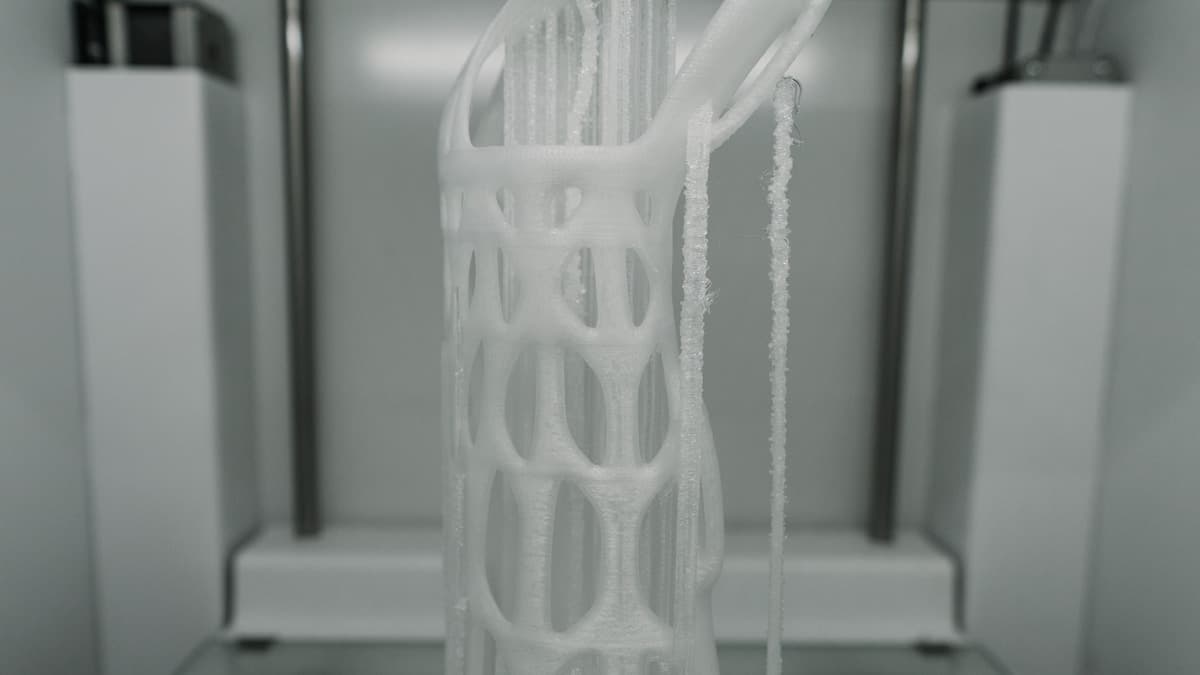
Look at the print in the photograph above. The layer striations across those struts are what a food-safety auditor sees first, and they are a fair thing to object to. Every layer boundary on an extruded part is a small re-entrant groove running the circumference of the part, and micro-porosity between beads runs deeper than that. Soil and moisture get in; a cloth, a brush and a detergent do not reliably get them out. Published work on cleaning printed surfaces has repeatedly found that bacteria persist on as-printed plastic after cleaning regimes that clear a smooth moulded control, and that is the whole reason sanitary standards ask for smooth, crevice-free, non-absorbent product-contact surfaces.
The practical responses, in the order shops actually use them:
- Print smoother. Fine layer heights, generous walls, high extrusion consistency, orientation that puts the food-contact face where it resolves best.
- Design out the traps. Generous internal radii, no deep blind pockets, no unnecessary texture, nothing that needs a support structure on a contact face. The rules in design for 3D printing guidelines apply doubly here.
- Smooth after the fact. Vapour smoothing, tumbling, sanding and sealing all reduce roughness. Post-processing and finishing services is the general reference.
- Coat it. A food-grade epoxy fills the layer crevices and gives a wipeable skin. It genuinely helps cleanability; it does not certify anything, it can chip, and its own temperature and chemical limits now apply too.
- Accept a service life. The most honest answer on many parts: cheap, replaced monthly, logged. Printing is unusually good at making that affordable — the same argument as 3D printed replacement and spare parts.
What the Shop Must Do Differently
A provider set up for food work runs the job differently from a prototype, and the differences are answerable questions rather than vague assurances:
- Virgin material with lot traceability. A sealed spool or an unmixed powder lot, with the supplier's food-contact documentation and the lot number recorded against your job.
- A clean machine and a stainless hot end. Standard brass nozzles are usually a leaded alloy. Shops doing this work print food jobs on stainless or hardened steel, on machines that have not just run carbon-filled or unknown material.
- Powder discipline on MJF and SLS. Refreshed powder rather than heavily recycled, with the refresh ratio stated.
- Handling. Gloves after the build, no unrecorded solvent or release agents, packaging that arrives sealed.
- Documentation. Material data sheets, food-contact statements, the lot record and a note of what was and was not done. If they cannot produce paperwork, you cannot answer an auditor, however good the part is.
Cost follows the same lines as any functional job — size, volume, machine time, and above all finishing — so the general model in how much does 3D printing cost still applies. Expect a real premium over a generic prototype quote: the documentation, the dedicated setup and the surface work are the job.
How to Brief It
Send this and the first reply is a quote rather than a questionnaire:
- What the part touches, and how. "Dry pasta, seconds of contact, ambient" and "warm butterfat, continuous, 60 °C" are different products from the same drawing.
- The cleaning regime, named. Hand wash, commercial dishwasher, caustic wash-down, CIP loop, sanitiser chemistry and temperature. This decides the material more often than the geometry does.
- Which standards you are being audited against, if any, and what your quality team needs on file.
- STEP geometry plus a note of which faces are product-contact, and any dimension that has to hold — see tolerances and accuracy.
- Quantity and replacement interval. Twelve now and twelve every quarter is a different recommendation from one part forever, and at real volume rapid tooling or injection moulding may beat printing outright.
- Whether the line is down. If it is, say so, and read same-day and rush 3D printing services before you call.
How to prepare files for a 3D printing quote and how to choose a 3D printing material cover the general submission.
Qualifying a Provider
Three questions separate a shop that has done this from one that will learn on your job.
"What documentation comes with the part?" The good answer names the material statement, the lot number and the machine. A shop that answers "PLA is food safe" has told you it has not done this before.
"Which machine and which hot end will run it?" You are listening for a dedicated or cleaned machine and a non-brass nozzle, offered without prompting.
"What service life would you put on this part in my application?" A provider who volunteers a replacement interval is thinking about your process. One who says the part will last indefinitely is not.
Get a Food-Contact Part Quoted
Answer the contact question first — what it touches, how hot, how wet, how often, and how it gets cleaned — and the material, the process, the finishing and the price all follow from it. Then ask two or three shops, and weigh the paperwork as heavily as the price, because the part that cannot be evidenced is the one that gets pulled off the line.
Browse 3D printing providers to send the job out, or start in the food and beverage manufacturing clusters: Illinois providers for the Chicago processing and packaging base, Wisconsin providers for dairy and food equipment work, or California providers for produce, beverage and specialty food operations.
Related Resources
- 3D Printing Services for Packaging Prototypes — the mockup side of the same product
- 3D Printing Services for Agriculture and Farm Equipment — the other end of the food supply chain
- 3D Printed Replacement and Spare Parts — the economics of a part you replace on a schedule
- How to Choose a 3D Printing Material — the general material decision
- 3D Printing Post-Processing and Finishing Services — smoothing, sealing and coating
- Multi Jet Fusion 3D Printing Services — tough nylon parts for wash-down duty
- Browse 3D Printing Providers — get it quoted
Hero photo by Tom Claes.