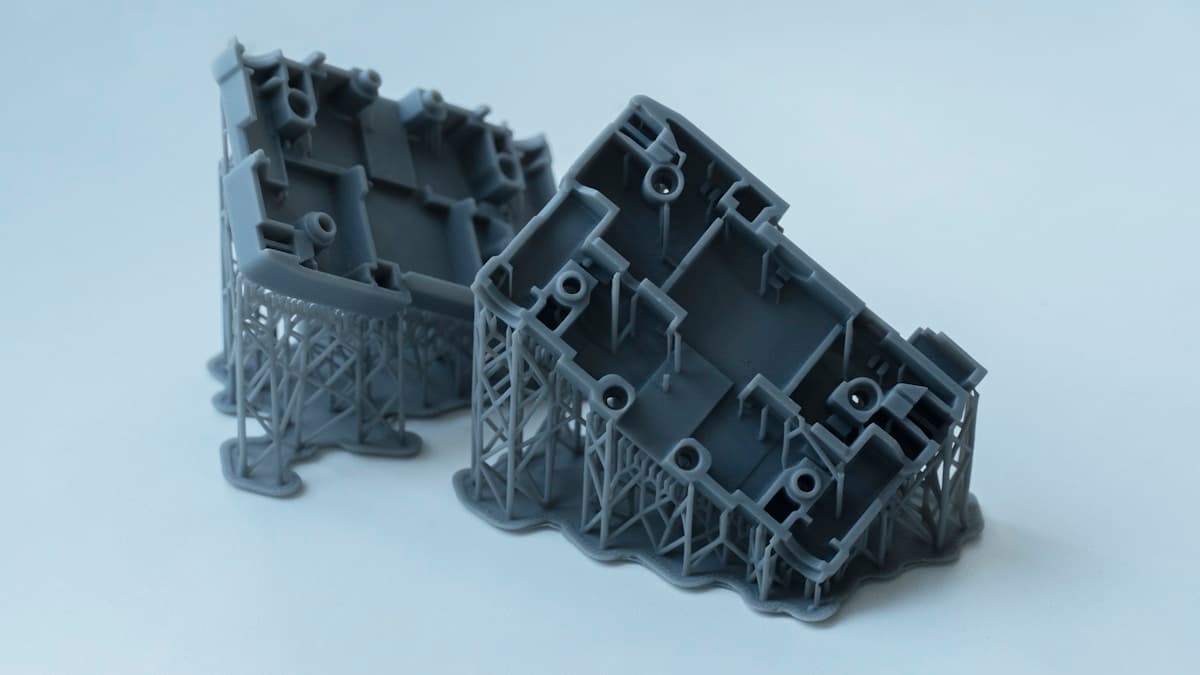
The short version: treat liquid resin as a hazardous chemical and cured resin as an ordinary plastic. Everything that matters in resin safety follows from that one distinction. Wear nitrile gloves — never latex — keep the printer in a ventilated space that isn't a bedroom, never let uncured resin or used IPA reach a drain, and cure every drop of waste solid before you throw it away. The finishing order that keeps you out of contact with the liquid is wash → remove supports → cure → sand. If you'd rather not run this workflow at all, order the part from a provider instead.
Resin printing is the one desktop process with a genuine chemical-handling component, and it's the part new owners read last. This guide covers what the hazard actually is, the PPE that matters, how to finish a print without handling uncured resin, and how to dispose of the waste properly.
This post contains affiliate links. If you purchase through these links, 3D Prototyping Hub may earn a small commission at no extra cost to you.
This post also contains Amazon affiliate links. As an Amazon Associate we earn from qualifying purchases.
The One Distinction That Governs Everything
A finished, properly cured resin part is inert. You can handle it, sand it, paint it, and hand it to someone else without a second thought. At that point it's just plastic.
Liquid resin is not that. Uncured photopolymer resin is a skin and eye irritant, and — the part that deserves the most attention — it is a sensitizer. An irritant causes a problem while it's on you. A sensitizer can teach your immune system to react to it permanently. Repeated skin contact with uncured resin can produce an allergic contact dermatitis that, once developed, tends not to go away, and people do have to abandon resin printing entirely because of it.
This is why the advice is "gloves every time" rather than "gloves when it's messy." The risk isn't primarily the one splash that stings — it's the accumulation of small, casual contacts across months: the quick plate grab, the wipe with a bare thumb, the "it's only a drop."
Everything below is downstream of this: keep the liquid off you, out of the air you breathe, and out of the water supply.
PPE: What Actually Matters
Nitrile gloves — not latex
This is the piece of safety advice with the least disagreement anywhere in resin printing, and it's specific: nitrile.
Latex is the mistake worth naming directly. It's a poor barrier against the (meth)acrylate chemistry that photopolymer resins are built on and can be permeated by it, and latex carries its own well-known allergy risk on top. A latex glove can leave you feeling protected while the thing you're protecting against passes through. Vinyl is likewise not the answer. Nitrile is what resin manufacturers specify.
Two honest qualifications. Disposable nitrile is rated for incidental splash and short contact, not for soaking your hands in solvent. And the failure mode most people actually hit isn't glove material, it's glove discipline: working on in a glove that already has resin on it, then touching a phone or a light switch. Change gloves the moment they're contaminated, and never reuse a disposable pair. A box of nitrile gloves is the cheapest line item in resin printing and the one to never ration.
Eye protection
Wear safety glasses whenever resin could move — draining a vat, peeling a print off a plate, shaking a bottle, cleaning a spill. Resin in the eye is a genuine emergency rather than an inconvenience.
If it happens, standard chemical first aid applies: flush with water immediately and continuously — the usual guidance is around 15 minutes — remove contact lenses if present, and seek medical attention. Your resin's safety data sheet carries the manufacturer's specific first-aid instructions, and it's worth reading that sheet before you need it, not while you're holding your eye open over a sink.
Ventilation
Ventilation, not a mask, is the primary control. The distinction that matters: you want air moving out of the space, not circulating within it. An extraction path to outside — a window fan, ducting, an enclosure vented outdoors — does the job. An open interior door mostly relocates the problem to the next room.
The practical rule that follows: a resin printer does not belong in a bedroom or a living area. Not because of a specific measured threshold, but because those are the rooms where you spend eight unconscious hours, and there's no upside to finding out where the line is.
On respirators: one with organic-vapor cartridges is a sensible addition for higher-exposure tasks — spills, vat draining, working somewhere you can't ventilate well. A dust mask or surgical mask does nothing at all against vapor and is worse than useless if it makes you feel protected. A respirator supplements ventilation; it never replaces it.
Skin contact — and the mistake almost everyone makes
If uncured resin gets on your skin, wash it off promptly with soap and water.
The mistake is reaching for the IPA. It's right there, it's what dissolves resin off everything else, and it is the wrong tool for skin. Solvent strips the skin's natural oils and can help carry the resin into it rather than off it — the opposite of what you want from a wash. Soap and water, then keep an eye on the area. If irritation persists or a rash develops, that's a signal to take seriously rather than work through, and it's worth medical advice — this is exactly how sensitization announces itself.
The Post-Processing Order
A print coming off the plate is covered in liquid resin and is only "green cured" — hard enough to hold its shape, not hard enough to have reached its final properties. The order you finish it in is a safety decision as much as a quality one, because the whole point is to stop handling the liquid as early as possible.
1. Wash. Always first, and this is the one step with no flexibility. Every step after it involves touching, cutting, or abrading the part, and none of those should happen while it's coated in uncured resin. Standard resins wash in isopropyl alcohol; water-washable resins rinse in plain water. Gloves stay on for this entire step.
2. Remove supports. Most people do this after the wash and before the final cure, while the part is still green. A green part is softer and less brittle, so supports snap away cleanly instead of chipping the surface or tearing out a divot — and cured support nubs are meaningfully harder to remove without leaving a mark. The honest trade-off is that green parts also bend and mar more easily, so very fine or fragile geometry is sometimes cured first and the harder removal accepted. Both approaches are defensible; the wash coming first is not negotiable either way.
3. Cure. UV exposure at around 405nm takes the part to full hardness. Time depends on the resin, the part's size and color, and your station's UV power — check your resin's datasheet rather than trusting a number from a forum. Cure times for typical desktop prints run in minutes, not hours. Both directions are real failures: under-cured parts stay weak and tacky, and over-curing — the one people underestimate — makes parts brittle and can yellow clear and light-colored resins. Start low, check, add time only if needed.
4. Sand and finish. Only after the final cure, and this one is a safety rule rather than a preference. Sanding an uncured or partially cured part smears liquid resin around and generates dust and aerosol from material that hasn't finished reacting. Cure it fully first; then it's just plastic, and normal sanding precautions apply.
A dedicated station makes the first and third steps repeatable, and there's a real safety argument for one beyond convenience: it keeps the IPA sealed instead of evaporating off an open tub on your bench, and it contains the UV. The Anycubic Wash & Cure and the ELEGOO Mercury are the two most common answers; Best Resin Wash & Cure Stations in 2026 compares them properly.
IPA vs. Water-Washable: A Safety Trade, Not a Free Lunch
Water-washable resin is often pitched as the safe option. It's more accurate to say it trades one set of problems for another.
What you genuinely gain: no isopropyl alcohol in the house. IPA is flammable, needs storing away from heat and ignition sources, evaporates into the air of whatever room it sits in, and eventually has to be disposed of. Removing it from the workflow removes a real fire and inhalation consideration — a meaningful win if your printer lives in a spare room or an apartment. If you're staying with standard resin, 99% IPA carries less water and stays effective longer than lower concentrations.
What does not change at all: the resin is still resin. Water-washable resin is a photopolymer with the same skin and eye hazards and the same sensitization risk as any other. It needs the same nitrile gloves and the same ventilation. "Water-washable" describes the cleanup solvent — it is not a statement about toxicity, and reading it as one is the trap. Low odor doesn't mean low hazard either: a resin that smells like nothing can sensitize you just as effectively.
What people miss entirely: the rinse water is now resin-contaminated waste. It is not greywater, it does not go down the drain, and you cure it like any other resin waste.
For a fuller comparison of the formulations, see Best Resin for 3D Printing in 2026.
Disposal: Cure It Solid First
The single rule: nothing liquid goes down the drain, ever. Not resin, not used IPA, not water-washable rinse water.
There are two reasons, and both stand on their own. Photopolymer resins are typically classified as toxic to aquatic life — drain disposal puts them into the water system. And liquid resin can cure inside plumbing, which is a slower and more expensive lesson.
The method is the same for all resin waste, and it uses the property that makes the whole process work — UV cures resin, so use UV to neutralize the waste:
- Leftover resin: don't pour it back into the bottle unfiltered. Strain it through a filter funnel to catch cured fragments — debris in the vat is a common cause of failed prints. What you can't reclaim goes into a clear container in direct sunlight or under a UV lamp until it hardens.
- Used IPA: it doesn't expire, it gets dirty. Let the dissolved resin settle out, decant the cleaner alcohol off the top to reuse, and cure the sludge at the bottom solid. This stretches a gallon a long way and shrinks the waste to a small puck.
- Water-washable rinse water: same treatment. Sunlight or UV until the residue solidifies, then dispose of the solids.
- Paper towels, wipes, failed prints, gloves: anything with wet resin on it gets cured before it goes in the bin. A resin-soaked towel in a trash bag is still liquid resin.
Once it's fully cured, it's inert plastic. Check your local regulations for solid waste and for flammable solvents — requirements vary by area, and this guide can't tell you what your municipality wants.
Storage
- Dark and sealed. UV cures resin — that's the operating principle — so light is what ruins it in the bottle. Keep it capped, in its opaque bottle, out of sunlight. A well-stored bottle typically stays usable for around a year or more; follow the shelf life printed on it.
- Cool and stable. Not next to a radiator, not in a car, not in a sunlit window.
- Away from children and pets. Resin bottles look like ordinary bottles, and an open vat is an uncovered container of a sensitizing chemical at exactly the wrong height. Lock it up.
- IPA away from ignition sources. It's flammable — not a solvent to keep near anything hot.
- Label everything, especially waste containers and decanted alcohol. The container of cloudy liquid you'll find in six months should not be a mystery.
- Don't leave resin in the vat between jobs. Filter it back to the bottle: it stays fresher, and there's no open container of liquid sitting in the machine.
When to Skip the Workflow Entirely
All of the above is a reasonable amount of process, and it's genuinely worth it if you print resin regularly — the hazards are well understood and manageable.
It stops being worth it in three places. If you need one high-detail part, buying a printer, resin, a station, IPA, gloves, and sorting out ventilation and waste disposal is a lot of chemical handling for a single object. If the job needs a specialty material — biocompatible, castable, dental, or validated engineering resins — that's professional-system territory, not a home purchase. And if you can't ventilate properly, that's a real answer rather than an obstacle to work around; there's no version of this where ventilation is optional.
In each case, ordering the finished part is the better call. Browse the 3D Prototyping Hub directory for a provider running SLA or DLP and order just the part — no chemicals, no waste stream, no PPE. If you're still deciding whether resin is the right process at all, SLA vs. FDM Printing Explained is the place to start.
The Short Checklist
- Liquid resin = hazardous chemical. Cured resin = ordinary plastic. Everything follows from this.
- Nitrile gloves, every time. Never latex. Change them when contaminated.
- Safety glasses whenever resin can move. Know where the SDS is before you need it.
- Ventilate out of the space. The printer doesn't live in a bedroom.
- Resin on skin → soap and water, not IPA.
- Wash → remove supports → cure → sand. Wash always first; sand only after the final cure.
- Cure times come from your resin's datasheet. Over-curing is a real mistake.
- Nothing liquid down the drain. Cure all waste solid, then check local rules.
- Store dark, sealed, cool, and away from kids, pets, and ignition sources.
Related Resources
This guide covers general good practice and is not a substitute for your resin manufacturer's safety data sheet (SDS), which carries the specific hazard, handling, and first-aid information for the product in your hands. Read it, and follow your local regulations for chemical and solvent waste disposal.
This post contains affiliate links — 3D Prototyping Hub may earn a commission if you purchase through them, at no cost to you. As an Amazon Associate, we earn from qualifying purchases.