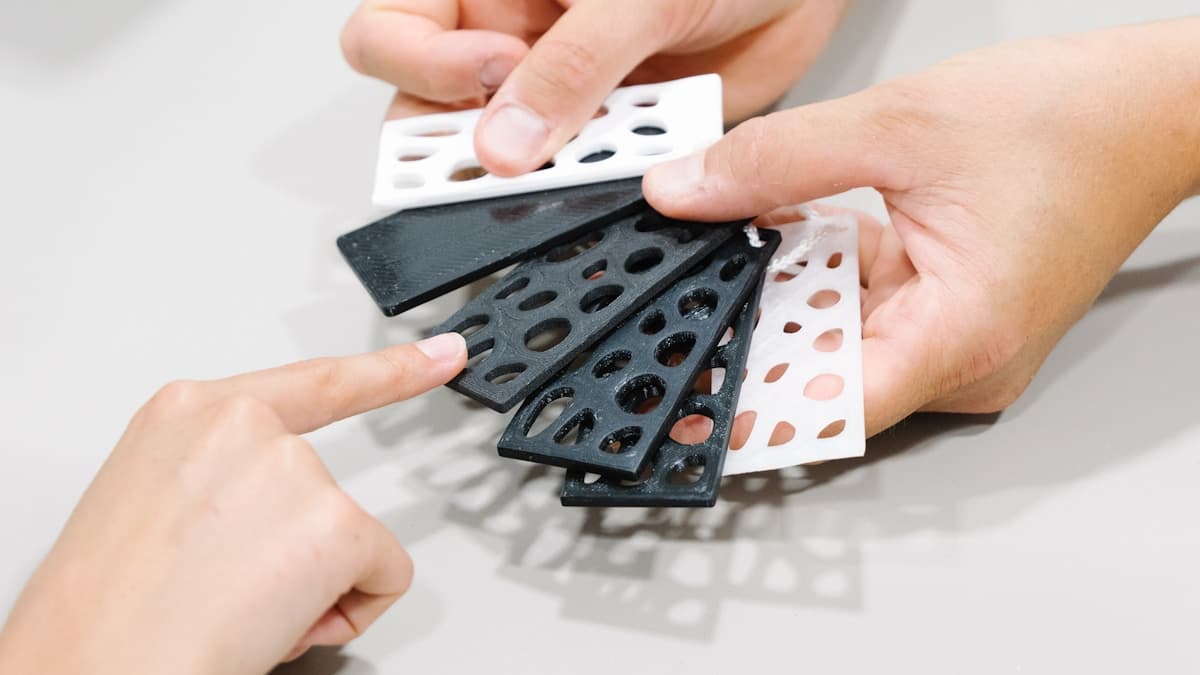
3D printing services for packaging prototypes get hired against a calendar, not a specification. A retailer line review, a trade show, a photoshoot or an investor meeting lands on a date, the structural design is still moving, and injection tooling is a twelve-week commitment nobody wants to make yet. Printing fills that gap — bottles, jars, closures, dispensers, trays, inserts and rigid cartons that you can hold, fill, photograph and hand to a buyer. What it does not do is behave like the production polymer, and knowing exactly where that line sits is most of what separates a useful mockup programme from an expensive one. Start with the 3D printing provider directory when you have geometry ready to quote.
Two Jobs That Look the Same and Aren't
Almost every packaging brief is really one of two requests, and quoting them as one is why the finish disappoints or the budget doubles.
Looks-like. The part exists to be seen. Shelf-impact studies, consumer research, retailer presentations, packaging photography, trade-show displays, awards submissions. What matters is surface, colour accuracy, clarity and the label sitting flat. Dimensional tolerance matters only where it shows.
Works-like. The part exists to be tested. Does the closure run onto the neck at the right torque, does the pump prime, does the trigger reach, does the tray hold the unit without rattling, does the carton close over the assembled product, does the hand grip actually feel right when full. What matters is dimensional accuracy and mechanical function; the part can be grey and ugly.
Ask for both in one part and you pay for a cosmetic finish on a part you are about to torque-test to destruction. Most well-run programmes split the build: a small number of finished cosmetic units, and a larger number of cheap functional ones. 3D printing services for product development covers the broader iteration loop this sits inside.
Process by Packaging Job
| Packaging job | Sensible route | Why |
|---|---|---|
| Cosmetic bottle, jar or closure under ~200 mm | SLA / DLP resin | Smoothest as-printed surface; least prep before paint or clear coat |
| Clear bottle or window simulation | SLA clear resin or PolyJet | The only routes that polish to convincing transparency |
| Multi-material — rigid body plus soft gasket or grip | PolyJet | Rigid and elastomeric materials, and graphics, in one build |
| Functional closures, pumps, snap fits, dispensing parts | MJF or SLS nylon | Tough, isotropic, no supports inside mechanisms |
| Rigid cartons, trays, inserts, large display packs | FDM or large-format printing | Cheapest route to size; nobody inspects an internal fit check |
| 25–200 identical show units | Vacuum casting from a printed master | Consistent finish across a set, far below tooling cost |
| A few hundred units, or production resin required | Rapid tooling | The point where a real mould is the cheaper answer |
Two notes buyers get wrong. Nylon from MJF or SLS is the right functional material but a poor cosmetic one — it is porous, it dyes rather than paints cleanly, and it will not pass as glass or PET without heavy filling and finishing. And a printed part in "PP-like" resin is not polypropylene: a printed living hinge will crack in a handful of cycles where a moulded PP hinge runs for thousands. Test the hinge concept on printed parts, prove the hinge on moulded ones.
Clarity and Cosmetic Finish Are the Real Work
On packaging, the print is usually the cheap half of the job. What the buyer is actually paying for is what happens after it.
- Clear parts. Printed clear resin comes out hazy. Transparency is produced by wet sanding through progressive grits, polishing and clear coating or dipping. A good finisher gets close enough for photography; it will still carry a faint cast and will yellow under UV over weeks.
- Colour. Brands specify Pantone, so ask for a sprayed and matched finish, not a tinted resin. A colour drawdown or a sprayed chip approved before the full set runs saves a reprint.
- Effects. Soft-touch, matte, high-gloss, pearlescent and vacuum-metallised finishes are all reproducible on a printed substrate, and metallised caps in particular photograph far better than a silver spray.
- Labels and decoration. Apply real pressure-sensitive labels or supply the artwork as a wrap. Where the decoration is integral, a full-colour PolyJet machine can print graphics directly onto the part.
- Weight. A printed bottle feels wrong in the hand because it is light. If the unit is going to a consumer panel, ask the shop to fill or ballast it to the target filled weight — it changes how people react more than any other single detail.
3D printing post-processing and finishing services covers the finishing chain in general, and it is worth reading before you agree a price, because a shop that quotes only machine time is quoting half the job.
What a Printed Mockup Cannot Tell You
Being explicit about this in the brief protects the programme.
- Transit and drop performance. ISTA and ASTM D4169 procedures test material behaviour. A printed part fails differently from PET or HDPE and its layer-wise anisotropy has no production equivalent. Use printed parts for the geometry around the test — nesting, location, closure of the shipper — and run the protocol on real material.
- Barrier and shelf life. Oxygen and moisture transmission are properties of the production resin and wall. A printed part says nothing about them.
- Product contact. Do not fill a mockup with the real formulation for anything beyond a quick visual. Photopolymers can carry unreacted monomer, paint and clear coat add unqualified layers, and layer lines are hard to clean.
- Long-term hinge, snap and fatigue life. Good for the first hundred cycles of feel, useless for the ten-thousandth.
- Wall thickness and moulding behaviour. A printed part will happily hold a 0.8 mm wall that would not fill or would sink in a mould. Have the moulder review the geometry in parallel — injection moulding versus 3D printing covers where the two diverge.
How Pricing Works
Quotes on packaging work vary more than in most categories, and it is nearly always the finishing that moves them.
- Size and volume drive the print. A 500 ml bottle printed hollow with a sensible wall is far cheaper than the same bottle printed solid. Say it is a mockup so it can be hollowed and drained.
- Finish level drives the total. A grey functional part, a primed and matched part, and a polished clear part with a metallised cap can be three very different prices from the same file.
- Quantity changes the process, not just the price. Ask for a quote at your quantity and one tier up; the shop will often tell you the crossover into casting or tooling without being asked.
- Speed is a real line item. Packaging deadlines are immovable, and every shop has a rush tier — same-day and rush 3D printing services covers what is realistically achievable when the date has already slipped.
How much does 3D printing cost covers the general model, and low-volume 3D printing services the economics of the 25–200 unit band where most packaging mockups sit.
How to Spec the Job
Send these and the first quote is a number rather than a conversation:
- The purpose, in the first line. "Twelve cosmetic units for a retailer line review on the 14th" and "three functional necks to check application torque" produce different builds, different materials and different prices.
- STEP geometry, plus a drawing calling out the neck finish by its standard designation — 24-410, 33-400 — and any dimension that must gauge.
- The finish, named. Pantone references, gloss level, effects, and whether labels are applied by you or by the shop.
- Which parts are printed and which are production. Pairing a printed neck with a stock closure gives a far more meaningful torque result than printing both.
- Quantity now and the likely follow-on. Twelve now and eighty in three weeks may change the recommendation to a cast set.
- The date, and what happens on it. A photoshoot booked for a Tuesday is a harder constraint than "end of the month", and shops schedule accordingly.
- An NDA before the first file moves. Unreleased packaging is one of the most leak-sensitive assets a brand owns — NDAs and IP protection with 3D printing services covers the agreement to have in place.
How to prepare files for a 3D printing quote covers the general submission, and design for 3D printing guidelines the geometry rules worth applying before you send.
Qualifying a Provider
Three questions sort a shortlist fast.
Show me clear parts you have finished. This is the single best filter in packaging work. Polishing photopolymer to convincing transparency is a craft skill that a machine list does not tell you anything about, and a shop that does it well will have photographs ready.
Do you paint and colour match in-house? Subcontracted finishing is common and not disqualifying, but it adds days to every iteration and it is where schedules quietly slip. If the deadline is tight, in-house spray is worth paying for.
Can you cast as well as print? A provider who can move you from printed masters to a silicone tool without changing supplier keeps the set consistent and saves a handover when the quantity grows. Tolerances and accuracy in 3D printing is the reference to have open when you discuss what they can actually hold on a neck.
Get Packaging Mockups Quoted
Decide first whether each part is being looked at or being tested, because that one answer sets the process, the material, the finishing bill and the schedule. Then send the STEP file, the neck finish, the Pantone references, the quantity and the date — and ask for printing and finishing to be priced as separate lines so you can see what you are really buying.
Browse 3D printing providers to find shops that take cosmetic packaging work, or start near the consumer-goods and personal-care clusters: New Jersey providers for cosmetics and pharmaceutical packaging, Ohio providers for consumer goods and rigid packaging converters, or Illinois providers for the Chicago food and beverage base. Ask two or three — the shop that asks what the mockup is for before quoting is usually the one to use.
Related Resources
- 3D Printing Services for Product Development — the iteration loop packaging work sits inside
- 3D Printing Services for Retail Displays and Signage — the in-store half of the same programme
- PolyJet 3D Printing Services — multi-material, clear and full-colour mockups
- Rapid Tooling Services — the bridge from mockup to pilot run
- Injection Molding vs 3D Printing — where the crossover actually falls
- SLA vs FDM Printing Explained — why cosmetic parts come off a resin machine
- Browse 3D Printing Providers — send the job out
Hero photo by Tom Claes.