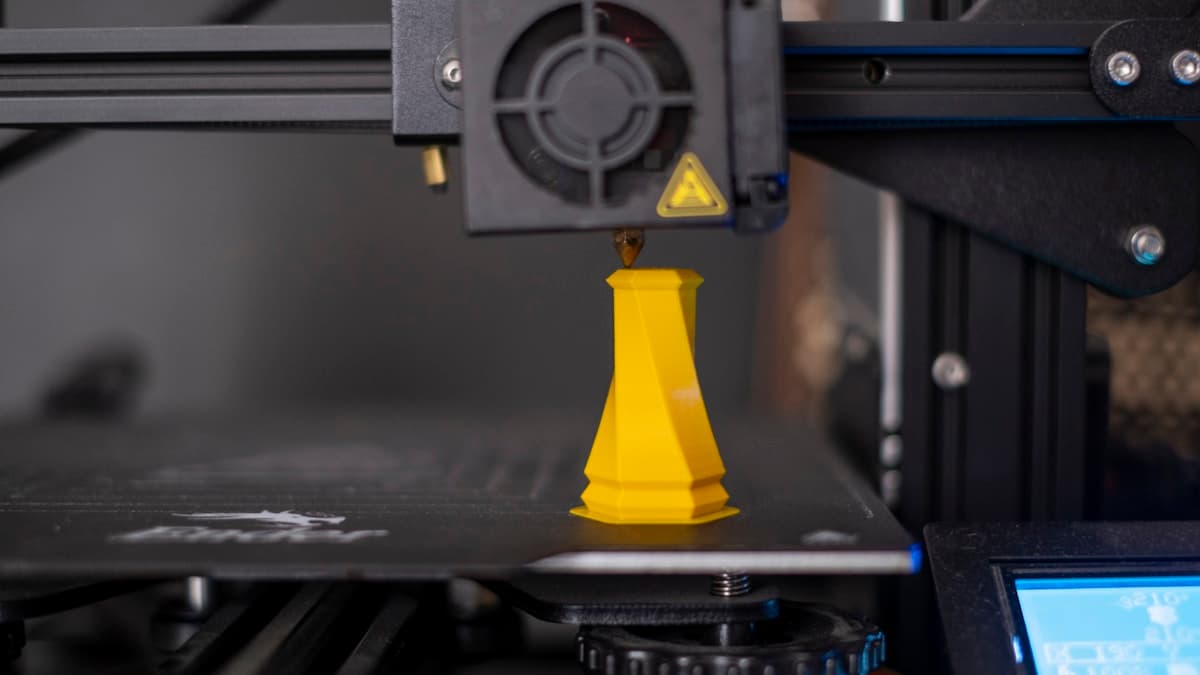
SLA and FDM are the two technologies you'll encounter in almost every 3D printing service catalog. Both are plastic-based additive manufacturing processes — but the similarity ends there. They use different physics, produce different part properties, and suit entirely different applications.
This guide breaks down the real differences, not the marketing version.
This post contains affiliate links. If you purchase through these links, 3D Prototyping Hub may earn a small commission at no extra cost to you.
This post also contains Amazon affiliate links. As an Amazon Associate I earn from qualifying purchases.
How Each Technology Works
FDM (Fused Deposition Modeling) builds parts by melting a plastic filament and depositing it layer by layer through a nozzle. Think of a hot glue gun on a precision gantry. Each layer bonds to the previous through heat. The result is an anisotropic part — stronger in the XY plane than in the Z direction. For teams evaluating in-house FDM capability, the Anycubic Kobra 3 Combo is a capable multi-material desktop option. The Bambu Lab ecosystem has also become widely adopted for prototyping teams that prioritize print speed and automatic calibration.
SLA (Stereolithography) uses a UV laser (or LCD/DLP light source in modern MSLA printers) to cure liquid resin into a solid. The build platform lifts out of a resin vat as each layer is cured from below. The result is an isotropic part — more uniform strength in all directions, but properties depend heavily on the resin chemistry. The Anycubic Photon-S is a widely-used desktop SLA option for prototyping, dental, and jewelry applications. The Anycubic Photon Mono is another popular MSLA resin option with strong community support and broad resin compatibility.
Surface Finish: SLA Wins Clearly
This is the least complicated comparison. SLA produces a significantly smoother surface finish than FDM.
FDM layer lines are visible to the naked eye. A 0.2mm layer height — typical for quality FDM prints — produces visible ridges on curved surfaces. Flat horizontal surfaces look fine; curved and angled surfaces show the stepping pattern. Smoothing is possible through sanding, acetone vapor smoothing (ABS only), or filler primer, but it adds time and cost.
SLA surfaces are near-smooth as-printed. The step height from each layer is typically 0.025–0.1mm — essentially invisible to the eye. Post-processing (washing in isopropyl alcohol, UV post-curing) is required but doesn't change surface quality significantly. A dedicated unit like the Anycubic Wash & Cure Max handles both steps in one station.
Use SLA when: the part will be seen, photographed, or evaluated aesthetically. Consumer product models, presentation prototypes, dental appliances, jewelry, display miniatures.
Use FDM when: the part's function matters more than its appearance. Jigs, fixtures, housings, structural brackets, concept-check prototypes.
Detail and Minimum Feature Size
SLA resolves features that FDM cannot physically produce.
A standard FDM nozzle is 0.4mm in diameter. This creates a physical floor on minimum wall thickness, embossed text size, pin diameter, and hole accuracy. Attempting features smaller than approximately 0.8mm in FDM typically results in failure or significant dimensional inaccuracy.
SLA's minimum feature is constrained by the laser spot size or LCD pixel pitch — typically 0.05–0.15mm on professional machines. This means:
- Lettering as small as 0.5mm point size resolves clearly
- Thin walls of 0.2mm are printable
- Interlocking features with 0.1mm clearance are achievable
For miniatures, dental models, jewelry, PCB enclosures with fine ribs, or any application where small features matter: SLA. For demanding detail work, Chitu Sculpt Resin is formulated specifically for fine-feature applications where surface sharpness and edge definition are critical.
Mechanical Properties: It Depends on the Resin vs. Filament
People often say FDM is stronger than SLA. This is true for standard materials — standard PLA or PETG vs. standard general-purpose resin — but misleading as a general rule.
| Property |
FDM (PETG) |
SLA (Standard Resin) |
SLA (Tough Resin) |
| Tensile Strength |
~50 MPa |
~55 MPa |
~45–65 MPa |
| Impact Resistance |
Good |
Brittle |
Moderate |
| Elongation at Break |
~50% |
~6% |
~20–40% |
| Flexural Modulus |
~1.9 GPa |
~2.8 GPa |
~2.0–2.8 GPa |
Standard SLA resin is brittle. It will crack under impact loads where FDM in PETG or Nylon would deform and absorb the energy. If you drop a standard SLA part on a hard floor, it may shatter. The equivalent FDM part typically survives.
However, engineering resins — tough, ABS-like, flexible, and high-temp variants — close most of these gaps. The catch is cost: engineering resins cost 3–5× more than standard resin, and service bureaus charge accordingly.
For structural parts, living hinges, snap fits, or anything subjected to impact: FDM in PETG or Nylon. For stiff, dimensionally accurate parts with fine detail: SLA in engineering resin.
Material Options
FDM material library (widely available):
PLA, ABS, PETG, ASA, TPU/TPE, Nylon (PA6, PA12), Polycarbonate, HIPS, PVA (support), carbon-fiber-filled variants of most of the above.
SLA material library:
Standard resin, tough resin, ABS-like resin, flexible resin, high-temp resin, ceramic-filled resin, castable wax resin (for jewelry investment casting), dental-specific resins (biocompatible Class I–IIa).
FDM wins on raw material variety. SLA wins on specialized, application-specific formulations — especially in dental, medical, and casting workflows.
Speed and Cost
For large, simple parts: FDM is faster and cheaper. A 4"×4"×4" solid block in FDM takes 4–8 hours at standard quality. The equivalent SLA part might take 8–16 hours and cost 2–3× more in resin.
For small, complex, detailed parts: the difference narrows. SLA can print many small parts in a single build at high detail simultaneously. Per-part cost on small complex geometries is often competitive with FDM.
Cost rule of thumb:
- FDM: $2–8 per cubic inch depending on material and infill
- SLA standard resin: $5–15 per cubic inch
- SLA engineering resin: $15–40 per cubic inch
Quick Decision Guide
| Application |
Recommended Technology |
| Concept prototype (form check only) |
FDM |
| Functional prototype (mechanical testing) |
FDM (Nylon or PETG) |
| Display model / presentation prototype |
SLA |
| Consumer product visual model |
SLA |
| Dental model / surgical guide |
SLA (dental resin) |
| Jewelry pattern (investment casting) |
SLA (castable resin) |
| Jigs, fixtures, tooling |
FDM (PETG or Nylon) |
| Parts with fine text / embossing |
SLA |
| Large structural parts |
FDM |
| High-temp functional parts |
FDM (PC or ABS) or SLA (high-temp resin) |
Getting Quotes for Both
When sourcing a part where the technology isn't obvious, request quotes for both FDM and SLA. Most service bureaus offer both, and having side-by-side quotes on the same geometry makes the trade-off concrete.
You can browse providers in the 3D Prototyping Hub directory filtered by technology to find services that specialize in exactly the process you need, whether that's FDM for functional parts or SLA for high-detail models.
If your team runs FDM parts frequently enough that in-house ownership makes sense, desktop machines from Flashforge — including the Adventurer 5M — produce engineering-quality FDM parts starting around $400. SLA is harder to replicate at that price point with consistent results, making service bureaus the better call for most SLA work.
Which Should You Buy?
Hero photo by Osman Talha Dikyar via Unsplash.
Ready to find a 3D printing service provider?
Browse 2,000+ verified providers across the United States and submit your quote request free.
Browse Providers