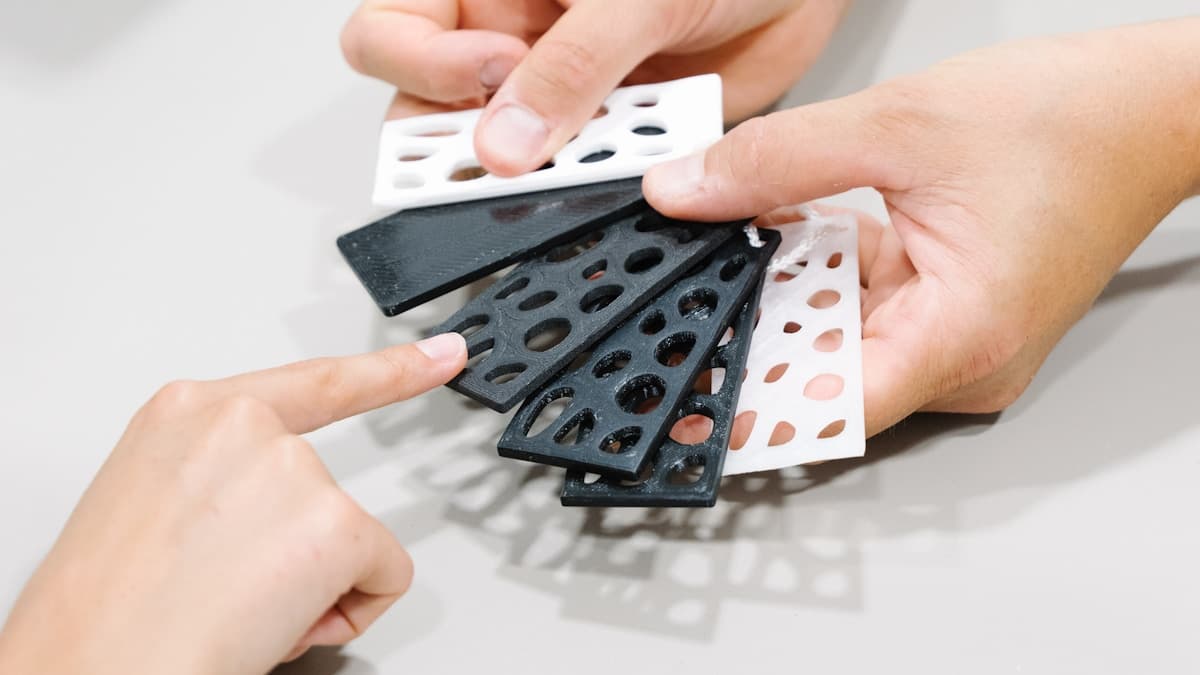
3D printing services for EV and battery parts are bought by a narrower set of people than the phrase suggests. Very little of a production electric vehicle is printed. What is printed, in real volume, is the scaffolding around the cells — holders, spacers, insulating covers, harness routing, sensor mounts, duct prototypes and the fixtures used to build the pack. If you are a conversion shop, a motorsport or marine pack builder, a stationary-storage integrator or an engineer prototyping a module before tooling, that scaffolding is most of your parts list and almost none of it is in a catalogue. This guide covers which of those jobs suit a printing service, which materials survive what is actually present inside a pack, where the hard line sits, and what to send so the first quote is real. When you are ready, start with the 3D printing provider directory.
The Parts Worth Printing
Sort the job list by whether electricity goes through the part. It is a more useful axis than size or material.
| Part | Typical process | Why it prints well |
|---|---|---|
| Cell holders and spacers (18650, 21700, prismatic) | Sintered nylon (SLS / MJF) | Sparse lattice, dozens of identical parts, no support scars |
| Busbar covers, terminal shrouds, insulating barriers | Sintered nylon or flame-retardant PC | Geometry is specific to your layout; nobody sells it |
| Module end plates, BMS mounts, brackets | Filament (ASA, PC, PA-CF) or sintered nylon | Low count, loaded but not structural |
| Harness clips, grommets, strain reliefs, routing | Filament; TPU where it has to flex | Dozens of small bespoke shapes |
| Cooling duct and shroud prototypes | Filament, large format | Fit checking before sheet metal or moulding |
| Build fixtures: welding jigs, cell-insert tools, gauges | Filament | Shop-floor tooling, replaced freely |
The last row is often where the money is. A pack built by hand lives or dies on its spot-welding fixture, and that fixture is a one-off by definition — 3D printing services for jigs, fixtures and manufacturing aids covers that class of work on its own terms. Everything above the line is ordinary functional-parts work; functional and end-use 3D printed parts sets out what qualifies a printed part for service.
Carbon Fiber Filled Plastic Conducts
This is the one specification error that turns a good part into a hazard, and it is easy to make because it arrives as a helpful suggestion.
Chopped carbon fiber filled nylon is the default stiff engineering material in most print shops. It is stiffer than unfilled nylon, warps less, and looks like the obvious upgrade on a quote. It is also electrically conductive, which disqualifies it from every part whose job is to insulate: busbar covers, terminal shrouds, cell holders, barriers between modules, anything that could bridge a gap if it shifted. Specify unfilled or glass-filled grades for insulating parts, and write it on the order — if you leave the material open, carbon fiber filled is what a shop will propose for a stiff bracket near a pack. Keep it for genuinely structural, genuinely isolated parts like a motor mount or a jig, where carbon fiber 3D printing services is exactly the right call.
The related point is surface rather than bulk. High-voltage design works to creepage and clearance distances — the path across a surface and the gap through air between conductors, coordinated under IEC 60664-1. A printed surface is not smooth; layer grooves collect conductive dust and moisture in a way a moulded surface does not. If your part sets a creepage distance, that is a design review item, not a printing question.
Heat, And Which Heat You Mean
Three different temperatures get confused in the same conversation, and only one of them is a material-selection problem.
Ambient service temperature is the real constraint. A pack in a vehicle parked in summer sun sees cabin and underbody temperatures well above what people assume, and charging adds its own rise. PLA softens around 60 °C and has no business in a pack. Thermal runaway is the third temperature, measured in hundreds of degrees, and no polymer is a defence against it — if your safety case depends on a printed part surviving a cell venting, the safety case is wrong, not the material.
| Material | Where it belongs | What to watch |
|---|---|---|
| PA12 (SLS / MJF) | Cell holders, internal brackets, covers | Tough, no supports, good insulator; absorbs moisture over time |
| ASA | Parts near a charger or under the hood; anything in daylight | Holds up under UV where ABS yellows |
| Polycarbonate | Hot zones, impact-exposed covers | High usable temperature; demanding to print well |
| PA-CF, PC-CF | Motor mounts, jigs, stiff isolated brackets | Conductive — never as an insulator |
| TPU | Grommets, pads, anti-vibration mounts | Compliant; see flexible and TPU 3D printing services |
| PEI / ULTEM 9085 | Where a flame and smoke rating is genuinely required | Several times the cost, and few shops run it |
| PLA | Mock-ups on a bench, nothing else | Softens around 60 °C |
How to choose a 3D printing material covers the wider trade space, and high-temperature 3D printing services covers the grades above polycarbonate if you have a genuinely hot location.
One mechanical note that catches pack builders specifically: printed polymers creep under sustained load. A cell compression fixture that holds prismatic or pouch cells at a set pressure will relax over months if the printed part is the spring. Use metal or a designed-in spring element and let the printed part locate rather than clamp.
A Material Rating Is Not a Part Rating
A UL 94 V-0 rating belongs to a tested specimen — a stated material, in a stated colour, at a stated thickness, produced a stated way. A printed part made from flame-retardant feedstock is anisotropic, contains voids between beads or partially fused powder, and is frequently thinner in places than the bar that was tested. The rating does not transfer to your part automatically.
That does not make flame-retardant grades pointless; it makes them the beginning of a process. If a rating must hold on the finished component, the finished component gets tested as built, and the provider should raise this before you do. The same reasoning applies to any certification claim attached to a printed part — 3D printing service certifications covers what a shop's own accreditations do and do not cover, which is the question underneath this one.
What to Send So the First Quote Is Real
EV and battery jobs stall on information nobody thinks to include.
- The actual cells. Brand and wrap, not just "21700". The wrap thickness is the dimension a holder fits to, and it varies between suppliers.
- The maximum temperature the part sees, and whether that is ambient, charging or next to a specific component.
- Whether the part is inside the high-voltage zone. This changes material, finish and whether the job should be printed at all.
- The flame requirement, if there is one, and who is going to accept it.
- Clamp loads and bolt torques. A printed boss has a torque limit; say what you intend to apply and ask for heat-set inserts.
- How many, and when the second batch lands. Quantity changes the process recommendation outright — forty cell holders nest into one sintered build, four do not.
Tolerances and accuracy in 3D printing sets realistic expectations for a part that cells have to drop into, and why 3D printed parts fail when you scale them up is worth reading before you take a working prototype holder straight to a 14S14P pack. If the design is commercially sensitive — and pack layouts usually are — 3D printing services and NDA / IP protection covers how to handle that before files go out.
What Separates a Good Provider Here
A shop that has done battery work asks what voltage the pack runs at before it asks for a file. It volunteers that carbon fiber filled nylon is conductive instead of quoting it as an upgrade. It can produce a material datasheet and a lot number rather than "nylon". It offers one cell holder before forty. And it says plainly when a part should not be printed, which is the most useful thing a provider can tell you.
Send the same drawing and the same questions to three shops and compare the replies, not just the prices. How to choose a 3D printing service covers the general criteria; the battery-specific one is whether they raise the conductivity and flame-rating questions unprompted.
Where the Line Is
- Fine: cell holders and spacers, insulating covers and shrouds, brackets, harness clips and routing, sensor and BMS mounts, duct and shroud prototypes, service and assembly tooling, enclosure mock-ups before tooling.
- Not fine: anything in the high-voltage current path, any structural member in a crash load path, anything relied on as a certified flame or shock barrier, and anything inside a certified assembly you intend to keep certified.
Cooling plates and conformal fluid passages are a separate conversation — they are a metal job rather than a polymer one, and metal 3D printing services covers what that costs and what it buys. For the non-electrified parts of the same vehicle, 3D printing services for automotive parts is the closer fit.
Get Your EV or Battery Part Quoted
Settle four things before asking for a price: whether the part is in the high-voltage zone, the maximum temperature it sees, whether a flame rating has to hold on the finished part, and how many you need now versus later. Every line on the quote follows from those answers.
Browse 3D printing providers and favour shops that ask about voltage and material grade before they ask for your file. Order one part first — on a pack of forty identical holders, a single sample costs almost nothing and settles every fit question at once.
Related Resources
- 3D Printing Services for Automotive Parts — the non-electrified side of the same vehicle
- 3D Printing Services for Electronics Enclosures — BMS, charger and controller housings
- 3D Printing Services for Wind and Solar Energy Parts — the stationary-storage neighbour
- 3D Printing Services for Drone and UAV Parts — lightweight packs and the same insulation problems in miniature
- Low-Volume 3D Printing Services — where a run of forty stops being prototyping
- Carbon Fiber 3D Printing Services — when the conductive material is the right one
- How Much Does 3D Printing Cost — the general shape of a quote
- Browse 3D Printing Providers — send the job out
Hero photo by Tom Claes.