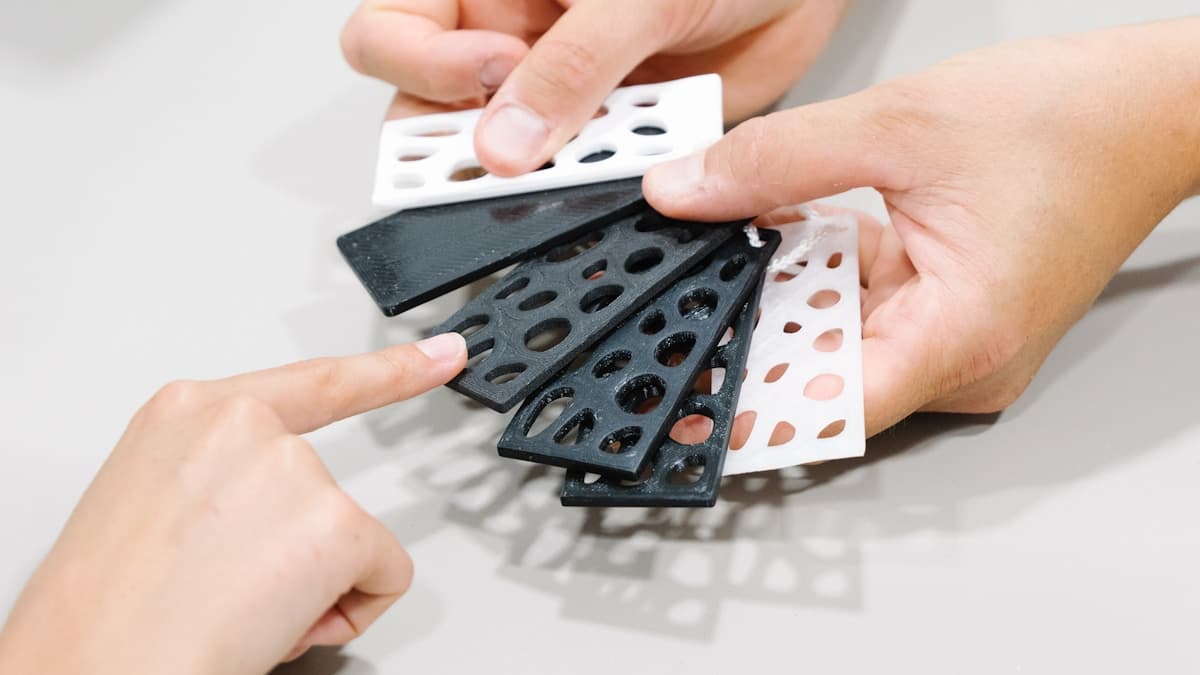
3D printing services for automotive parts cover far more ground than the prototype dashboard everyone pictures. The jobs that actually come through a print bureau's door are brackets, ducting, sensor mounts, interior bezels, restoration trim for cars nobody tools for any more, and the line-side jigs that hold a body panel while somebody bonds it. What they share is low quantity and a need for the part next week rather than next quarter. This guide covers which of those jobs additive genuinely suits, which ones it does not, how to pick a material for where the part lives, and what to send a shop so the first quote is the real one. Browse the 3D printing provider directory when you are ready to put the job out.
What Automotive Shops Actually Print
Sort the work into four groups and the process choice mostly makes itself.
Development and fit-check parts. Bezels, housings, ducting, intake and airbox mock-ups, mirror and camera mounts. These exist to answer a fitment question before tooling is cut, and they are the classic additive job — one or two off, iterated in days.
Functional parts that go on the vehicle. Wiring-harness clips, sensor and ECU brackets, splash shields, cable guides, blanking plates, brake-cooling ducts. Non-structural, but they live in a real environment and need a real material.
Restoration and obsolete parts. Dash bezels, vent louvres, interior clips, badge surrounds, switch housings — parts for vehicles whose tooling was scrapped decades ago. Quantity one, no drawing, and an original that is cracked but measurable.
Line-side and workshop hardware. Assembly jigs, checking fixtures, torque-tool guides, trim-protection covers, tool trays. This is the least glamorous group and often the highest return, because a fixture that saves five seconds a unit pays for itself in a week. Jigs, fixtures and manufacturing aids covers that case in detail.
Motorsport sits across all four and simply compresses the timescale: one-off ducting, aero test sections, button housings and instrument panels, printed on Tuesday because the car runs on Saturday.
Where 3D Printing Is the Wrong Answer
Worth saying plainly, because the enthusiasm around automotive additive tends to skip it.
Do not print parts in a load path that keeps the car on the road or the occupants in it. Suspension arms, steering components, brake system parts, wheel hardware, seat frames and seatbelt anchorages all belong to machining, casting or forging. The reason is not that additive plastics are weak — some are impressively strong — but that they are anisotropic: a printed part is measurably weaker along the build axis than across it, and its fatigue behaviour under vibration is far harder to predict than a wrought equivalent. That is a bad combination for a component whose failure mode is a crash.
Anything carrying a homologation, type-approval or emissions requirement is also off the table unless your provider is running a qualified production process with documentation to match. And if a part is simply a solid metal lump, CNC machining will usually be cheaper and better than printing it.
Choose the Material From Where the Part Lives
The single most common automotive misorder is a part specified by appearance and destroyed by temperature. A dark dashboard behind glass on a hot day comfortably exceeds 60 °C; an engine bay commonly runs 80–120 °C ambient and much higher next to a turbo or exhaust. Match the material to that first.
| Where the part lives | Sensible materials | What kills the wrong choice |
|---|---|---|
| Cabin interior, cosmetic | PA12 (SLS/MJF), ABS, ASA, resin for appearance only | PLA deforms on a sunlit dash; resin yellows and embrittles under UV |
| Engine bay, moderate heat | ABS, ASA, polycarbonate, PA12 | PLA and PETG soften and creep under sustained heat |
| Engine bay, high heat and stiffness | PC, carbon-fibre-filled nylon, PPS, PEEK, PEI | Unfilled commodity plastics lose stiffness long before they melt |
| Exterior, UV and weather exposed | ASA, painted PA12 | ABS chalks and fades outdoors; ASA is the UV-stable version of it |
| Fuel, oil or coolant contact | Nylon grades, PPS, PEEK | Polycarbonate is prone to stress cracking against hydrocarbons; nylon absorbs moisture and moves dimensionally |
Published heat-deflection figures vary widely by grade and by how a part is annealed, so treat the table as a shortlist and confirm against your provider's datasheet for the exact filament or powder they run. How to choose a 3D printing material goes deeper on the trade-offs.
Processes and When Each Fits
| Process | Typical automotive job | Why it wins here |
|---|---|---|
| FDM | Brackets, ducting, line-side jigs, large mock-ups | Cheapest route to real engineering thermoplastics, and the only one that scales to large parts affordably |
| Resin / SLA | Bezels, lens and lamp housings, fit-check masters | Smoothest surface and finest detail straight off the machine |
| SLS nylon | Interior trim, clips, complex ducting, short runs | Tough PA12, no supports to scar the surface, even matte finish that takes dye |
| MJF | The same parts at higher quantities | Consistent part-to-part properties across tens or hundreds |
| Metal AM | Manifolds, turbo housings, motorsport uprights | The only additive route to a genuine metal part; expect cost and lead time to match |
| Cast urethane | 20–200 cosmetic or elastomeric parts | Soft tooling bridges the gap before injection moulding is justified |
For stiff, light brackets specifically, carbon fibre 3D printing is worth pricing against aluminium — it is often the better answer for a mount that must not resonate.
What Drives the Quote
Machine time dominates, not material. The levers that move an automotive quote most:
- Layer height. Halving it roughly doubles print time. Ask for a coarse layer on faces nobody sees.
- Support material. On ducting and overhung brackets this can rival the part volume, and you pay to print it and to remove it.
- Nesting and quantity. Ten brackets on one build plate cost very differently from ten separate jobs. Batch your parts.
- Finishing labour. Sanding, filling and paint-prep on a cosmetic part is frequently the largest single line. Say clearly whether the part is as-printed, paint-ready or painted.
- Material grade. PA-CF, PPS and PEEK carry both a material premium and a machine premium, because far fewer shops can run them.
- Documentation. First-article inspection reports and material certificates are chargeable time.
How much 3D printing costs breaks the general pricing model down further.
How to Spec the Job
Send this and you will get a quote you can act on rather than a range:
- STEP, not just STL. If a wall needs thickening for heat or load, the shop can only do it to solid geometry.
- The operating environment — peak temperature, fluids, UV, vibration. This is the field buyers omit most often and the one that decides the material.
- How the part is loaded, and where it would break if it broke. Orientation is an engineering decision; a bracket printed flat can be several times stronger than the same bracket printed upright.
- Critical dimensions and datums, flagged individually. Everything else can be general tolerance. See tolerances and accuracy for what is realistic.
- Fastener strategy. Heat-set threaded inserts beat printed threads in almost every automotive application. Design the boss for the insert.
- Fitment allowance. Vehicle sheet metal moves. Slotted holes and a little clearance save a reprint.
- Quantity now and likely quantity later. One today with fifty next year is a different engineering brief than one and done.
Qualifying a Provider
Ask these four questions and the shortlist sorts itself:
Which of this is in-house? Many shops broker powder-bed and metal work to a partner. That is normal, but it changes lead time and who owns a fault.
What quality system do you hold? ISO 9001 is the sensible baseline. If parts are heading anywhere near series production, IATF 16949 is the automotive standard and very few print bureaus carry it — better to know before the programme depends on it.
Can you supply material traceability and a dimensional report? For a mock-up, no. For a part going on a customer vehicle, insist.
What DFM feedback will you give? The best answer to "print this bracket" is often a note about orientation, a wall thickness, or a suggestion to change material. A shop that quotes without comment on a part destined for an engine bay has not looked at it. How to choose a 3D printing service covers the wider qualification checklist.
Restoration and Obsolete Parts
The strongest single automotive case for additive is the part you simply cannot buy. Trim clips, vent louvres, switch surrounds and bezels for vehicles whose tooling was scrapped decades ago all share the same profile: quantity one, no drawing, and an original that is cracked but still measurable.
The route is scan, model, print. A provider 3D-scans the original, rebuilds it as parametric CAD — which is where cracks and warping get corrected rather than faithfully reproduced — and prints it in a material suited to the location. 3D scanning for custom automotive parts covers that first stage, and 3D printed replacement and spare parts covers the broader case. Ask for the CAD as a deliverable: once the model exists, the next set costs printing time alone.
Get Automotive Parts Quoted
Decide first which of the four groups your part belongs to, because that fixes the process and the material before anyone talks price. Then send STEP geometry, the operating temperature, the load path and the quantity — those four things turn a vague enquiry into a firm number.
Browse 3D printing providers to find shops that take automotive work, or start with Michigan providers if you want a supplier inside the Detroit supply base. Ask two or three: the spread in what they ask you about the part's environment tells you more about capability than the spread in their prices does.
Related Resources
- 3D Scanning Services for Custom Automotive Parts — the reverse-engineering front end
- Functional and End-Use 3D Printed Parts — when a printed part stops being a prototype
- Carbon Fiber 3D Printing Services — stiff, light brackets and mounts
- Low-Volume 3D Printing Services — the twenty-to-two-hundred bracket
- Large-Format 3D Printing Services — bumpers, panels and aero sections
- 3D Printing Services in Michigan — the Detroit-area supply base
- Browse 3D Printing Providers — send the job out
Hero photo by Tom Claes via Unsplash.