Looking for 3D printing services in Albany? The 3D Prototyping Hub directory lists 8 providers with Albany addresses — fifth in New York behind Buffalo, New York City, Rochester and Brooklyn — and the shortest route to a quote is the Albany provider directory. Pull the list up, qualify two or three by trade rather than by keyword, and send your file only to the ones that actually run the process your part needs.
That qualifying step carries more weight here than anywhere else in the state, because not one of Albany's eight listings records what it prints. This guide covers what those eight are really made of, what the Capital Region's economy means for the work you can get done well, and where the region's published capability actually sits — which, as it turns out, is mostly outside the city line.
Where New York's Listed Capacity Sits
| City | Listed providers | Directory page |
|---|---|---|
| Buffalo | 18 | /providers/location/ny/buffalo |
| New York | 12 | /providers/location/ny/new-york |
| Rochester | 11 | /providers/location/ny/rochester |
| Brooklyn | 9 | /providers/location/ny/brooklyn |
| Albany | 8 | /providers/location/ny/albany |
| Rest of New York | 28 | /providers/location/ny |
Albany holds 8 of New York's 86 listings. The upstate share of that table is the part worth noticing — Buffalo, Rochester and Albany together out-list the five boroughs — and the New York state guide covers the wider picture. Rochester and Buffalo are the deeper upstate markets if the Capital Region comes up short.
Now the number that should change how you use this page: 0 of Albany's 8 listings publish a service list. Statewide, 39 of 86 do, and in Brooklyn it is 7 of 9. Albany and Buffalo are the two quiet ones. No New York listing is a claimed, vendor-maintained profile either, so nothing here is kept current by the shop itself. In this market, capability comes from the call — treat the directory as a phone list with addresses attached, which is a genuinely useful thing to have and not the same thing as a capability database.
Read the Listings Before You Dial
The trade names are legible, and they tell you which of four quite different conversations you are about to have:
- Five of the eight trade under a printing, reprographics or packaging name — commercial print and document businesses, at least one of them a regional chain with an Albany branch. Some of these genuinely run a machine; for others, "printing" means ink. One question settles it.
- One reads as a dedicated 3D design and printing operation.
- One is a community makerspace. That is a different offer, not a worse one: a makerspace usually sells access, training and bench time rather than a finished part, which is excellent if you want to learn and print it yourself and the wrong door if you need a vendor, an invoice and a delivery date.
- One is a ceramic additive manufacturing technology company — a specialist in a process most people never need, whose business is machines and high-value technical ceramics rather than quoting a bracket. Do not call it for a prototype housing.
There is a detail in the contact numbers worth a moment. Seven of the eight carry local 518 numbers and one carries a 929 — a New York City area code. Two of the eight also share a single 518-244 exchange. None of that is suspicious; numbers port, organisations are headquartered in one place and listed in another, and the Capital Region runs across municipal lines that nobody local thinks about. It is a reason to ask the obvious question early: where does the machine physically sit, and how do I get the part? If the answer is a courier, that may still be your best quote — you just want to know before you plan a same-day collection around it.
For the rest of that conversation, our guide to choosing a 3D printing service is the full qualifying checklist.
What the Capital Region's Economy Changes
Albany is not an industrial city in the way Buffalo and Rochester are, and the work that flows from its economy has a distinct shape.
State government and institutions. This is the state capital, and a large share of local demand is presentation and communication work rather than production: exhibit pieces, scale and massing models, demonstration hardware, replacement parts for display and facility equipment. Public-sector buying also brings paperwork — purchase orders, insurance, sometimes a bid process — so ask early whether a shop has invoiced an agency or a university before, because the ones that have will not be surprised by yours.
Semiconductor and nanotech research. The Albany NanoTech complex and the wider Tech Valley cluster, plus the chip-fab investment north of the city in Saratoga County, create a steady flow of fixtures, wafer- and tool-handling aids, enclosures and test hardware. Much of this is made in-house or by specialist suppliers under agreement, and nearly all of it is confidential — see NDA and IP protection for 3D printing services for what to put in writing before you upload anything.
Universities and medicine. The engineering school across the river in Troy, the state university, the colleges in Schenectady and the region's teaching hospital make research fixtures, anatomical models and student project work ordinary requests here rather than exotic ones. 3D printing for schools and universities covers how those jobs are usually specified and funded.
Legacy heavy engineering and defense. The region's turbine, power-equipment and ordnance engineering heritage still shapes the parts that appear: guards, handles, bushings, cover plates and feed components for machinery that is decades old and unsupported. Those jobs usually start with measurement rather than CAD, which is the path 3D scanning for reverse engineering describes, and anything touching a defense programme carries its own specification and handling rules.
Manufacturing support work. Underneath all of it sits the steadiest additive demand in any region with a factory floor: jigs, fixtures and manufacturing aids, usually a low-volume job rather than a prototyping one, and exactly what a competent local FDM shop does well and cheaply.
Processes, and When Each Is the Right Call
| Process | Best for | Trade-off |
|---|---|---|
| FDM | Functional prototypes, jigs and fixtures, brackets, large parts, PETG or ASA for anything living outdoors | Visible layer lines; fine detail limited by nozzle size |
| Resin (SLA/DLP) | High-detail models, small parts with fine features, smooth surfaces, casting patterns | Higher cost per part; most resins stay brittle and go on curing under UV |
| SLS / MJF nylon | Durable end-use parts, living hinges, complex geometry that would need heavy support in FDM | Higher minimum cost; grainy surface unless finished |
| Metal | Load-bearing and high-temperature parts | Treat as a specialist or brokered job, not a walk-in service |
Most Capital Region jobs are FDM jobs, and most people who ask for resin actually want a surface finish rather than a process — SLA vs FDM printing explained works that decision through on a real part. If your part genuinely needs metal, read metal 3D printing services before you call anyone, because the specification conversation is different.
Spec It for Upstate New York, Not Just the Drawing
Three habits save money and a week of back-and-forth in this market.
Describe where the part will live before anyone quotes it. PLA is the default spool in every small shop and it is the wrong answer twice over up here: it creeps and softens in a car parked in July, and it is the most brittle common filament in a January cold snap — which is how snowblower brackets, trailer fittings and outdoor mounts break. Ask for PETG as the outdoor default, ASA where sunlight is constant, and nylon or a glass-filled grade where load matters. Road salt is worth mentioning too, because it rules out some metal inserts and fasteners you might otherwise specify. How to choose a 3D printing material has the comparison.
Name the critical dimension with a number and a direction. In a pool where nobody publishes a capability list, the fastest way to sort candidates is to ask what they measure before shipping and what they measure it with. Tolerances and accuracy in 3D printing sets out what each process can realistically hold, so you can tell a confident answer from a hopeful one.
Send a file the shop can open, and say which one is authoritative. An STL for a part with tight fits and no dimensions is the most common reason a quote stalls — STL vs STEP files explains which to send and when.
Widening the Search Beyond the City Line
Here is the useful asymmetry in this region: the city listings are silent about capability, and the small-town ones are not. Within about an hour of downtown Albany, four nearby listings publish exactly what they run.
- Saratoga Springs — about half an hour north, one listing, and the only one in the region advertising metal alongside FDM and resin.
- Chatham — roughly half an hour southeast, two listings, one of them publishing FDM, resin and SLS/MJF nylon, the other resin.
- Middleburgh — under an hour southwest, one listing publishing FDM, resin and nylon powder.
- Amsterdam — about forty minutes northwest on the Thruway, one listing publishing resin.
Single-listing towns never surface in a city search, which is why a buyer who only looks at Albany concludes the region is thin when it is mostly just quiet. Beyond the Capital Region, there is a dedicated bureau with a full process spread near Syracuse, and the New York provider directory is the fastest way to see all 86 listings at once.
Decide which kind of job you are running before you widen. If the file is settled and the tolerances are ordinary, distance is a shipping cost and nothing more — online vs local 3D printing services covers that trade honestly. If you expect three revisions and a conversation about each one, keep it close enough to drive.
Start Here
Browse the Albany provider directory, qualify two or three by trade, and send the same file with the same brief to each. If the city pool is thin for your part, widen to Saratoga Springs and Chatham, then the New York provider directory, then the full provider directory.
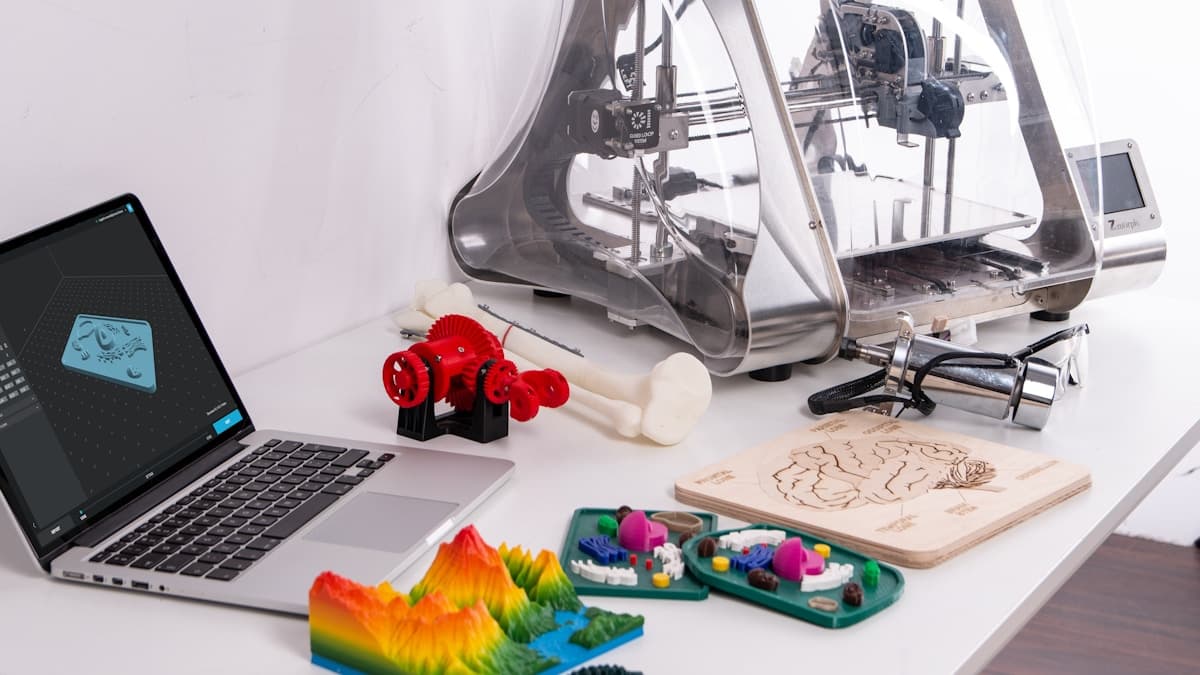
Hero image: a multitool desktop FDM machine beside CAD, with a desk of printed demonstration parts. Photographer ZMorph All-in-One 3D Printers.