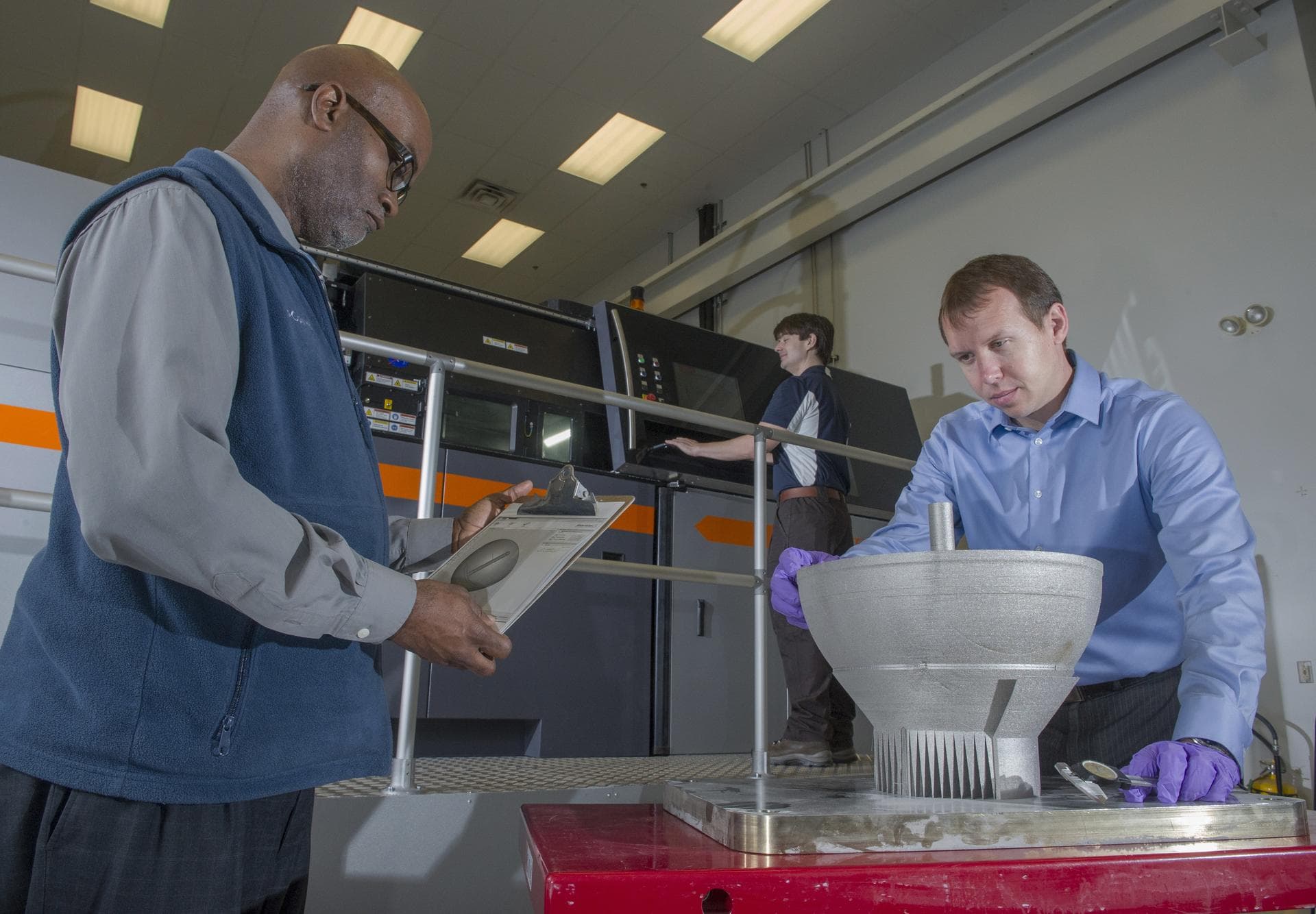
3D printing services for defense and military parts exist because defense platforms outlive their supply chains by decades. A ground vehicle fielded in 1994 is still in service, the injection moulder that made its interior switch panel closed in 2006, and the national stock number now returns a backorder with no promised date. Nobody will cut a new tool for sixty pieces. Meanwhile the vehicle is deadlined, which costs more per day than the part ever did. This guide covers what defense programs, depots and their subcontractors realistically print, the export-control and data-handling questions that pick the provider before price does, and what to send a shop to get an accurate quote. When you have the failed part in hand, start with the 3D printing provider directory.
What Defense Programs Actually Print
Five groups cover most commercially printed defense work, and knowing which one a part belongs to settles process, material and approval path before anyone discusses money.
Obsolete and diminishing-source spares. The DMSMS problem in physical form: knobs, bezels, escutcheons, cable clamps, connector backshells and covers, ducting adapters, blanking plates, interior trim and latches for platforms whose original suppliers no longer exist. This is the highest-volume category and the easiest business case, because the alternative is a minimum order of five hundred from a tooling quote.
Ground-support and shop tooling. Alignment and drilling jigs, go/no-go wear gauges, protective caps for machined surfaces in transit, lifting and handling cradles, test-set adapters, calibration fixtures, ergonomic aids for awkward maintenance access. None of it goes on a platform, so none of it carries the qualification burden, and it is the fastest way for a depot or shop to prove the workflow internally — the same case made in jigs, fixtures and manufacturing aids.
Training aids and mock-ups. Inert trainers, cutaway models, fit-check masters, classroom articles and instrumentation dummies. Fidelity matters, certification generally does not, and turnaround is usually the whole requirement.
Retrofit and integration bracketry. The mounts that exist only because a specific radio, camera, counter-IED antenna, display or sensor was fitted to a specific vehicle or shelter. Quantity is one per platform, the design changes after the pilot installation, and that is exactly the low-volume production profile printing serves best.
Obsolete metal fittings. Bracket bodies, housings, manifolds, linkage covers and tooling inserts originally cast or machined at quantities no foundry will quote again. Metal 3D printing produces these in stainless, aluminium or nickel alloys with mating faces finish-machined afterwards. It is the most expensive route here and the only one available for some parts.
Where a Commercial Print Order Is the Wrong Answer
The boundary in defense work is drawn by engineering authority and by law, not by what a machine can physically produce.
Structural, flight-critical and load-path components. Airframe structure, rotor and drive components, suspension and running gear, lifting points. Layer adhesion is the weak axis of a printed part and this is not where you discover that. Flight hardware is a separate conversation with its own qualification regime — see 3D printing for aerospace parts.
Anything associated with weapons or ordnance. Firearm and ordnance components, pressure-bearing gun hardware and energetics-adjacent fixturing are legally controlled items with their own manufacturing licensing. They do not go to a commercial bureau on a purchase order, and a shop that offers to try is telling you something important.
Pressure-carrying and fluid-system components. Hydraulic fittings, reservoirs, pneumatic couplings, fuel-system hardware. Buy the certified item.
Ballistic protection. Armour and armour attachment hardware is qualified as a system by test, not substituted by geometry.
The rule of thumb that survives contact with a real depot: print the cover, the bracket, the housing, the trainer and the gauge — buy the thing that carries a load, holds pressure, stops a projectile or holds a certificate.
Export Control Picks the Shop Before Price Does
This is the constraint that separates defense work from every other sector on this site, and the one most often discovered too late.
If the geometry is on the United States Munitions List, ITAR applies and the manufacturer has to be registered with the State Department's DDTC. If it falls under the Commerce Control List, the EAR applies instead with its own licensing logic. Which one covers your part is a determination your program's export or security office makes — not the vendor, and not the engineer sending the file.
Three practical consequences:
- Export happens on access, not on shipment. A foreign national reading the file inside a domestic shop is a deemed export. Ask where files are stored, who administers that storage and which nationals can reach it.
- Brokered work is where geometry leaves the country by accident. Bureaus routinely subcontract overtaking demand, and powder-bed metal work in particular. Ask explicitly whether any part of the job is brokered offshore, and get the answer in the quote.
- An NDA is not export compliance. NDAs and IP protection for 3D printing services covers the commercial agreement. Export control sits on top of it and is enforced by a different authority with different penalties.
Alongside it sits data handling. If your contract flows down DFARS 252.204-7012, controlled unclassified information has to be protected to the NIST SP 800-171 controls at the subcontractor too, with CMMC assessment at whatever level your contracting officer requires. And if the specialty metals restriction at DFARS 252.225-7009 is on the order, the provider must be able to show where the powder was melted and produced. Put the applicable clauses in the RFQ package. A shop that has never seen them will usually say so, which is exactly the answer you want before the files move.
Processes and When Each Fits
| Process | Typical defense job | Why it wins here |
|---|---|---|
| FDM | Interior fittings, covers, brackets, ground-support tooling | The common route to high-temperature and flame-retardant grades such as PEI, and it scales to large parts |
| SLS nylon | Clips, ducting, connector shells, housings with internal geometry | Tough, near-isotropic PA12 with no support scars inside the part |
| Metal AM | Obsolete cast or machined fittings, tooling inserts, manifolds | Produces parts no longer available commercially at any quantity |
| Large-format | Shelter panels, ducting sections, full-scale mock-ups and trainers | A metre-long part in one piece beats a bonded assembly of five |
| SLA / resin | Master patterns, fit-check models, appearance and briefing articles | Surface finish and fine detail; not a material for field duty |
For most sustainment work the honest answer is FDM in a rated grade for anything mounted on a platform, SLS for tough hidden hardware, and metal only where the part must be metal. How to choose a 3D printing material covers the temperature, load and environment trade-offs; check the datasheet for the exact grade a provider runs rather than the generic family name.
Reverse Engineering Is Most of the Job
Legacy defense hardware rarely arrives with a usable model, and when a technical data package does exist it is often a set of scanned 1970s drawings rather than CAD.
Measure and model. Calipers, a photograph with a scale in frame and a designer for an hour or two. This covers more parts than engineers expect: plates, spacers, bezels, escutcheons, simple housings.
3D scan. For moulded shapes, worn castings and compound curves, scanning captures the geometry and a designer rebuilds it parametrically. Remember that a scan of a broken part captures the break and a scan of a worn part captures the wear — somebody has to decide what it looked like new. Reverse-engineering scanning services covers how that work is quoted.
Redesign outright. Often the best answer, because the original was designed for a moulding volume you will never print and it probably failed for a reason worth engineering out.
Whichever route you take, settle the data rights on the purchase order and take delivery of the released STEP file. The file is the durable asset, not the plastic — the argument made in full in 3D printed replacement and spare parts.
What to Send for an Accurate Quote
- Geometry — a STEP file, or the failed part plus dimensioned photographs with a scale in frame.
- Export and data status — whether the geometry is ITAR or EAR controlled, and which security clauses are on your contract. State it explicitly; do not leave it to be inferred from the part.
- Platform and location on it — interior, exterior, engine bay, shelter, shipboard or off-platform. This sets temperature, UV, salt-fog and fire requirements, and therefore the material.
- The load and duty — steady, cyclic or shock, and the temperature range where it sits.
- Critical interfaces — bolt patterns, pin and shaft diameters, the two or three features that must be right. Calling those out beats tolerancing the whole part, for the reasons in tolerances and accuracy in 3D printing.
- Quantity now and likely repeat — six this month and sixty over five years is a different quote from six, once.
- Documentation required — material certificates, mill and lot traceability, first-article inspection report, certificate of conformance. These are routine requests here and a real cost line. Raise them before the quote, not after.
Choosing a Provider
Are they registered and assessed for your requirements? ITAR registration, NIST SP 800-171 posture and CMMC status where it applies. This is the first filter and it eliminates most general-purpose shops immediately.
Is the work kept in-house? Ask what they broker out, to whom and where. A yes is not disqualifying for uncontrolled work, and it is fatal for controlled geometry.
Can they produce the paperwork? Certificates, lot traceability and a first-article report are ordinary in a regulated environment and awkward for a shop that has never issued one.
Can they do the design work? For legacy platforms this matters more than printing capacity, because the file usually does not exist. Confirm the cost and confirm you own the result.
Are they near the depot or installation? Parts move with people, and vehicles do not wait. The defense industrial base clusters hard — Alabama providers around Huntsville and the Tennessee Valley, Virginia providers across Hampton Roads and Northern Virginia, with the Alabama and Virginia guides covering those supply bases in more depth. How to choose a 3D printing service has the general checklist.
Model the Parts Before the Platform Needs Them
Programs that get real value from this do not wait for a deadline report. During scheduled depot maintenance, when equipment is stripped and parts are on a bench anyway, they identify the fittings known to fail and no longer procurable, have them modelled and material-qualified once, and file the models with the test reports and the data rights already settled. The next failure becomes a purchase order against an existing file instead of a six-month engineering exercise — the point where a printed part has stopped being a prototype and become an end-use component with a supply chain behind it.
Get Defense and Military Parts Quoted
Work out which of the five groups your part belongs to, settle its export-control status with your security office, then send the geometry, the applicable clauses, the quantity and the documentation you need. Browse 3D printing providers and ask two or three. A shop that asks who can access the file before it asks for the file is telling you more about whether this will go smoothly than the spread in their prices ever will.
Related Resources
- 3D Printing Services for Aerospace Parts — flight hardware and its qualification regime
- 3D Printing Services for Drone and UAV Parts — the adjacent unmanned-systems brief
- 3D Printed Replacement and Spare Parts — the obsolete-part argument in full
- 3D Printing Services NDA and IP Protection — the commercial agreement underneath export control
- Metal 3D Printing Services — when the fitting has to be metal
- 3D Printing Services in Alabama — the Huntsville and Tennessee Valley supply base
- Browse 3D Printing Providers — send the job out
Hero photo by Emmett Given — NASA / Marshall Space Flight Center, public domain. NASA does not endorse 3D Prototyping Hub.