Looking for 3D printing services in Rochester? The 3D Prototyping Hub directory lists 11 providers with Rochester addresses — third in New York behind Buffalo and New York City — and the shortest route to a quote is the Rochester provider directory. Pull the list up, qualify two or three by trade rather than by keyword, and send your file to the ones that actually run the process your part needs.
That qualifying step matters more here than the headline number suggests, because the Rochester pool is unusually mixed and unusually quiet about what it can do. This guide covers what those eleven listings are really made of, what the region's industry means for the work you can get done well, and what to ask on the first call.
Where New York's Listed Capacity Sits
| City | Listed providers | Directory page |
|---|---|---|
| Buffalo | 18 | /providers/location/ny/buffalo |
| New York | 12 | /providers/location/ny/new-york |
| Rochester | 11 | /providers/location/ny/rochester |
| Brooklyn | 9 | /providers/location/ny/brooklyn |
| Albany | 8 | /providers/location/ny/albany |
| Rest of New York | 28 | /providers/location/ny |
Rochester holds 11 of New York's 86 listings, and the upstate share of that table is the part worth noticing: Buffalo, Rochester and Albany together out-list the five boroughs. Read it as a count of listings rather than a ranking of capability — the New York state guide covers the wider picture, and Buffalo is the nearest deeper market.
One thing about the Rochester eleven is worth acting on immediately: only two of them record what they print. Statewide, 39 of 86 listings publish a service list, so Rochester is quieter than the state average, and no New York listing is a claimed, vendor-maintained profile. In this market, capability comes from the call.
Read the Listings Before You Dial
The mix is legible from the business names, and it tells you which conversation you are about to have:
- Four of the eleven trade under a print, printing or print-solutions name — commercial printing and graphics businesses that added a 3D printer alongside the existing equipment.
- Three carry a 3D name and read as dedicated additive operations.
- One is a community makerspace. That is a genuinely different offer: a makerspace usually sells access and training rather than a finished part, which is excellent if you want to learn and print it yourself, and the wrong door if you need a vendor with an invoice and a delivery date.
- One is a design studio, one a plastics fabricator that runs CNC machining alongside additive, and one is hard to classify from its name at all.
The two listings that do publish capability are the 3D-named shop and the fabricator, and both advertise the same three-process spread: FDM, resin, and SLS or MJF nylon powder.
There is a smaller pattern in the contact details. Nine of the eleven carry local 585 numbers; the other two carry a Utah mobile and a western-Massachusetts mobile. That is not evidence of anything shady — numbers port, people move, and a small additive shop run off a personal line is completely normal. It is a reason to spend one question confirming the obvious: where does the machine sit, and how do I get the part? If the answer involves a courier, that may still be your best quote; you just want to know before you plan a same-day collection around it.
For the rest of that conversation, our guide to choosing a 3D printing service has the full qualifying checklist.
What Rochester's Industry Changes
The city's economy shapes what local shops are used to being asked for, even where the heaviest capacity is not for sale to you.
Optics, photonics and imaging. Rochester's defining cluster is precision optics and imaging, and it produces a buyer who specifies properly: tolerances stated, datums chosen, finishes called out. The additive work that flows from it is mounts, housings, alignment fixtures, light-blocking shrouds, bench jigs and enclosure prototypes — small, dimensioned, often black, often needed in ones and twos.
Precision machining and legacy industrial equipment. This is an old manufacturing city with a deep machining and gear-cutting heritage, which means a steady supply of parts that exist as an object and not as a file. Guards, handles, bushings, cover plates and feed components for machinery nobody supports any more are a routine local job, and they usually start with measurement rather than CAD — 3D scanning for reverse engineering explains what that path costs and where it goes wrong.
Universities and medical devices. RIT and the University of Rochester, plus the region's hospital systems and device firms, make research fixtures, anatomical models and student project work an ordinary request here rather than an exotic one.
Manufacturing support work. Behind all of it sits the steadiest additive demand in any industrial region: jigs, fixtures and manufacturing aids, which is usually a low-volume job rather than a prototyping one, and which a competent local FDM shop does well and cheaply.
Processes, and When Each Is the Right Call
| Process | Best for | Trade-off |
|---|---|---|
| FDM | Functional prototypes, jigs and fixtures, brackets, large parts, PETG or ASA for anything living outdoors | Visible layer lines; fine detail limited by nozzle size |
| Resin (SLA/DLP) | High-detail models, small parts with fine features, smooth surfaces, casting patterns | Higher cost per part; most resins stay brittle and go on curing under UV |
| SLS / MJF nylon | Durable end-use parts, living hinges, complex geometry that would need heavy support in FDM | Higher minimum cost; grainy surface unless finished |
| Metal | Load-bearing and high-temperature parts | Treat as a subcontract or specialist bureau job, not a local shop-floor service |
Most Rochester jobs are FDM jobs, and most people asking for resin actually want a surface finish rather than a process — SLA vs FDM printing explained works that decision through on a real part.
Spec It for Upstate New York, Not Just the Drawing
Three habits save money and a week of back-and-forth in this market.
Describe where the part will live before anyone quotes it. PLA is the default spool in every small shop and it is the wrong answer twice over here: it creeps and softens in a car parked in July, and it is the most brittle common filament in a January cold-snap, which is how snowblower brackets and trailer fittings break. Ask for PETG as the outdoor default, ASA where sunlight is constant, and nylon or a glass-filled grade where load matters — how to choose a 3D printing material has the comparison.
Name the critical dimension with a number and a direction. In a city this used to metrology, asking a shop whether it checks a critical feature before shipping — and with what — is a fair question rather than a rude one. The answer sorts the pool fast. Tolerances and accuracy in 3D printing sets out what each process can realistically hold.
Send a file the shop can open, and say which one is authoritative. Sending an STL for a part with tight fits and no dimensions is the most common reason a quote stalls — STL vs STEP files explains which to send and when.
Widening the Search Beyond the City
Rochester sits in the middle of a dense corridor, so the practical pool is bigger than the city count. Buffalo holds 18 listings about 75 minutes west on the Thruway and is the obvious first widening. There is additive capacity east toward Syracuse and scattered south and east through the Finger Lakes — small shops in single-listing towns that a city search never surfaces — and the New York provider directory is the fastest way to see all of it at once.
Decide which kind of job you are running before you widen. If the file is settled and the tolerances are ordinary, distance is a shipping cost and nothing more; online vs local 3D printing services covers that trade honestly. If you expect three revisions, keep it close enough to drive.
Start Here
Browse the Rochester provider directory, qualify two or three by trade, and send the same file to each with the same brief. If the city pool is thin for your part, widen to Buffalo, then the New York provider directory, then the full provider directory.
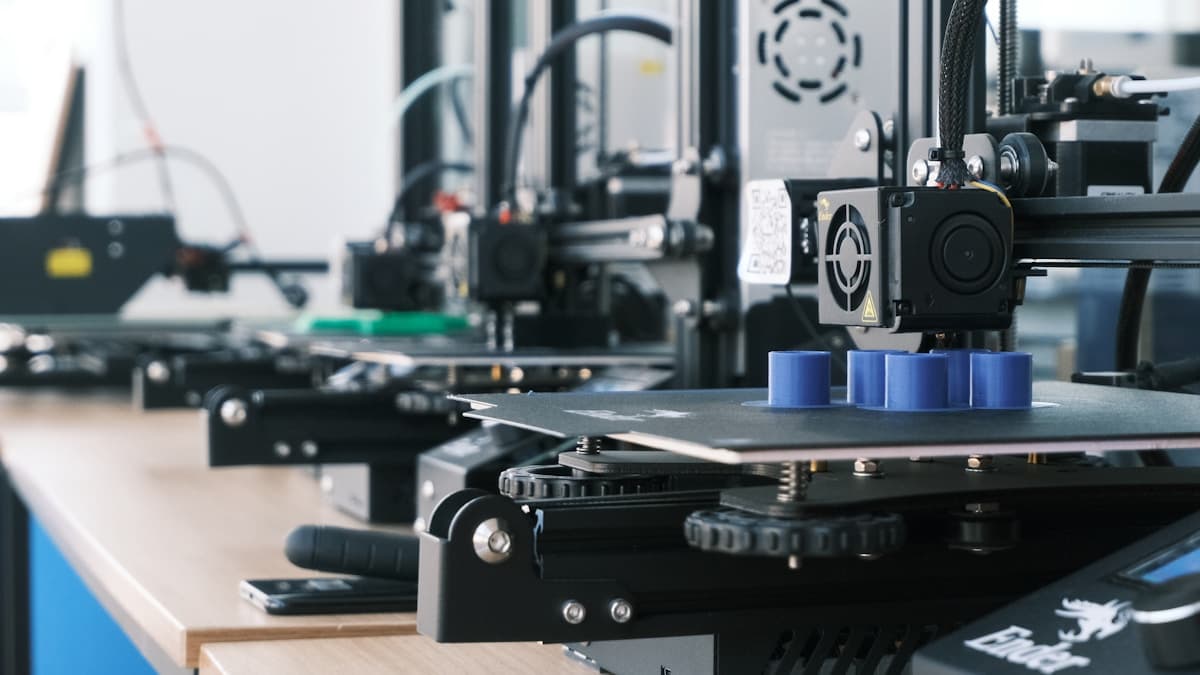
Hero image: a bench of open-frame desktop FDM printers mid-job. Photographer Minku Kang.