3D printing services for musical instruments get used for a narrower, more practical set of jobs than the "printed violin" headlines suggest. The work that actually pays is small, precise and unglamorous: a key touch for a clarinet the manufacturer stopped supporting in 1974, a batch of pickup rings in a colour nobody sells, a set of drum lugs matched to a vintage shell, a mouthpiece facing you want to try in six variants before you pay for one to be cut, and the jigs and fixtures that make the rest of the bench faster. This guide covers what on an instrument is genuinely worth printing, what printing does and does not do to the sound, and how to spec the job so a shop can quote it. When you are ready to source, browse the 3D printing provider directory.
What Actually Gets Printed
Split the instrument before you request a quote. Almost every good answer in this category is a part, not an instrument.
Replacement and obsolete parts. The largest real demand. Key touches, levers, rollers, thumb rests, end caps, spit-valve parts, tuner buttons, drum lugs and claws, mic-clip adapters, case latches and feet — all discontinued, all unobtainable, all small. 3D printing for replacement and spare parts covers the general workflow; instruments are the version of it where the part is also visible from the audience.
Mouthpieces, ligatures and fitting trials. A mouthpiece is a geometry problem — facing curve, tip opening, chamber volume, baffle. Printing lets a player hold six variants in a week for the cost of one custom cut piece. Read the contact-safety section below before anyone plays one.
Guitar, bass and pedal hardware. Pickup rings and covers, control plates, truss rod covers, string trees, knobs, pickguard prototypes, battery compartments, pedal and Eurorack panels, and the mounting brackets that hold any of it in a case.
Pro-audio and speaker parts. Waveguides and horn profiles, port tubes, driver gaskets, grille frames, rack-ear adapters and cabinet prototypes. Acoustic geometry is the entire point of a waveguide, which makes it an unusually good fit for printing — you can iterate a profile instead of arguing about it. The structural side of that work overlaps with 3D printing services for electronics enclosures.
Lutherie jigs and fixtures. Bending forms, radius blocks, clamping cauls, binding jigs, fret slot templates, nut slotting guides, neck routing templates, drill fixtures. Nothing acoustic, no appearance standard, and a payback measured in a single build.
Stage and studio hardware. Mic clips, stand adapters, rack and desk mounts, instrument hangers, custom case inserts.
What does not get printed well: soundboards, resonant bodies, brass bells, cymbals, strings and reeds. In every one of those the material is the instrument, and substituting it produces a different one.
Does It Change the Sound?
This is the question every customer asks, and the honest answer is that it depends on which part — not on printing in general.
For wind instruments, bore geometry and internal surface finish do most of the work. The air column does not know much about what is outside it as long as the wall is rigid and sealed, which is why printed mouthpieces, lead pipes and headjoint studies are a working tool rather than a stunt. What will change the sound is a rough or porous bore, a leak at a joint, or a wall thin enough to flex. Specify a smoothed interior and a sealed surface and you have removed most of the variables.
For plucked and struck instruments, the material is the sound. A guitar body's species, mass and stiffness, a drum shell's ply and depth, a cymbal's alloy — these are the instrument, and a printed version is a new instrument that may be interesting but is not a copy. Print the hardware that hangs off them, not the resonator.
For loudspeakers, geometry rules again. A printed waveguide, port or horn with the correct profile behaves as designed; the risk is panel resonance in a thin wall, which you solve with ribbing, infill and mass rather than with a different process.
The useful rule across all three: print the parts whose geometry does the work; buy the parts whose material does the work.
Process Selection
| Process | Best for | Watch for |
|---|---|---|
| SLS / MJF nylon | Key work, levers, rollers, hardware, brackets, cases, functional batch parts | Tough, support-free and consistent across a batch; the matte surface is slightly porous, so dye or seal anything handled or in contact |
| SLA / DLP resin | Mouthpiece trials, fine engraving, trims, master patterns for casting | Sharpest detail available; brittle and UV-sensitive, and must be fully post-cured before any skin or mouth contact |
| FDM | Jigs, fixtures, templates, forms, large low-cost shapes, mock-ups | Cheapest route to a big part fast; layer lines and a weak Z axis rule it out of anything loaded in bending |
| Metal AM | Valve parts, structural key work, bridges and tailpieces where the load is real | Honest and expensive; usually worth it only when the alternative is a machining setup you cannot get quoted |
| Urethane casting from a printed master | Tens to hundreds of knobs, lugs, rings or covers | The standard answer once quantity makes printing the wrong tool |
The deeper hubs worth reading before you specify are SLS 3D printing services and multi-jet fusion 3D printing services for nylon hardware, SLA 3D printing services for mouthpieces and fine detail, and metal 3D printing services for loaded parts. For the trade-offs across all of them at once, how to choose a 3D printing material covers the ground once rather than per project. If the part flexes by design — a strap-lock pad, a bumper, a damping foot — flexible and TPU 3D printing services is the relevant hub.
Mouth and Skin Contact Is the Hard Line
One rule in this category is not a preference.
Photopolymer resins contain monomer that is a skin and mucous-membrane irritant until it is fully cured, and "looks cured" is not cured. Separately, any part with a layered or porous surface gives bacteria a place to live that no amount of swabbing reaches. Both problems apply to a mouthpiece, a reed holder, a chin rest, a thumb rest and an in-ear shell.
The workable pattern is to print for fit and iteration and to make the final part properly. Print six facings, play-test them with a barrier or a sacrificial cap, pick the geometry, then have that geometry cut, moulded or cast in a material certified for the contact. State the contact requirement in the RFQ in those words — 3D printing services for food-safe parts explains how shops read that language and what they can and cannot certify. A shop that answers "sure, it's fine" without naming a material grade has told you what you need to know.
When There Is No CAD File
There almost never is. The part you want is forty years old, the manufacturer is gone, and the only reference is the broken half in a bag.
That makes scanning and measurement the real first step, and the real cost. A handheld or structured-light scan of the broken part plus the parts it mates with produces a mesh; rebuilding that into a model you can modify, mirror and fit is a separate, billable job. For a small symmetric part — a lug, a cap, a knob — hand measurement and modelling from a drawing is often cheaper and more accurate than scanning. For an organic one — a key touch, a chin rest, a carved bridge — scanning wins.
Two practical notes. Send the mating parts, not just the broken one: a key that fits its post and a key that fits its drawing are different parts. And agree who owns the resulting model, because the second and third copies are cheap only if you have the file. 3D printing services without a CAD file covers the whole path from object to printable model.
How to Spec the Job
Say what the part mates with. "A clarinet key" is unquotable. "A key touch that pivots on a 2.5 mm post, 61 mm long, with a pad cup at one end" is a part. Send photographs with a scale next to them.
Call out the fit dimensions separately. Most instrument parts fail on one or two dimensions — a post bore, a shaft diameter, a slot width. Mark those on the drawing and let everything else run at the process default. Tolerances and accuracy in 3D printing is worth reading before you put a number on a dimension you cannot check on arrival.
Separate the functional from the visible. A jig can come raw off the machine. A pickup ring on the front of an instrument cannot. Say which is which and the shop will orient and finish them differently — see post-processing and finishing services.
Ask for one before the batch. A single printed key that fits its post is the cheapest insurance in the project, and it costs a few days.
Send STEP where you have it. A solid model lets a shop adjust a clearance without guessing. How to prepare your files for a 3D printing quote is the fastest read in the archive for lowering a price.
Give your real quantity. Thirty lugs and three hundred lugs are different processes — low-volume 3D printing services and urethane casting vs 3D printing cover where the line sits.
Qualifying a Provider
Five questions, before the whole job goes out.
- Can you print one part first and hold the file? A fit check before a batch is standard practice in repair work.
- What do you do about mouth or skin contact? The right answer names a material and a limit. The wrong answer is reassurance.
- Do you model from a physical part, or do I need to supply CAD? Many shops print only. The ones that model are the ones useful to a repair bench.
- Can you dye, seal or smooth nylon in-house? Raw powder-bed parts are grey, matte and absorbent. In-house finishing beats a second vendor.
- Will you quote the casting route alongside the printed one? A shop that volunteers the crossover is thinking about your cost rather than its machine hours.
Geography is worth a thought. Nashville's instrument-repair and touring-production trade is dense enough that shops there have usually seen this work before — see 3D printing services in Tennessee or go straight to the Tennessee provider directory. You do not need a local shop to print a key touch, but one that already knows what a pad cup is saves a round of explanation. Shops serving a film or theatre cluster are the other good bet — same small-batch, deadline-bound work, described in 3D printing services for film and TV production.
Get Your Part Quoted
Start with the one part that is stopping an instrument from being played, not the full wish-list. Send the broken piece, its mating parts, photographs with a scale, and the single sentence that says whether anything goes in a mouth. Browse 3D printing providers and compare what they ask you back — the shops that want to know what the part pivots on are the ones that will quote it correctly.
Related Resources
- 3D Printing for Replacement and Spare Parts — the general obsolete-part workflow
- 3D Printing Services Without a CAD File — scanning and modelling from a physical object
- 3D Printing Services for Museums and Cultural Heritage — the conservation sibling of historic-instrument work
- SLS 3D Printing Services — the nylon process behind most instrument hardware
- 3D Printing Services for Food-Safe Parts — how contact-safety language works in an RFQ
- Tolerances and Accuracy in 3D Printing — what a fit dimension really costs
- Browse 3D Printing Providers — send the part out
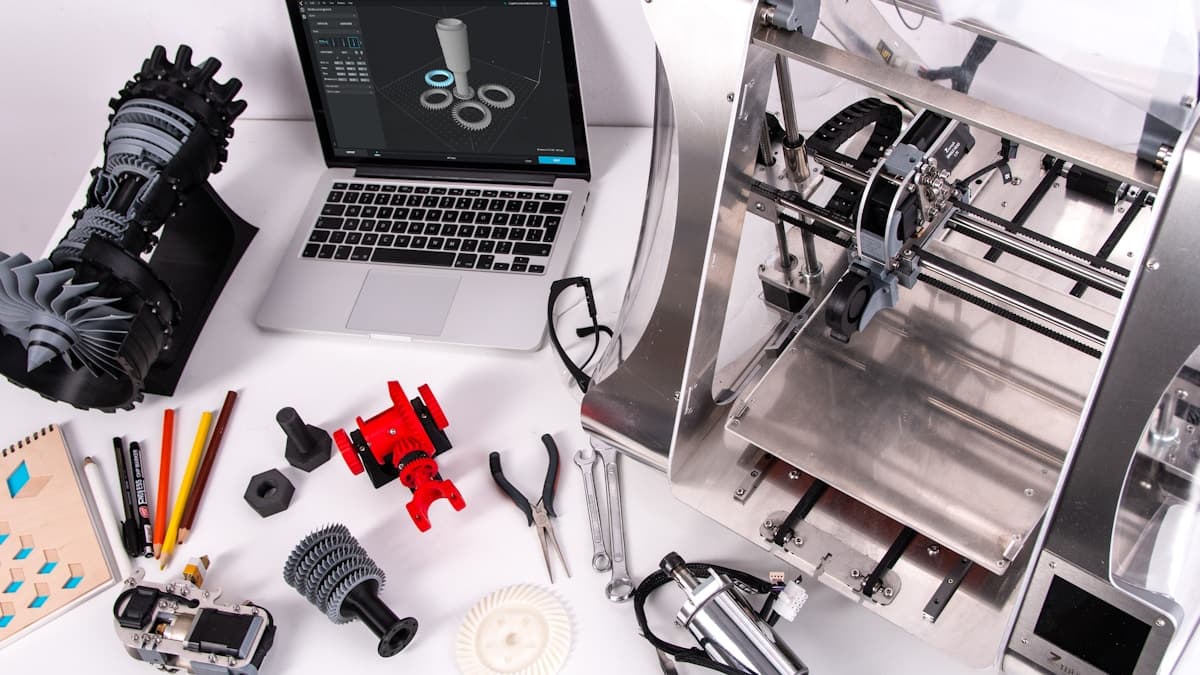
Hero photo: ZMorph All-in-One 3D Printers via Unsplash.