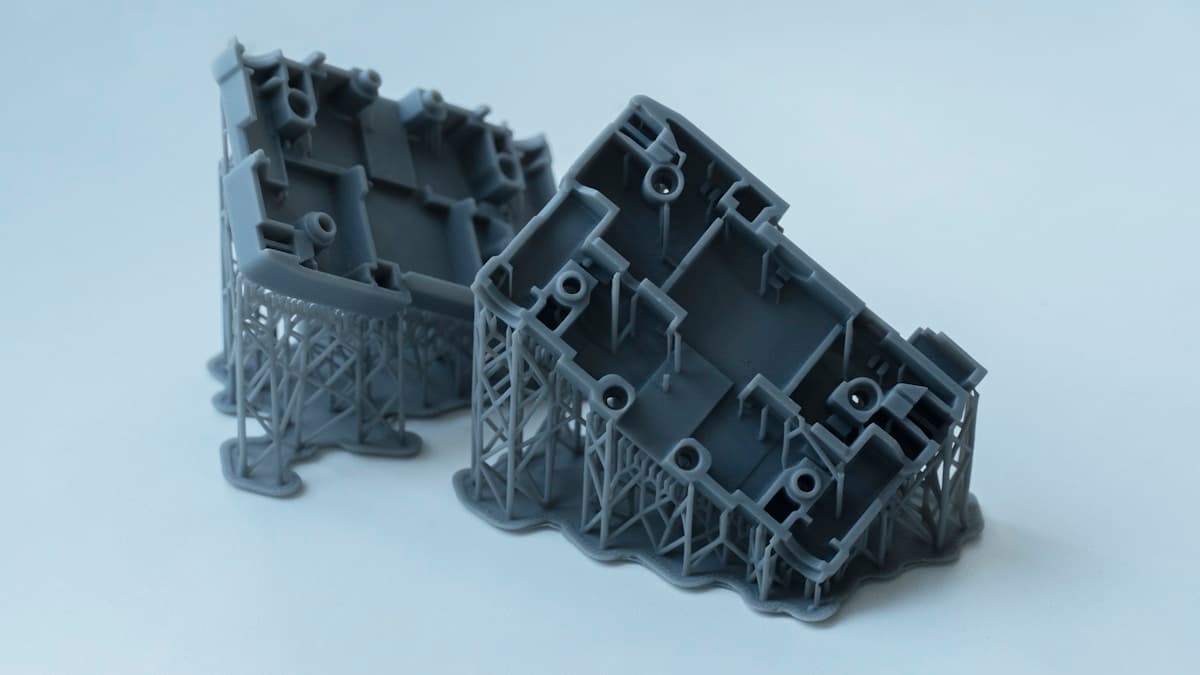
SLA 3D printing services exist for the jobs where the surface is the point. When a part has to photograph well, drop into a sales meeting, carry legible 1 mm text, or serve as the master for a silicone mould, stereolithography is the process that gets you there without a finishing bill that dwarfs the part. It is also the process most often ordered as though it were a thermoplastic — and photopolymer is not a thermoplastic, which is where most disappointments come from. This guide covers what SLA is genuinely good at, what actually drives your quote, how to spec a part so the shop can hit it, and how to tell a capable bureau from a cheap one. Browse 3D printing providers when you are ready to send the job out.
What SLA Actually Is, and When It Is the Right Call
SLA — stereolithography — cures liquid photopolymer with ultraviolet light, one layer at a time, in a vat. Because a light source can be focused far more tightly than molten plastic can be extruded, the process resolves features an extruder cannot approach, and the surface comes off the machine essentially smooth. Everything good and bad about SLA follows from that one mechanism.
SLA is the right call for:
- Cosmetic prototypes and appearance models where layer lines would kill the illusion
- Master patterns for silicone moulding and urethane casting, where every flaw in the master is copied into every part
- Castable patterns for jewellery and investment casting, which burn out cleanly
- Dental models, surgical guides and aligner work, where biocompatible grades and fine detail are both mandatory
- Small assemblies with thin walls, sharp edges, fine text or textured surfaces
- Fit-check parts where you need the tightest dimensional agreement with the CAD you can get in plastic
SLA is the wrong call when the part has to survive. Standard photopolymer is stiff and brittle, it yellows and embrittles under UV, and it keeps ageing on the shelf. A bracket that passes its test on Friday can be noticeably more fragile a few months later. If the part carries load for a working life, SLS nylon or an FDM engineering plastic is the honest answer, and it is usually cheaper too.
The Thing Most Buyers Get Wrong: Resin Choice Is an Engineering Decision
Most SLA quotes are returned in the shop's default standard grey unless you say otherwise, and standard grey is a visual material — it exists to look good and hold detail. Buyers who ask for "SLA" and get a part that shatters in a drawer usually specified the process and left the material to chance.
| Resin family | What it is for | What it costs you |
|---|---|---|
| Standard | Appearance models, master patterns, visual prototypes | Brittle, poor impact resistance, ages under UV |
| Tough / durable | Snap fits, short-life functional prototypes, housings | 30–80% material premium, slightly softer detail |
| High-temperature | Parts near heat, mould inserts, thermal fixtures | Usually more brittle again; often needs a longer post-cure |
| Castable | Investment-casting and jewellery patterns | Fragile to handle; sized for burnout, not for service |
| Biocompatible / dental | Guides, splints, models in a clinical workflow | Certified supply chain, documented cure cycle, higher price |
| Flexible / elastomeric | Gaskets, grips, soft-touch prototypes | Limited stock at smaller shops; slower to print |
Tell the provider the operating environment rather than the resin name. "It lives in a car cabin in Arizona" or "it gets handled by a customer at a trade show for two days" gets you a better recommendation than a grade you found in a spec sheet, and it lets the shop tell you when SLA is not the right process at all.
How SLA Pricing Actually Works
SLA prices on volume, not on footprint. The vat is consumed by what the part displaces, plus the support lattice, plus the raft — so geometry that a buyer thinks of as "small" can be expensive if it is solid.
The levers, roughly in order of how much they move the number:
- Part volume. Hollowing a solid model and adding drain holes can cut the resin in a large part dramatically. Ask whether hollowing is acceptable for your application before you assume it is not.
- Resin grade. Speciality photopolymers run several times the cost of standard, and biocompatible grades carry documentation overhead on top.
- Finishing level. This is the line buyers underestimate most. Support nubs on a cosmetic face have to be sanded and blended by hand, and a painted or clear-coated finish is skilled labour. A "raw, as-printed, supports removed" price and a "presentation finish" price for the same geometry are not close to each other.
- Machine time and layer height. Finer layers mean more exposures. Dropping from 100 µm to 25 µm can quadruple the build.
- Turnaround. Rush work displaces other jobs on the plate, and rush surcharges on resin work are common because the post-cure cycle cannot be shortened safely.
Ask for the quote broken into resin, machine time and finishing. If a shop will not split it, you cannot tell which lever to pull, and you will end up negotiating the only number you can see.
How to Spec and Order an SLA Part
- Send solid, watertight geometry. STL is standard for SLA; STEP is better when tolerances matter, because it preserves the true surfaces rather than a triangulated approximation. Which format to send and why changes what the shop can verify before printing.
- Name the cosmetic faces. Supports have to touch the part somewhere. If you do not say which surfaces must be flawless, the shop chooses for you — usually the orientation that prints fastest.
- Call out the critical dimensions. A drawing with three toleranced features is far more useful than a blanket tolerance across the model, and it lets the shop orient and compensate deliberately. Our guide to tolerances and accuracy covers what is reasonable to ask for.
- Specify the finish in words, not adjectives. "Supports removed, nubs sanded flush, no paint" is a specification. "Nice finish" is a dispute waiting to happen.
- State the post-cure expectation. Under-cured parts are weaker, tackier and dimensionally unstable; over-cured parts are more brittle. A shop that has a documented cure cycle per resin is telling you something useful about the rest of its process. The same variables show up on the desktop — see resin safety and post-processing basics.
- Say when you will measure it. If the part is going on a CMM, measure it soon after delivery and agree that with the provider, because photopolymer does not hold still indefinitely.
What to Look For in an SLA Provider
Ask which machine class your part will run on. Large-format laser SLA, production DLP and desktop MSLA are all sold as "SLA", and the difference shows up in build volume, plate-to-plate consistency and what happens when you order the same part again in three months.
Then ask four questions:
- Which resins do you stock, and which do you order in? A shop that stocks one standard grey and buys everything else in has a longer lead time than its quote implies.
- What is your post-cure procedure for this resin? You want a time and a temperature, not "we cure everything".
- Who removes the supports, and to what standard? The answer tells you whether finishing is a process or an afterthought.
- Can you reproduce this part later? Batch-to-batch consistency on photopolymer depends on resin lot, vat age and cure discipline. If this is a master pattern you will re-cut, it matters.
If the shop is also quoting your post-processing and finishing in-house rather than subcontracting it, you generally get a shorter loop and a single point of accountability when a cosmetic part comes back wrong.
Related Processes Worth Comparing
| Process | Choose it over SLA when |
|---|---|
| FDM | The part is large, structural, or needs a real thermoplastic — and cost matters more than finish |
| SLS | You need durable, support-free nylon parts with complex geometry and a working life |
| PolyJet | You need multi-material, multi-colour or over-moulded soft-touch features in one build |
| Urethane casting | You need 10–100 copies of an SLA-quality part in a production-like material |
The two head-to-head comparisons buyers ask for most are SLA vs FDM and SLA vs SLS. If multi-material is on the table, PolyJet services cover ground SLA cannot. And if you are sourcing in the Southeast specifically, we have a regional page for SLA services in Georgia.
Find an SLA Provider
SLA is widely available — almost every plastics bureau runs resin of some kind — so the real sourcing question is not who owns a machine but who runs the finishing and cure discipline that makes resin parts worth ordering. Send the same geometry, the same resin family and the same written finish spec to two or three shops and compare what comes back, including how they answer the four questions above.
Browse verified 3D printing providers in the directory and filter by technology — and if the part is cosmetic and fragile, weigh a shop close enough to collect from by hand over one that has to trust it to a courier.
Hero photograph by EnCata PD.