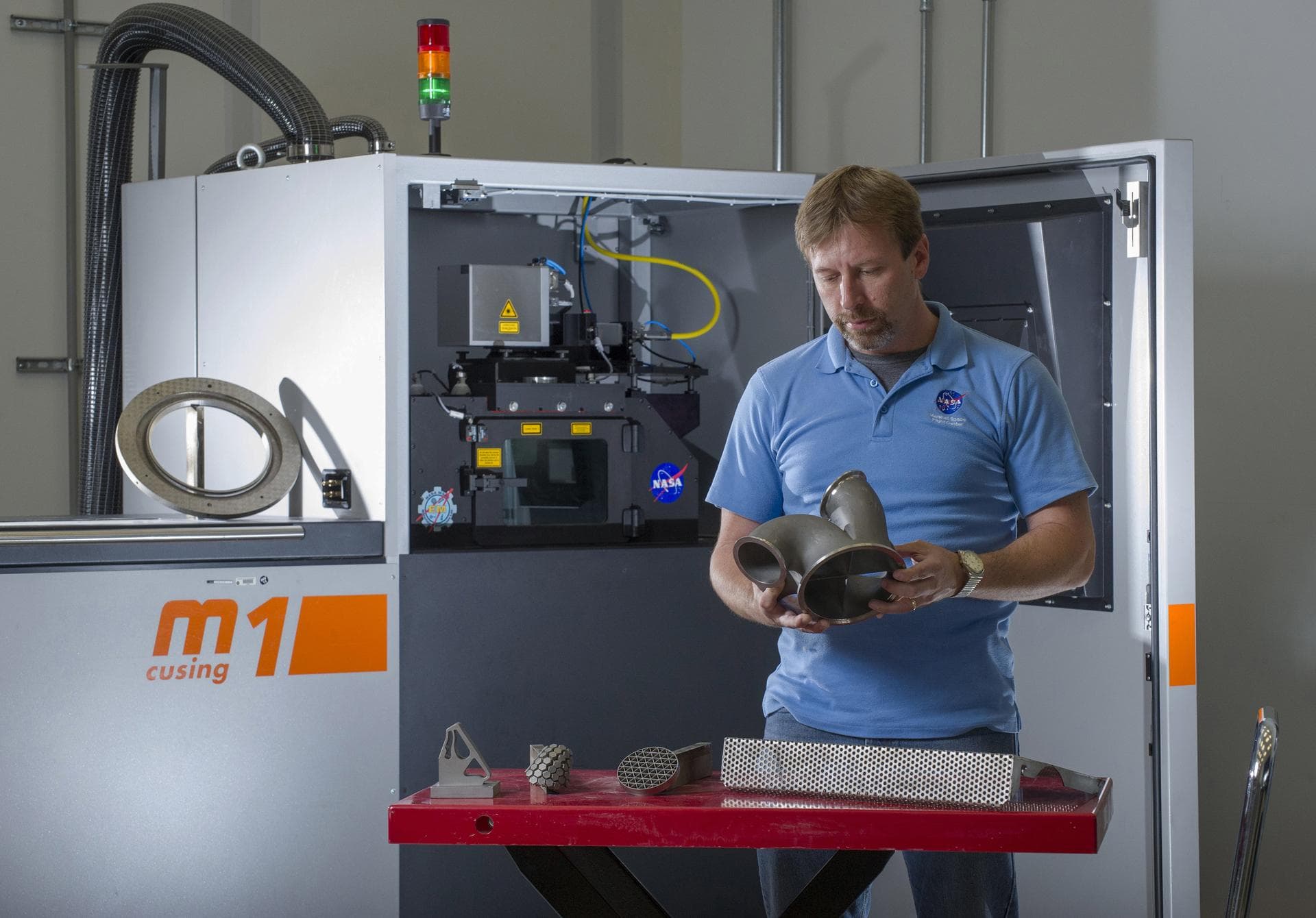
3D printing services for aerospace parts get bought for two very different reasons, and confusing them is the most expensive mistake in the category. One buyer needs a drill jig on Thursday and can order it from anyone competent. The other needs a bracket that will sit on an aircraft for twenty-five years, and is buying a documented process far more than a printed part. The technology is the same; the price, the lead time and the supplier list are not. This guide covers which aerospace parts additive suits, where the flight-hardware line sits, what the qualification paperwork costs, and how to spec a job so the first quote is a real one. Start with the 3D printing provider directory when you are ready to put work out.
Classify the Part Before Anything Else
Every downstream decision follows from one question: does this part go on the aircraft?
Non-flight hardware — tooling, jigs, fixtures, ground support equipment, mock-ups, training aids, shop aids. No airworthiness approval, no certified material, no traceability requirement beyond your own. Any capable shop can make it, turnaround is days, and this is where most of the real additive volume in aerospace sits.
Flight hardware — anything installed on the aircraft, from a cabin bracket to a fuel-system fitting. Approval route, qualified material, frozen process parameters, build-level traceability and inspection records. A narrow supplier list and a lead time measured in weeks to months.
Decide on day one. A part that was never traceable cannot be made traceable retrospectively — it has to be built again.
Tooling and Ground Support: The Unglamorous Majority
If you print one thing in aerospace this year, it will almost certainly be a tool.
Drill and trim templates, assembly and bonding fixtures, composite layup mandrels and cauls, cable-routing guides, protective covers, inspection aids, ground support brackets, and the hundreds of shop aids that exist because one operator does one job on one station. The economics are obvious once you see them: a machined aluminium fixture is a week and a purchase order, a printed one is overnight and gets replaced without an argument when the design moves.
Large-format machines matter more here than anywhere else, because tooling is where the parts get big — wing-scale templates and full-size mandrels. Large-format 3D printing services covers the size-versus-cost trade, and 3D printing for jigs, fixtures and manufacturing aids covers the design rules that keep a printed tool dimensionally honest through a shift.
Two aerospace-specific cautions. Anything that touches a composite layup must survive cure temperature without moving, which rules out commodity filaments. And anything that touches a finished surface needs a finish that will not mark it — the tool is cheap, the panel it scratches is not.
Cabin Interiors and the Flammability Wall
Interior parts are the most common route to a genuinely installed printed part, because the geometry is forgiving and the loads are low. The barrier is not strength; it is fire.
Cabin components have to meet the FAR 25.853 requirements covering flammability, smoke density and heat release, and ordinary engineering thermoplastics do not clear them. That is why polyetherimide grades like ULTEM 9085 dominate aerospace FDM — they meet the interior requirements and hold their properties at temperature. Running them needs a high-temperature chambered industrial machine, so this is a real supplier filter rather than a material preference. Confirm the shop runs the certified grade, not a look-alike, before you design around it.
Typical parts: air ducting and vents, wire routing, brackets and standoffs behind panels, seat and monument details, bezels and trim, galley fittings. Short runs, high mix, and often replacements for parts the original supplier stopped making — which is the whole argument.
Flight Structure, Metal AM, and What It Really Costs
Metal powder-bed fusion is the process that made aerospace pay attention, and the reason is part consolidation. When an assembly of brazed and bolted components becomes a single grown part, you remove joints, fasteners, leak paths and inspection steps along with the mass. The canonical example is the LEAP engine fuel nozzle, where roughly twenty conventional pieces became one printed component — the interesting number is not the mass saved but the assembly steps deleted.
The alloys that carry aerospace work are Inconel 718 and other nickel superalloys for hot sections, Ti-6Al-4V for structural and high-strength fittings, AlSi10Mg for light non-critical brackets and housings, and 17-4PH stainless for general hardware. Metal 3D printing services covers the process in general terms.
What surprises first-time buyers is the post-print bill. A metal printed part is not finished when the build ends: it needs stress relief on the plate, removal from the plate, support removal, usually hot isostatic pressing to close internal porosity, heat treatment to the specified condition, machining of every sealing and mating face because as-built tolerances will not hold an O-ring groove, and non-destructive inspection — typically CT — on anything critical. Expect the print to be well under half the total, and expect finishing to drive the schedule. Post-processing and finishing services covers the general chain, and tolerances and accuracy what to expect before machining.
The honest test: if you could machine the part from billet without much argument, machine it. Metal AM earns its place on geometry a cutter cannot reach — internal channels, consolidated assemblies, lattice and topology-optimised structure.
MRO and the Obsolete Part Problem
Aircraft outlive their supply chains. A twenty-year-old airframe needs a cabin fitting whose tooling was scrapped, in a quantity of six, against a minimum order of five hundred.
The workable pattern: scan the surviving part, rebuild it as clean parametric CAD rather than printing the scan mesh, requalify it through the appropriate approval route, print on demand. The engineering and approval work dominates the cost — but you pay it once, and the released CAD makes the next occurrence cheap. The same logic drives 3D printed replacement and spare parts outside aviation; aerospace just has the longest service lives and the strictest approval route.
Process and Material by Job
| Job | Sensible route | Why |
|---|---|---|
| Drill jigs, trim templates, shop aids | FDM in engineering thermoplastic | Cheapest fast route at real size and stiffness |
| Layup mandrels and cauls | High-temperature FDM, large format | Must hold dimension through cure |
| Cabin interior parts | FDM in a certified PEI grade | The only common route past the FAR 25.853 wall |
| Ducting, housings, complex non-structural | SLS or MJF nylon | No supports inside channels, consistent part-to-part |
| Stiff lightweight brackets, UAV-scale structure | Carbon-fibre-filled polymers | Stiffness per gram |
| Flight brackets, manifolds, hot-section hardware | Metal powder-bed fusion | The only additive route to a genuine metal part |
| Form and fit checks, wind-tunnel models | Resin / SLA | Surface finish and fine feature resolution |
For anything you will need repeatedly across a fleet, price additive against soft tooling before committing — rapid tooling services and low-volume 3D printing between them cover where the crossover sits. How to choose a 3D printing material goes deeper on grades.
The Paperwork Is the Product
For flight hardware, you are buying evidence. Know what you are asking for, because each item has a price:
- AS9100 quality system — the baseline for aerospace supply. Meaningful for flight hardware, an unnecessary cost filter for tooling.
- NADCAP accreditation for special processes — heat treatment, non-destructive testing, welding. Ask which are in-house and which are subcontracted.
- Material and lot traceability — powder or filament lot numbers, and for metal, the policy on virgin-versus-reused powder. A real property variable, not a formality.
- Frozen process parameters — a qualified part means a qualified parameter set on a specific machine. If the shop retunes between builds, your qualification does not transfer.
- Witness coupons — tensile specimens built alongside the part and tested per build. The standard evidence that this build behaved like the qualified one.
- First article inspection to AS9102, and a defined route for non-conformance.
- Export control — ITAR or EAR coverage, ITAR registration, where files are stored and whether work is ever brokered offshore. NDAs and IP protection with 3D printing services covers the commercial agreement; export control sits on top of it and an NDA does not substitute.
How to Spec the Job
Send these and the quote comes back as a number rather than a range:
- STEP geometry, not just STL, plus a drawing that flags critical dimensions and datums individually. General tolerance covers the rest.
- Flight or non-flight, stated in the first line of the enquiry. It changes everything downstream.
- The material by grade and the specification it must meet, not by family — "PEI to the interior flammability requirement", not "something like ULTEM".
- Operating environment — temperature range, fluid and fuel exposure, UV, vibration, service life.
- Post-processing required — HIP, heat treat condition, machined features, surface finish, NDT, and who owns each step.
- Documentation required — material certs, FAI, coupon data. This is a cost line; leaving it out is why second quotes come back higher.
- Quantity now and later. Six now and possibly sixty later is a different process recommendation.
How to prepare files for a 3D printing quote covers the general submission, and design for 3D printing guidelines the geometry rules.
Qualifying a Provider
Four questions sort a shortlist fast.
Which processes are genuinely in-house? Brokering powder-bed work to a partner is common and not disqualifying, but it changes lead time, export exposure and who owns the fault.
Have you delivered flight hardware, and through which approval route? A shop that has done it once will answer specifically. A shop that has not will answer in general terms about capability.
How do you control powder or filament lots? The answer tells you more about a metal shop than its machine list does.
What is your turnaround on a revision? For tooling this matters more than the price of the first set, because you will iterate. How to choose a 3D printing service covers the wider checklist, and the industrial buyer's guide the capability tiers.
Get Aerospace Parts Quoted
Classify the part first — flight or non-flight — because that single answer sets your material, your supplier list, your documentation bill and your schedule. Then send STEP geometry, the material specification, the required post-processing and the documentation you need, and ask for the finishing chain to be itemised rather than rolled into one number.
Browse 3D printing providers to find shops that take aerospace work, or start near an established supply base: Washington providers around the Everett and Renton aircraft cluster, or Arizona providers for the Phoenix and Tucson aerospace and defence base. Ask two or three — the spread in what they ask you about traceability and finishing tells you more about capability than the spread in their prices does.
Related Resources
- Metal 3D Printing Services — the process behind flight-hardware brackets and manifolds
- 3D Printing Services for Drone and UAV Parts — the unmanned side, where mass rules everything
- 3D Printing for Jigs, Fixtures and Manufacturing Aids — where most aerospace additive volume actually goes
- Functional and End-Use 3D Printed Parts — when parts stop being prototypes
- How Much Does 3D Printing Cost — the general pricing model
- 3D Printing Services in Washington — the Puget Sound aerospace supply base
- Browse 3D Printing Providers — send the job out
Hero photo by Emmett Given / NASA Marshall Space Flight Center (public domain).