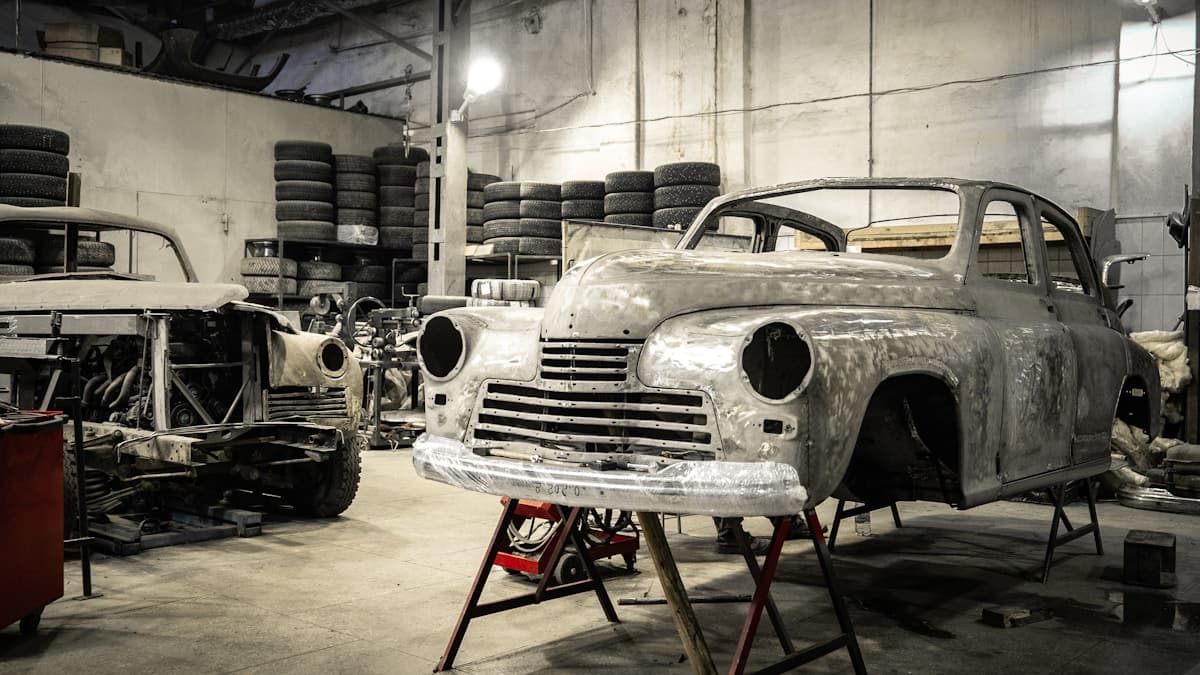
A buyer in southeastern Pennsylvania recently submitted a quote request through the 3D Prototyping Hub directory. He had a 1932 MG K3 radiator shell — brass, freshly chrome-plated, sitting at a friend's place in Lahaska. He needed it scanned to produce a DXF file he could use to CNC mill a wooden buck, from which he'd hand-form a replica shell.
The job was matched to a 3D scanning service provider in the Philadelphia metro area the same day. No manual coordination. No cold calls to shops that don't do scanning. No shipping a fragile chrome part across the country.
That's the use case this guide is built around: a real part, a real buyer, and a local provider who was the right fit — and who wouldn't have been easy to find any other way.
Why Local 3D Scanning Makes Sense for Automotive Parts
Shipping automotive parts for 3D scanning is the worst-case option. Parts are large, awkward, often fragile, and sometimes irreplaceable. A 90-year-old radiator shell isn't something you drop-ship to a national scanning bureau and hope arrives intact.
Local scanning solves the logistics problem in two ways:
-
Mobile scanning — the scanning service comes to you. Large assemblies, assembled vehicles, and parts that can't be safely moved are common in automotive restoration. Most professional scanning services will travel within a regional radius for a modest on-site fee.
-
Drop-off and same-day turnaround — for smaller parts that can be transported, a local service can scan, process, and deliver the mesh or STEP file on the same day or the next morning. No shipping time, no transit damage risk, no weeks-long turnaround.
For custom automotive parts specifically, local is almost always the right default.
What Type of Scanning Does an Automotive Job Actually Need?
The right scanning technology depends on what you need from the output.
Structured light scanning is the standard for automotive body work, trim, and restoration components. Accuracy of 0.02–0.05mm. Works well on complex curved surfaces and organic geometry — which describes almost every automotive exterior component. Requires surface prep (scanning spray) for polished or chrome surfaces.
Handheld laser scanning is better for larger assemblies — a full door opening, a quarter panel, a chassis subframe. Slightly lower accuracy than structured light (0.05–0.1mm) but covers more area faster and handles complex undercuts and recesses.
CT scanning is required for parts with internal geometry you need to capture — throttle bodies, carburetors, intake manifolds. Expensive, but it's the only technology that captures internal passages and wall thicknesses without disassembly.
Photogrammetry (photos reconstructed into 3D) is not suitable for fit-critical automotive work. Accuracy in the 0.5–2mm range is insufficient for any part that mates with another component. It's useful for large-scale exterior reference captures (digitizing a full bodyline from multiple angles for styling reference) but not for a part you're going to reproduce.
For the MG K3 radiator shell: structured light scanning. Complex exterior curves, chrome surface that needs scanning spray prep, and the output needed to be accurate enough to guide CNC toolpaths for a wooden buck.
The Surface Prep Problem: Chrome and Polished Metal
Chrome and polished metal are the most common failure point in automotive scanning jobs. Structured light and laser scanning both depend on a surface reflecting light back to the sensors in a predictable way. Highly reflective surfaces scatter, absorb, or mirror the light in ways that produce gaps, noise, and artifacts in the scan data.
This is standard practice for chrome, polished aluminum, and any highly reflective surface. It does not damage chrome plating or affect the surface finish.
A competent automotive scanning service will have AESUB or an equivalent on hand and will apply it as a standard step before scanning reflective parts. If a service you're considering doesn't mention surface prep when you describe a chrome or polished part, that's a gap worth probing.
What to Ask a 3D Scanning Service Before Hiring
These questions separate services that will deliver usable results from ones that will deliver a scan that doesn't meet your needs.
1. What is the deliverable? An STL mesh (printable copy, not editable) or a STEP/IGES file (full parametric CAD model, editable and modifiable)? For automotive parts where you're going to CNC, modify, or mate with other components — you need STEP. Mesh-only is sufficient for a direct print copy of a simple shape.
2. What scanner hardware do you use and what is the stated accuracy? Professional-grade: Artec, Creaform, FARO, Hexagon, Zeiss GOM. Hobbyist-grade: Revopoint, Creality Raptor, iPhone LiDAR. The hardware tells you everything about achievable accuracy. Automotive restoration work needs professional hardware.
3. Have you scanned chrome or reflective surfaces before? If yes, ask what preparation they use. If they don't immediately mention scanning spray, that's a red flag.
4. Can you come to the part, or does the part need to come to you? For large, fragile, or assembled components, confirm mobile availability and the travel fee upfront.
5. What software do you use for mesh processing and CAD reconstruction? Professional: Geomagic Design X, Zeiss GOM Suite, Polyworks, Hexagon software. For CAD reconstruction on top of scanning: SolidWorks, CATIA, or Siemens NX. Consumer tools like MeshLab and Meshmixer are fine for mesh cleanup but insufficient for accurate reverse engineering.
6. Can you provide a sample deliverable or reference from a similar project? A previous automotive scan project — body panel, trim piece, engine component — tells you more than any description.
Finding a Local Scanning Service in Your Area
The 3D Prototyping Hub directory lists providers across all 50 states. Many providers offer 3D scanning alongside their printing services, and several specialize in reverse engineering and heritage part reproduction.
For projects in the Mid-Atlantic and Pennsylvania corridor specifically — the region with the highest concentration of vintage automotive restoration shops on the East Coast — the Pennsylvania provider listings include multiple scanning-capable services within driving distance of most of the state.
What to look for when browsing:
- Services listed include "3D Scanning" — filter for scanning-capable providers specifically
- Description mentions reverse engineering — indicates capability beyond simple scan capture
- Local or regional provider — for on-site scanning, confirm their service radius covers your location
Submit a quote request directly through the directory listing. Include the part description, approximate dimensions, material (chrome, polished aluminum, etc.), and the deliverable you need (mesh vs. STEP vs. DXF). A capable scanning service will respond with a scoped quote, not a generic price list.
After the Scan: Verification and Next Steps
A scan is the beginning of the workflow, not the end. For automotive restoration work, a few additional steps matter:
A 0.01mm resolution caliper is sufficient. This confirms the scan accuracy before you commit to downstream machining or tooling.
Confirm the file format is compatible with your downstream tool. If you're handing off to a CNC programmer, confirm whether they need STEP, IGES, or a specific native CAD format. If you're printing directly, confirm the STL is watertight and manifold (no open edges or inverted normals).
Ask for the raw scan data. A reputable scanning service should be able to provide the unprocessed point cloud alongside the finished mesh or STEP file. This is your backup if the deliverable needs to be reworked.
For the MG K3 radiator shell: the output needed to be a DXF usable for CNC toolpaths. A STEP file reconstructed from the scan data, exported to DXF in the appropriate plane, is the correct workflow. The scanning service was briefed on this upfront — which is why it was the right match.
The Short Version
If you need a 3D scan of an automotive part:
- Local is the default choice — mobile scanning is available, shipping fragile parts is avoidable
- Structured light or handheld laser scanning for exterior components; CT only if you need internal geometry
- Chrome and reflective surfaces need scanning spray — confirm the service knows this
- Ask for STEP, not STL, if you intend to modify or machine from the scan
- Cross-check scan accuracy against caliper measurements on 2–3 critical dimensions