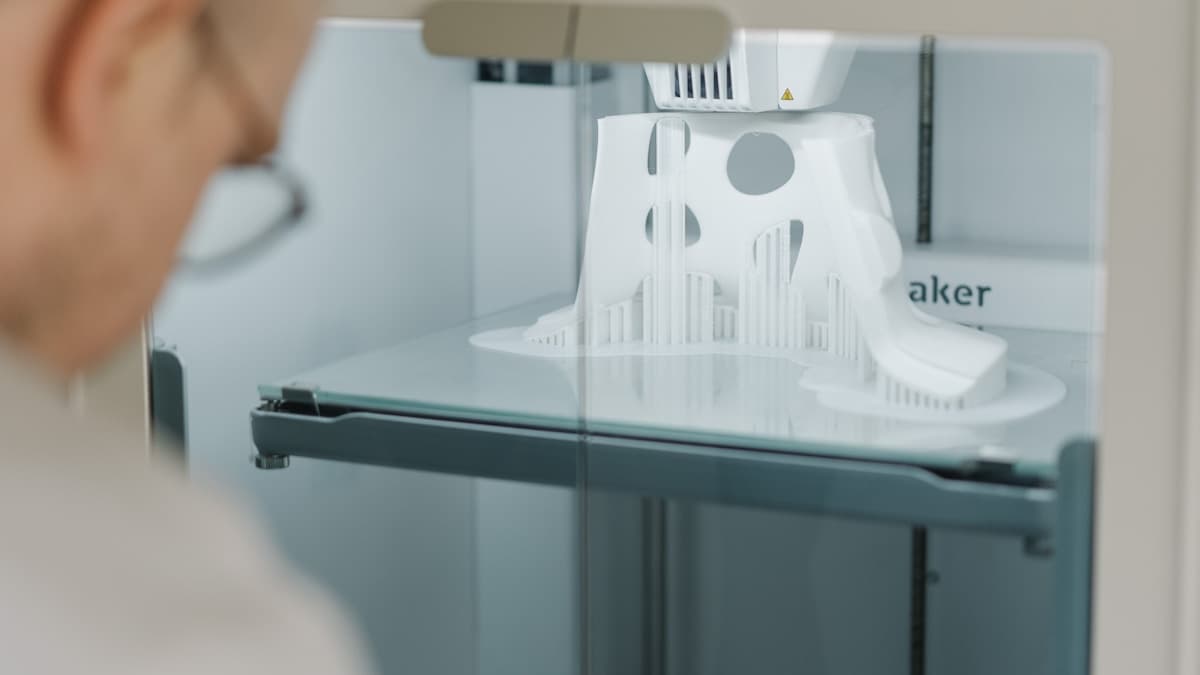
3D printing services for construction and concrete formwork solve a narrow but expensive problem: the one-off shape. A carpenter can build a rectangular form faster than any machine, and a precast yard already owns steel molds for everything it makes twice. What neither can produce economically is a doubly curved liner for fourteen non-identical facade panels, a blockout for a penetration that exists once on the whole job, or a template that holds thirty embeds in a pattern nobody wants to set out by hand twice. Those are printing jobs, and they are available from ordinary service bureaus today. This guide covers what actually gets printed for construction work, what concrete does to a plastic mold, and how to spec the job so the quote comes back right. When you are ready to source, browse the 3D printing provider directory.
First, a disambiguation that saves a wasted phone call. This is not construction-scale concrete printing — the gantry-extruded wall systems that make the headlines. That is a specialist contractor service with its own equipment and its own permitting conversation. Everything below is about printing polymer parts that shape, position or support concrete poured the normal way.
What Actually Gets Printed
Formwork liners and inserts. The highest-value use. A printed liner drops into a conventional plywood or steel box and gives the concrete face a geometry that would be uneconomic to joinery: fluting, relief patterns, logos and lettering, tapers, compound curves, parametric panel families where no two pieces repeat.
One-off and short-run precast molds. Bollards, benches, planters, copings, parapet caps, sample panels, bespoke drainage furniture. Anything the yard will make between one and a few dozen times, where a steel mold cannot be justified.
Blockouts, void formers and penetration sleeves. Shapes that occupy space in the pour and come out — or stay in, in the case of sleeves and duct formers. Nearly always one-off, nearly always urgent, and the classic case of a site waiting on a part.
Rebar jigs, embed templates and anchor-bolt setting plates. Geometry problems with no concrete face at all. A printed template that locates anchor bolts to the baseplate pattern removes the most common and most expensive setting-out error on a job.
Layout, survey and QA tooling. Setting-out targets, gauge blocks, cover meters and profile gauges, drill guides, mockup fixtures.
Site and plant spares. Guards, handles, adapter fittings, hopper chutes, control housings, bracket replacements for plant that is out of support. This is the same workflow as 3D printing services for mining and heavy equipment, run at a lower duty cycle.
Facade and design mockups. Non-structural presentation pieces for client sign-off, which overlap with 3D printing for architectural models but at full scale and in a material that has to survive a site visit.
The hard line across all of it: anything structural, load-bearing or life-safety belongs to the engineer of record, not the print shop. Printed components that position reinforcement, stay permanently in the pour, or carry load during construction need explicit approval before you order them. Formwork itself carries pour pressure, and a liner that fails mid-pour is a safety event, not a reprint.
What Concrete Does to a Plastic Mold
Four mechanisms spoil printed formwork, and all four are predictable enough to design around.
Heat. Cement hydration is exothermic. A thin architectural panel runs mild, but a thick section can hold the mold face well above ambient for hours. PLA begins to soften around 55–60 °C, which puts the shape you paid for at risk while it is under pressure — the same failure mode described in why 3D prints deform in a hot car, just with the heat source on the inside. ASA, PETG and polypropylene have the headroom; if the section is genuinely massive, ask about high-temperature 3D printing services and a material with a stated heat-deflection figure.
Alkalinity. Fresh concrete's pore solution is strongly alkaline. Polyester-based polymers such as PLA degrade in that environment, which matters for a multi-pour mold even if a single pour survives. A sealed surface coat removes the issue entirely.
Abrasion and demolding force. Concrete is a slurry of hard particles, and vibration drives it into every open pore in the mold face. Printed surfaces are porous, so paste keys into them and strikes tear material away. This, not heat, is what usually ends a liner's life.
Geometry lock. Steel formwork flexes; a printed liner does not. Draft is mandatory — plan on 1–3° on every demolding face, more on a textured one — and any feature that mechanically locks the part in has to be designed as a loose piece or a sacrificial insert instead.
Process and Material Selection
| Route | Best for | Watch for |
|---|---|---|
| FDM in ASA or PETG, coated | Liners, molds, blockouts, large forms | The workhorse. Cheap per litre, prints big, and the coating does the real work. Seams between segments telegraph into the concrete |
| FDM in polypropylene | Molds where chemical resistance and natural release matter | Excellent release behaviour; harder to print and more expensive, so specify it only if the shop has done it before |
| SLS or MJF nylon | Jigs, templates, setting plates, site spares | Tough, support-free, dimensionally consistent across a batch. Hygroscopic, so not for a mold left wet |
| Large-format pellet extrusion | Full-size molds, bollards, furniture, panel forms | The right call above roughly a metre; see large-format 3D printing services. Coarse beads, so it is always a print-then-machine-then-coat workflow |
| Printed master into cast rubber or urethane liners | Many repeats of one complex shape | Print once, cast many. Almost always cheaper past a handful of copies, and the same logic as rapid tooling services |
| Printed pattern for sand casting | Metal formwork hardware and fittings | Covered in 3D printing services for sand-casting patterns |
Coating is not optional on any exposed-concrete face. The standard sequence is print, fill, sand, seal with epoxy or polyurethane, then use a release agent the coating supplier approves — some solvent-based form releases attack bare printed thermoplastics, and finding that out on pour day is expensive. 3D printing post-processing and finishing services covers who does that work when the print shop does not.
How Pricing Works
Printed formwork is priced on the mold, not on the concrete, and the drivers are not the ones most construction buyers expect.
- Material volume and wall strategy. A mold is mostly air if it is designed properly. A shop quoting a solid block is quoting the wrong part — ask for a ribbed shell with a solid face.
- Build volume and segmentation. Anything over the machine envelope gets split, bolted and sealed. Each seam adds assembly labour and a line in the concrete.
- Finishing labour. On an architectural liner this routinely exceeds the print cost. It scales with surface area and with the finish class you demand, so specify the class honestly.
- Reuse count. The number that actually matters is cost per pour, not cost per mold. A liner that costs more and lasts twenty pours beats one that costs less and lasts three.
- Lead time. Large prints run for days. Compressing that means splitting across machines, which costs more and adds seams.
How much does 3D printing cost covers the general drivers, and tolerances and accuracy in 3D printing is worth reading before you put a dimension on a drawing — printed tooling does not hold machining tolerances across a metre-long part, and specifying as if it does is the fastest way to a dispute.
How to Spec It
Send these six things and you will get a quotable package:
- The concrete face geometry, as a solid model or a surface with a stated offset. A shop can invert a face into a mold; it cannot guess which side the concrete is on.
- Pour count and finish class. "One buried blockout" and "forty architectural panels" are different products from the same CAD file.
- Section thickness and mix, so heat and pressure can be assessed.
- Release agent and coating, if the site is committed to a product.
- Transport and handling limits — door widths, crane access, what two people can lift.
- The date concrete is scheduled. This governs everything.
No model yet? A broken part or an existing profile can be scanned and rebuilt; 3D printing services without a CAD file is the route in.
What to Look for in a Provider
Ask five questions and the shortlist sorts itself:
- Have you printed a mold that had concrete poured against it? Experience here is uncommon and immediately obvious in the answer.
- What is your largest single-piece build volume, and how do you handle parts above it? Listen for a seam strategy, not just a number.
- Do you coat and finish in-house? Outsourced finishing adds a vendor, a week and a liability gap.
- Will you state a pour count for the finish class I need? A shop that commits to a number has thought about demolding.
- Can you deliver to a site, not a loading dock? Large formwork is a logistics problem as much as a printing one.
Proximity helps more here than in most categories — a liner that does not fit is a problem you want to solve with a van, not a freight claim. Texas is a reasonable example of a market where precast and civil work are dense enough that bureaus have seen this job before: see 3D printing services in Texas or go straight to the Texas provider directory. Tooling and jig work of this kind is the same muscle as 3D printing services for jigs, fixtures and manufacturing aids, so a shop strong in that is usually a safe bet even without concrete on its CV.
Get Your Formwork Quoted
Start with the single shape that is holding up a pour, not the whole architectural package. Send the face geometry, the pour count and the date, and ask for cost per pour rather than cost per mold. Browse 3D printing providers and compare which ones come back asking about draft angle and demolding — those are the shops that have done it before.
Related Resources
- Large-Format 3D Printing Services — the machines that print a full-size mold
- Rapid Tooling Services — when a printed master beats a printed mold
- 3D Printing Services for Jigs, Fixtures and Manufacturing Aids — the template and setting-out side of the work
- 3D Printing Post-Processing and Finishing Services — the coating step that decides pour count
- Functional and End-Use 3D Printed Parts — how durability is specified
- Why 3D Printed Parts Fail Outdoors — relevant to anything stored on a site
- Browse 3D Printing Providers — send the job out
Hero photo: Tom Claes via Unsplash.