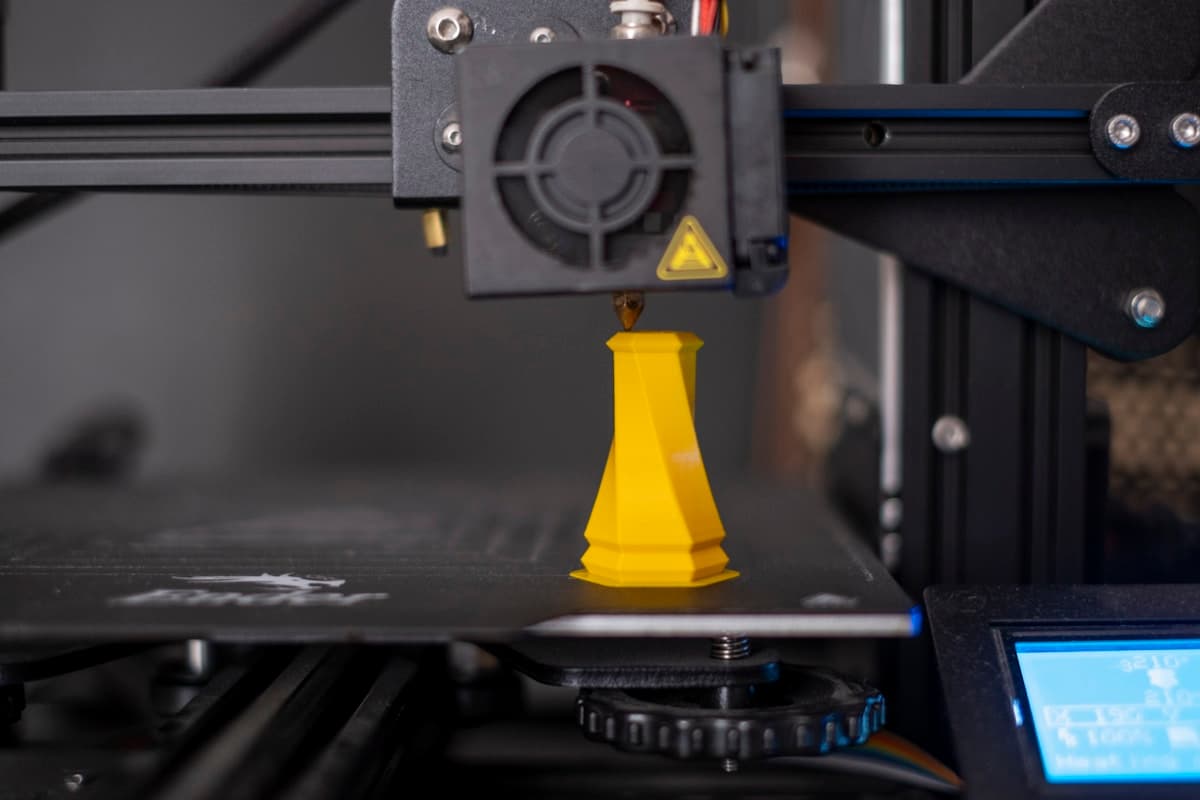
It starts about twenty minutes in. Something sweet drifting out of the spare room, or something sharper that sits at the back of your throat and follows you downstairs. 3D printers smell because every one of them is a small machine holding plastic above its melting point for hours in a room, and what comes off the nozzle depends almost entirely on which plastic it is. The useful part is that the smells are distinguishable — one of them is harmless, several of them are a ventilation problem, and two of them mean switch the machine off now.
This post contains affiliate links. If you purchase through these links, 3D Prototyping Hub may earn a small commission at no extra cost to you.
This post also contains Amazon affiliate links. As an Amazon Associate we earn from qualifying purchases.
Match The Smell To The Material
Before buying anything, work out what you are smelling. Most of this table is identification; the last two rows are the ones to act on immediately.
| What you smell |
What it actually is |
What to do |
| Sweet, faintly like waffles or hot sugar |
PLA — lactide and related compounds |
Ventilate normally; lowest-emitting common filament |
| Sharp, chemical, gives you a headache |
ABS or HIPS — styrene dominates |
Enclose and filter, or move it out of living space |
| Like ABS but milder, slightly waxy |
ASA |
Treat exactly as ABS |
| Acrid, faintly fishy |
Nylon — caprolactam, worse from damp filament |
Dry the spool, enclose, ventilate |
| Nail varnish and fish, strongest with the lid up |
Resin monomers plus IPA from the wash |
Air changes, not a carbon box |
| Burnt sugar or scorched toast |
Old filament baking onto the nozzle and heater block |
Clean the hot end — cosmetic, not chemical |
| Hot electronics, melting insulation |
A power terminal overheating |
Stop. Power off at the wall. |
| Sharp and metallic from a hot end above ~250 °C |
PTFE liner degrading |
Stop. The hot end is not rated for the material |
Smell Is A Clue, Not A Dose Meter
The thing that misleads people is that the nose ranks these materials in the wrong order. Styrene, the main vapour off ABS, is detectable at very low concentrations, so ABS seems alarming the moment it starts. PLA smells faintly pleasant and is widely treated as the safe option on that basis alone — but it still produces ultrafine particles, and particles have no odour at all.
What the emission rate actually tracks is material and temperature, not how strong the smell is. Pushing a nozzle 20 °C hotter for better layer bonding raises emissions as well, which is a reason to find the lowest temperature that bonds properly rather than the hottest one that still looks fine.
The corollary matters more than the ranking: a printer that has stopped smelling has not necessarily stopped emitting, and a new smell on a machine that never had one is information. Nothing about a printer should change character mid-print.
The Two Smells That Mean Stop
Hot electronics. A sharp smell of warm insulation is almost always a loose screw terminal — usually the heated bed or the hot-end heater, where a joint that is not quite tight turns a few watts into heat in the connector instead of the heater. Browning around a terminal block is the visible version of the same fault. Power the machine off at the wall, inspect every power terminal, re-terminate anything discoloured, and run the next print supervised. This is the single failure on a cheap machine most likely to end in a fire, and it always gives warning first.
Sharp and metallic from a hot end running hot. PTFE begins to break down somewhere around 250 °C. If a machine with a PTFE-lined melt zone is being pushed to polycarbonate or high-temperature nylon settings, the liner is the thing degrading, and the fumes it gives off are a recognised cause of short-lived flu-like symptoms — and are lethal to pet birds at concentrations that barely register to a person. Ventilation is not the fix here. An all-metal hot end, or a machine specified for the temperature, is.
Fix It At The Source First
Every pound spent on filtration is working against whatever you decided to print. Start upstream:
- Choose the material for the room. PLA and PETG indoors; ABS, ASA, nylon and polycarbonate in a garage, a workshop, or an enclosure vented outside. This single choice beats everything below it.
- Print at the low end of the temperature range. Run a temperature tower, take the coolest setting that passes, and leave it there.
- Dry the filament. Nylon and PETG in particular pop and steam when wet, and damp material degrades in the melt zone instead of simply melting.
- Clean the hot end and the plate. The burnt-sugar smell is literally last month's filament carbonising on the heater block. It is also a sign the nozzle is oozing more than it should — see why nozzles clog for the underlying cause.
- Move the machine. Out of a bedroom, away from an HVAC return that will distribute it through the house, and off the desk you sit at all evening.
Contain, Then Filter, Then Exhaust
These three are a sequence, not alternatives, and most people buy the middle one first and get the least from it.
Contain. A filter can only clean air that is still near the machine. An enclosure tent around an open-frame printer is the prerequisite for everything else, and it independently improves ABS and ASA by steadying the air around the part. The field is covered in our guide to 3D printer enclosures.
Filter. Two different media for two different problems. Activated carbon adsorbs the organic vapours you smell; HEPA captures the particles you do not. A unit with HEPA alone will not change the smell at all. An in-enclosure purifier with activated carbon brings its own fan, which is the part that does the work — and if the enclosure already has one, carbon filter sheet cut to the vent does the same job for less. Replace carbon on a schedule: it saturates silently and looks identical when it has stopped working. What to look for across the formats is in our air purifier and filter guide.
Exhaust. Everything above reduces a concentration in your room. Only ducting removes it. An inline duct fan with a carbon filter pulling enclosure air to a window is the arrangement workshops use, and it is the honest answer for running ABS or nylon in an occupied space. Pull from the enclosure rather than blowing into it, so the box stays at slightly negative pressure and leaks inward.
Sometimes The Machine Is The Fix
There is a useful overlap here. The materials that smell most are the same ones that need a warm, still chamber to print properly at all, so the hardware that solves the odour problem is hardware you would want anyway. QIDI's enclosed high-temperature line is built that way — the Plus5 and Max4 are fully sealed with an actively heated chamber specified at 65 °C, rather than a box that merely traps waste heat. A sealed chamber is also a mounting point: there is somewhere definite for a carbon stage or a duct spigot to go. If you are comparing that class of machine rather than diagnosing, the enclosed printer guide covers the field, and why cold garages ruin prints covers the thermal half of the same argument.
Resin Is A Different Problem
Resin odour is not a filtration problem you solve with a carbon box, because the source is not a nozzle — it is an open vat of liquid monomer and, usually, a tub of isopropyl alcohol next to it. Both evaporate whether or not a print is running.
What works is unglamorous: keep the vat lidded when the machine is idle, keep the printer in a space with genuine air changes rather than a sealed cupboard, and close the alcohol. A wash and cure station from ELEGOO's range replaces the open bath with a closed cycle, which is the single biggest change available to a resin bench. Note that "low odour" is a claim about smell and not about handling — gloves, ventilation and full curing before disposal apply to every photopolymer regardless. The whole procedure is in resin safety and post-processing basics.
When To Stop Printing It At Home
There is a point where the ventilation costs more than the parts. A machine capable of polycarbonate, an enclosure, a duct run and a window you are willing to cut into is a real build, and if the job is twenty ABS enclosures rather than a hobby, it is the wrong build to be doing in a spare room.
Shops already have sealed chambers and extraction plumbed in, so for the high-temperature materials the comparison is purely one of cost and lead time. Browse 3D printing providers by location and process when the material has outgrown the room, and read what high-temperature 3D printing services actually cover before asking for a quote — specifying the material and the service temperature up front is most of the job.
Ready to find a 3D printing service provider?
Browse 2,000+ verified providers across the United States and submit your quote request free.
Browse Providers