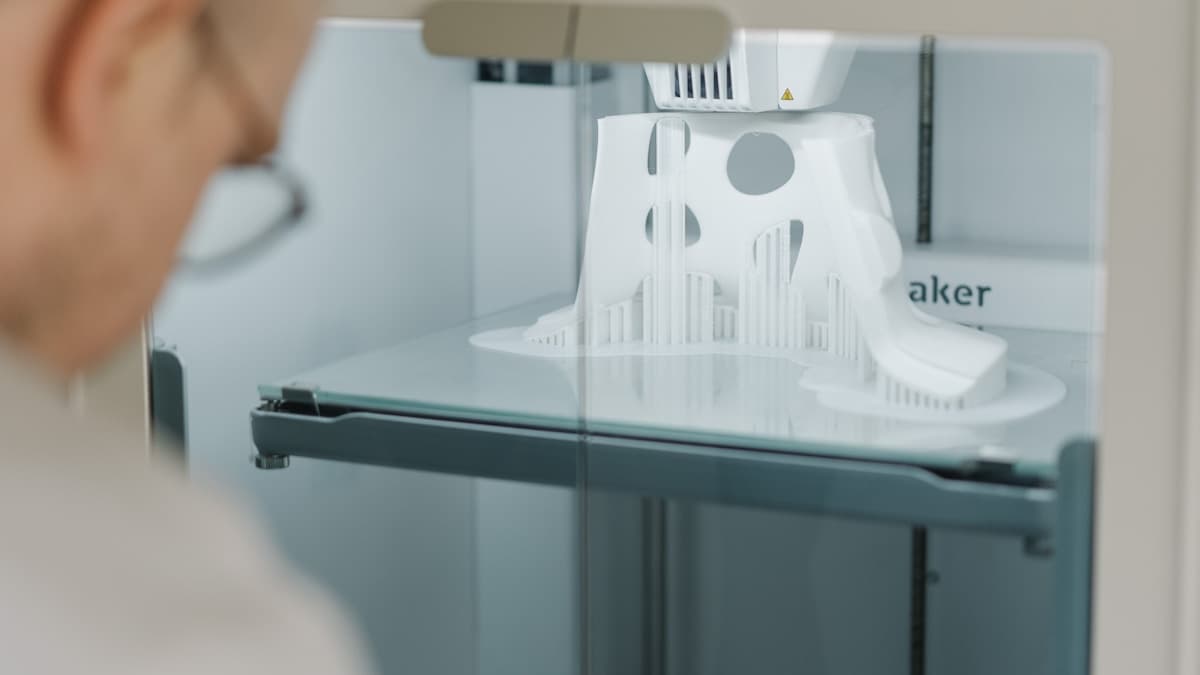
The direct answer: the Flashforge Adventurer 5M Pro is the best enclosed 3D printer under $500 in 2026 for engineering prototype work — a fully enclosed chamber, CoreXY motion, and dependable output on ABS, ASA, and PETG. The Bambu Lab P1S is the better pick if you want a faster, more polished machine and have room in the budget.
If the material you need is polycarbonate, pure nylon, or a carbon-fiber blend, none of the first four picks is specified for it. Skip to pick 5.
If you mostly print PLA and PETG, you may not need an enclosure at all — the FAQ at the bottom covers that. But the moment functional parts demand ABS, ASA, or nylon, an enclosed chamber stops being optional. If you'd rather outsource the work entirely, the 3D Prototyping Hub directory lists service providers who run these materials at production quality.
This post contains affiliate links. If you purchase through these links, 3D Prototyping Hub may earn a small commission at no extra cost to you.
This post also contains Amazon affiliate links. As an Amazon Associate I earn from qualifying purchases.
Why an Enclosure Matters
An enclosed build chamber does one thing: it traps the heat around your print so the part cools slowly and evenly. That sounds minor until you try to print ABS or ASA in open air, where the bottom layers cool and contract while the top is still hot — and the part warps off the bed or cracks along a layer line.
PLA and PETG don't care much; they print fine open-frame. ABS, ASA, and nylon do care, and those are exactly the materials you reach for when a part has to survive heat, sunlight, or mechanical stress. So the real question isn't "enclosed or not" — it's "which materials will I actually run?" Buy the enclosure for the materials you need, not for the spec sheet. SLA vs. FDM Printing Explained covers the broader process choice if you're still deciding.
1. Flashforge Adventurer 5M Pro — Best Overall Enclosed Printer
The Flashforge Adventurer 5M Pro is the printer most engineering teams should buy first. It pairs a fully enclosed chamber with CoreXY motion for speed and accuracy, adds auto-leveling and a direct-drive extruder, and includes filtration for running ABS and ASA in a shared space. Output is consistent on the materials that justify an enclosure, and it does it for under $500 — which is why it's our top pick for functional prototype work.
Best for: teams that need reliable ABS, ASA, and PETG parts without stepping up to a four-figure machine.
2. Bambu Lab P1S — Best Step-Up Pick
The Bambu Lab P1S is the machine to buy when you want speed and polish and have a bit more budget. It's a fully enclosed CoreXY printer with fast, clean output and a refined workflow, and it handles ABS and ASA reliably. You can find current pricing and bundles on Amazon. It costs more than the Adventurer 5M Pro, but the speed and consistency are worth it for teams printing daily.
Best for: higher-throughput teams that value print speed and a polished experience.
3. Creality K1 — Fast and Compact
The Creality K1 is an enclosed high-speed CoreXY machine with a compact footprint, suited to fast iteration on PETG and ABS. It's a strong middle option between the budget and step-up picks, widely available on Amazon. Tuning ABS takes a little attention, but the speed is genuinely useful when you're cycling through design revisions.
Best for: makers and engineers who want fast prints in a small space.
4. Flashforge Adventurer 4 — Larger-Volume Workhorse
If you need more build volume and a machine built for steady, hands-off production, the Adventurer 4 from the Flashforge collection is a dependable enclosed workhorse. It trades the 5M Pro's top-end speed for a larger chamber and proven reliability — a good fit for an office or lab that prints functional ABS and ASA parts regularly.
Best for: teams that prioritize build volume and reliability over peak speed.
5. QIDI Plus5 — Best for Polycarbonate, Nylon, and Carbon-Fiber Blends
The four picks above are specified for ABS, ASA, and PETG. None of them is specified for polycarbonate or pure nylon, which is why this guide used to answer that question by sending you to a service bureau. That answer was incomplete. The QIDI Plus5 is the machine it was missing.
Read off QIDI's own store on 2026-09-08: a 370 C nozzle, 65 C independent chamber heating, a 320x320x300 mm build volume, CoreXY motion on 9 mm belts, a 120 C bed, and a three-stage filter (G3 pre-filter, H12 HEPA, activated carbon). $749.
Two of those numbers do the work. Polycarbonate and nylon need a nozzle hot enough to melt them properly and a chamber that holds a set temperature for the whole print. A passively enclosed machine holds whatever the bed throws off, which drifts as the part gets taller and the nozzle moves further from the plate. That drift is what cracks a tall PC part along a layer line. Independent chamber heating removes it.
This is not the cheapest way into an enclosure and it is not trying to be. At $749 it costs more than the Adventurer 5M Pro and does a different job. If ABS and ASA are the materials you actually run, pick 1 is still the better buy.
Step up: the QIDI Max4 at $1,049 carries the same 370 C nozzle and 65 C heated chamber in a 390x390x340 mm volume, moves at up to 800 mm/s with 30,000 mm/s² acceleration against the Plus5's 600 mm/s and 20,000 mm/s², and QIDI lists PC, PA, TPU, and PPS-CF among its supported materials. Buy it for size and speed, not for capability the Plus5 lacks.
Best for: engineering teams printing polycarbonate, nylon, or carbon-fiber blends in house.
What we are not recommending, and why. The Q2 at $499 carries the same 370 C nozzle and 65 C chamber in a 270x270x256 mm volume, but on 2026-09-08 QIDI's store offered it only in China and Brazil pre-sale variants, so it is not a US buy today. The Q2C at $349 is the entry model and its store listing states neither an enclosure nor a nozzle temperature, so it does not belong in this comparison. The Plus4 was out of stock on the same read. Prices here move: three of these five changed in the six days before this update, so check the current figure before you buy.
A Note on Filament
The whole reason to buy an enclosure is reliable ABS and ASA, so don't pair it with bargain filament. eSUN ABS+ is a low-warp formulation built for exactly this — it forgives the small temperature swings that crack lesser ABS. If you mostly print PLA and PETG, an open-frame machine and Anycubic's budget lineup will serve you better for less money.
When to Use a Service Instead
A desktop enclosed printer is the right tool for in-house iteration and functional ABS parts. It is not the right tool for SLA detail work, SLS nylon production, metal, large parts beyond its build volume, or anything requiring certifications. For those, a service bureau is faster and more reliable — see How to Choose a 3D Printing Service and SLS 3D Printing Services. Most serious teams run both: print in-house for speed, outsource for specialty and production work.
Find a Provider for Production and Specialty Work
When a part needs SLA, SLS, metal, or certified materials — or simply more volume than a desktop machine can deliver — browse the 3D Prototyping Hub directory, shortlist providers that run the process you need, and request quotes on the same file. Run a print shop yourself? Claim your listing to start receiving quote requests from buyers.
Related Resources
Hero photo by Tom Claes on Unsplash. This post contains affiliate links — 3D Prototyping Hub may earn a commission if you purchase through them, at no cost to you. As an Amazon Associate, we earn from qualifying purchases.