The short version: a 3D printer air purifier is two different products that get sold under one name, and buying the wrong one is why people conclude filtration doesn't work. Particles need HEPA. Fumes need activated carbon — a real bed of it, weighed in grams, not a black-tinted mesh. Most desktop printers are best served by a room purifier that has both, an enclosure keeps the emissions concentrated where they can be captured, and anyone printing ABS or ASA daily should stop filtering and start ducting the air outside. If you'd rather not manage any of this, a service bureau prints in a properly ventilated shop and ships you the part.
This guide covers what actually comes off a printer, what to look for on a spec sheet, the four options worth your money in 2026, and the ones that only look like they're working.
This post contains affiliate links. If you purchase through these links, 3D Prototyping Hub may earn a small commission at no extra cost to you.
This post also contains Amazon affiliate links. As an Amazon Associate we earn from qualifying purchases.
What Actually Comes Off a 3D Printer
Two categories, and they need two different countermeasures:
- Ultrafine particles. Molten thermoplastic condenses into particles small enough to reach deep into the lungs. Every FDM material emits some; ABS, ASA and other styrene-based filaments emit substantially more than PLA, and emission rises with nozzle temperature. These are what HEPA is for.
- Volatile organic compounds. Gases. Styrene from ABS and ASA, caprolactam from nylon, a mix of aldehydes from PLA, uncured monomer and isopropyl alcohol from resin work. HEPA does not touch them. These are what activated carbon is for.
Resin is worth separating out. An MSLA machine produces almost no particulate — the entire problem is vapour off the vat and the wash tank. That is a carbon-and-ventilation job, and a HEPA-only purifier next to a resin printer is decoration. Our resin safety and post-processing basics guide covers the handling side.
The last variable is the room. The same printer that is a non-issue in an open garage is a genuine exposure in a closed spare bedroom, because what matters is concentration, and concentration is emission divided by air changes. If the only thing you change is opening a window, you have already done more than most purifiers will.
What to Look For
- Carbon by weight, not by adjective. The single most useful number on the box is how much activated carbon the filter holds. Hundreds of grams is a real filter. A "carbon-coated pre-filter" is a few grams bonded to mesh and is finished in days of printing.
- True HEPA, and a sealed path. H13-class media is standard and cheap now. Sealing matters as much as the media: air that leaks around a filter is air that was never filtered.
- Airflow matched to the room. A unit rated for a 20 m² room in a 40 m² workshop cleans slowly enough that you won't notice it working. Oversize it and run it on low — quieter and more effective than a small unit at maximum.
- Replacement media cost and availability. This is the number that decides whether the thing is still running in a year. Check the price of a replacement set and whether it is actually in stock before you commit to the platform.
- Noise. You will run this next to a printer for eight hours at a time. If it is louder than the machine, it gets switched off, and a switched-off purifier filters nothing.
- No deliberate ozone. Skip ozone generators entirely and treat ioniser modes as something to leave off. See the FAQ — they can make workshop air measurably worse.
The Best 3D Printer Air Purification Options in 2026
1. A Room Purifier With Real Carbon — Best for Most People
If you own one open-frame printer and print mostly PLA and PETG, this is the correct answer and the cheapest one. A room purifier with HEPA and a genuine carbon layer sits beside the bench, cleans the whole room rather than one machine's exhaust, and survives every printer you will ever own. Position it downwind of the printer relative to the room's airflow, not across the room, and run it continuously during and for an hour after a print — emissions do not stop the moment the job does.
What it will not do is capture at the source. Everything the printer emits enters the room first and is removed second, so the peak concentration next to the machine is unchanged. That trade is fine for PLA and marginal for ABS.
2. In-Chamber Carbon Units — Capture at the Source
An enclosure turns a diffuse problem into a contained one, and a small fan-and-carbon module mounted inside it scrubs the chamber air before it leaks out. This is the right upgrade for someone who prints ABS or ASA occasionally, already owns an enclosed machine, and doesn't want to run ducting. Anycubic sells filter units alongside the enclosures they fit, which is worth paying a small premium for — a module designed for your chamber mounts without fabrication and doesn't block the chamber fan.
Be realistic about capacity. These hold tens of grams of carbon and run intermittently. They meaningfully reduce what escapes an enclosure; they do not make a closed room safe for continuous ABS. If you don't have an enclosure yet, start with the enclosure guide — the enclosure does more of the work than the filter does.
3. Printers With Filtration Already Built In
Several current enclosed machines ship with HEPA and carbon in the chamber and a duct port on the back. If you are buying anyway, this is free filtration, correctly sized and already sealed — Flashforge's enclosed range is the obvious example, and integrated filtration is increasingly standard at the enclosed end of the market. Check two things before you assume it's handled: whether the filter is genuinely activated carbon or a token pad, and what a replacement cartridge costs. A cartridge that is expensive or perpetually out of stock becomes a printer with an empty filter housing.
4. Ducted Extraction — The Only Permanent Fix
If you run a print farm, print engineering materials daily, or have the machine in a room with no meaningful ventilation, stop filtering and start extracting. A 4-inch inline duct fan with a carbon canister, ducted from the enclosure to a window vent, moves the contaminants out of the building instead of storing them in media that saturates. It is the standard approach in resin workshops for the same reason.
Two practical notes. Extraction pulls conditioned air out of the room, so in winter you are heating the outdoors — run it during prints, not permanently. And extracting hard from a sealed enclosure fights the chamber heat that ABS needs; use a modest fan or duty-cycle it rather than running maximum airflow through a chamber you are trying to keep warm.
5. Resin: Contain It, Then Extract It
For MSLA, the priority order is containment, extraction, then carbon. Keep the hood on the printer closed except when you're working, keep the wash container lidded, and put the machine where you can vent. ELEGOO's accessory range includes small carbon units sized for a printer hood, which help with residual odour but are not a substitute for air changes. Nitrile gloves and eye protection matter more here than any filter does — the main exposure route for photopolymer is skin, not lungs.
What Else You Need
- An air-quality monitor — a consumer VOC and particulate meter is not laboratory-grade, but it will show you the difference between a closed door and an open window in real time, which is the fastest way to learn what your room actually does.
- Cut-to-size carbon sheet — the cheap way to keep a generic enclosure filter topped up, and to avoid being held hostage by a proprietary cartridge.
- Nitrile gloves — non-negotiable for resin, and useful for handling hot-end maintenance.
- An enclosure, if you don't have one. Contained emissions can be captured; room-scale ones can only be diluted.
What Doesn't Work
- HEPA alone against ABS or resin. It removes the particles and passes the styrene and the monomer through untouched. If a product's spec sheet mentions only HEPA, it is half a solution.
- A "carbon" pre-filter measured in millimetres. Adsorption capacity scales with the mass of carbon. A tinted mesh has almost none.
- Ozone generators and ioniser modes. Ozone irritates airways and reacts with the VOCs already present to form formaldehyde and fresh ultrafine particles.
- A purifier in the corner with the enclosure door open. You've undone the containment that made the enclosure worth having.
- Assuming PLA is inert. It is the lowest-emission common filament, not a zero-emission one, and a small closed room with a printer running twelve-hour jobs still accumulates.
Buyer Recommendation Summary
- One printer, mostly PLA/PETG, decent room → open a window and add a room purifier with a real carbon layer. Done.
- Occasional ABS or ASA in an enclosure → an in-chamber carbon unit made for your enclosure, plus the room purifier.
- Buying a new enclosed machine → pick one with filtration built in and check the replacement-cartridge price first.
- Daily engineering materials, or a print farm → duct it outside with an inline fan. Nothing else keeps up.
- Resin → containment and extraction first, carbon second, gloves always.
- You just want the parts → browse the provider directory and let a ventilated shop run the machine.
When to Use a Service Instead
Air handling is the part of desktop 3D printing that scales worst. One printer in a garage is a solved problem for the price of a fan. Six machines running ABS in a spare room is a ventilation engineering job, and the equipment that does it properly costs more than the printers. If your volume in high-temperature materials is climbing, price the ducting honestly against outsourcing — a bureau already has the extraction, the space and the machine time.
Browse the 3D Prototyping Hub directory to get parts made without building a ventilated workshop first. If you're staying in-house, the best 3D printing tool kits and accessories guide covers the rest of the bench.
Related Resources
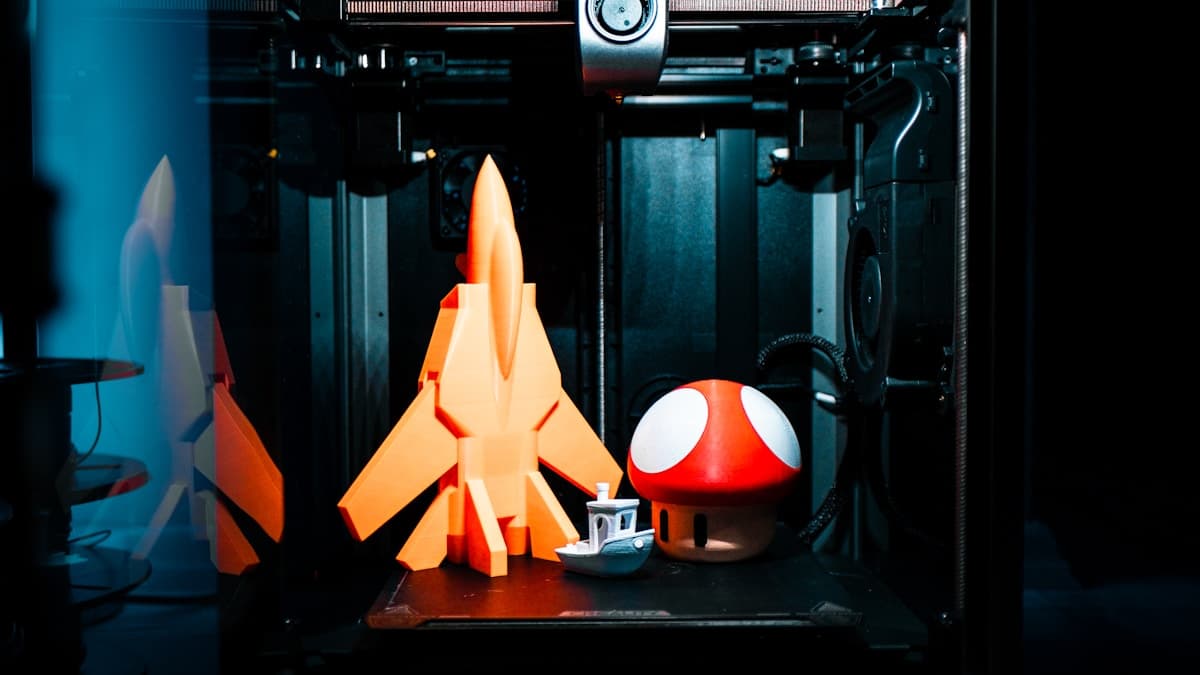
Hero photo by Efe Yağız Soysal on Unsplash. This post contains affiliate links — 3D Prototyping Hub may earn a commission if you purchase through them, at no cost to you. As an Amazon Associate, we earn from qualifying purchases.
Ready to find a 3D printing service provider?
Browse 2,000+ verified providers across the United States and submit your quote request free.
Browse Providers