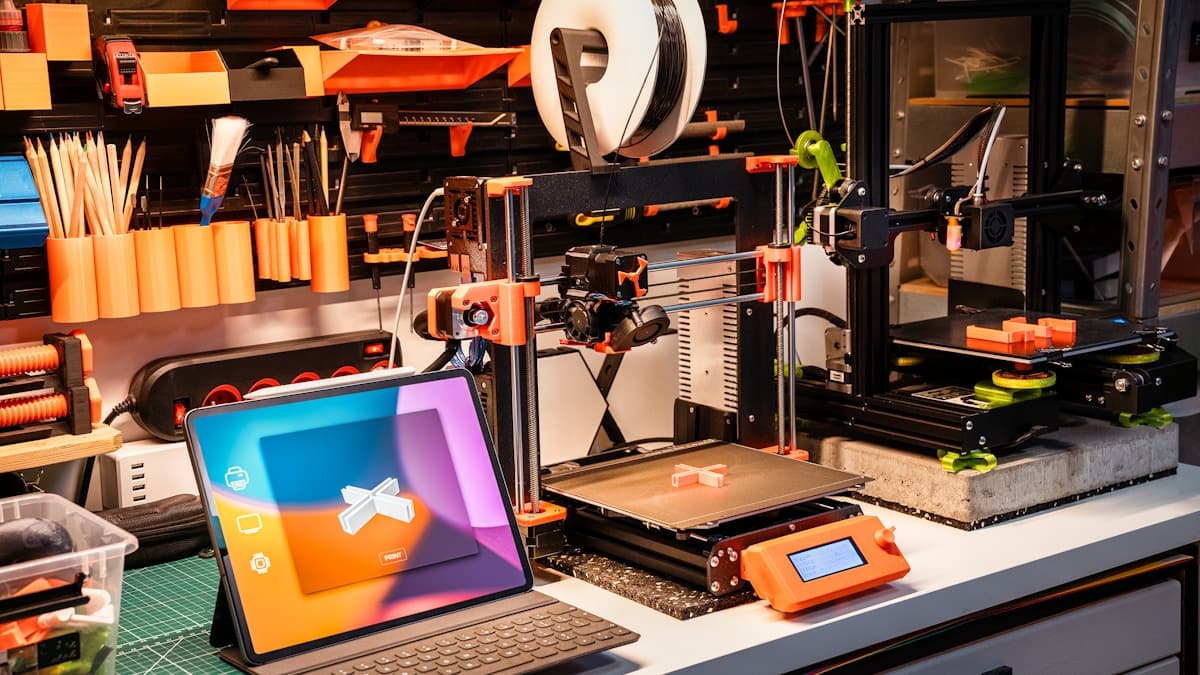
Nothing about the printer changed. The same profile that ran all summer now gives you a bed that takes twenty minutes to come up and still reads short, PLA that lifts at the corners of anything wider than a phone, and PETG parts that snap when you flex them instead of bending. The machine is fine. A cold garage is quietly changing three separate things at once — how much heat the bed can hold, how fast each extrusion cools before the next one lands on it, and how much the part shrinks on its way down to room temperature — and each of those breaks a different thing. This is how to tell them apart, and what to fix in what order.
This post contains affiliate links. If you purchase through these links, 3D Prototyping Hub may earn a small commission at no extra cost to you.
This post also contains Amazon affiliate links. As an Amazon Associate we earn from qualifying purchases.
Read the Symptom Before You Change the Profile
Four failures, four different mechanisms. Match yours before touching a setting, because the fix for one makes another worse.
| What you see |
What the cold is doing |
Where to start |
| Bed never reaches target, or reads target and won't stick |
Heat loss to the room scales with the temperature difference |
Insulate the bed, stop the draught |
| Corners lift, long parts bow off the plate |
Part cools and contracts faster than the layer below |
Enclosure, then brim |
| Parts break along layer lines under light load |
Each extrusion is too cold to weld to the last |
Fan down, nozzle up |
| Banding on tall parts, or a grinding Z axis |
Grease has thickened in the cold |
Thin film of cold-rated grease |
The Bed Is Losing the Fight to the Room
A heated bed does not have a temperature. It has a heater of a fixed wattage and a rate at which the room takes that heat away, and the temperature it settles at is where those two balance. That rate rises with the difference between the bed and the air around it — so the same heater that comfortably held 60°C in a 22°C workshop is being asked for a great deal more work in a 5°C garage, and it may simply not have it.
Two things follow that people miss. The first is that the display lies by omission: the thermistor sits under the plate, usually near the centre, and it can read 60°C while the surface under a 200mm part — cooled from above by the part fan and from below by cold air moving under the gantry — is several degrees cooler. The second is that warm-up time is not soak time. Reaching the target and being at the target throughout the plate are different states, and in the cold the gap between them is minutes.
What actually helps, cheapest first:
- Insulate the underside. The bottom face of the bed radiates into the room and does no printing. A self-adhesive insulation pad on that face shortens warm-up and lifts the temperature the bed can hold, and it is the one modification here that costs almost nothing.
- Soak before you print. Set the bed, then wait five to ten minutes past the beep before starting the job. A heat-soak G-code pause at the top of your start script makes it automatic.
- Stop the draught. Moving cold air strips heat off the plate far faster than still cold air. A garage door that does not seal, or a vent above the bench, is worth more than any setting change.
If the first layer is still marginal after all three, the problem has moved on from temperature and the diagnosis is in why prints don't stick to the bed — cold makes an existing adhesion problem visible rather than creating one from nothing.
Warping Is About the Difference, Not the Temperature
A part warps because the layer being printed cools and contracts while the layers below it have already finished contracting. The bigger the gap between extrusion temperature and the air the part is sitting in, the harder that pull, and a cold room widens that gap on every single layer.
This is why the cold hits materials so unevenly. PLA contracts little and forgives a cool room. PETG contracts more. ABS and ASA contract enough that in still, warm air they are manageable and in a 6°C garage they are close to hopeless — the corners come up on the first 10mm and the part cracks along a layer line halfway through. No brim fixes that, because the brim is holding a part that wants to tear itself apart internally.
The honest order of fixes is: enclose the machine, raise the bed temperature slightly, then add a brim — and treat a raft as the last resort it is. The full mechanism, including the geometry changes that reduce the pull in the first place, is in why 3D prints warp.
Cold Air Breaks the Weld Between Layers
A layer line is not a join in solid plastic — it is a weld, and welds need heat. Each extrusion has to still be soft enough when the next one lands on it for the two to fuse. In a cold room the extrusion loses that heat faster, and the result is a part that looks perfect and shears cleanly along a layer under a load it should have shrugged off.
The counterintuitive fix is to turn the part cooling fan down, not up. Fan settings are tuned in a warm room, where they stop overhangs drooping. In a 6°C garage the ambient air is already doing that job, and running 100% fan on PETG or ABS in the cold is actively destroying the bond you need. Drop the fan to 30–50% for PETG and to near zero for ABS and ASA, and raise the nozzle 5–10°C above your summer profile. Wider extrusion helps too, because a thicker bead carries more heat into the weld.
Do check whether the break is actually a cold problem before you chase it — why prints snap along layer lines separates the cold case from wet filament and from under-extrusion, which look identical in the broken part.
The Enclosure Is the One Fix That Addresses All Three
Everything above is a symptom of the same cause, and an enclosure is the only intervention that treats the cause. There is no heater in a passive enclosure — the bed and the hotend are the heat source, and the panels simply stop that warmth being carried off, so the air around the part settles well above the room and stays still. Warping, layer bonding and the bed's fight with the room all improve together.
For an open-frame machine, a fabric enclosure tent is the cheap version and works better than it has any right to, mostly because it eliminates the draught. A rigid panelled enclosure holds more heat and is easier to live with day to day; the trade-offs between the two are in our 3D printer enclosure guide.
Two cautions that matter more in winter than at any other time of year:
- Never put a space heater inside an enclosure. A small sealed volume, plastic panels, an unattended machine and hours of running is a fire, not a workaround. Heat the room, and let the enclosure keep that heat around the printer.
- PLA does not want a hot chamber. It softens in the hotend's heatsink when the surrounding air gets too warm, and jams. If you run PLA in an enclosure, crack the door or lift a panel.
Where the material list has genuinely outgrown a passive box — ABS, ASA, polycarbonate, nylon, in an unheated space, repeatably — the answer is a machine with a chamber heater rather than a chamber. QIDI's enclosed high-temperature line is built around that: the Plus5 and Max4 are fully enclosed with an actively heated chamber specified at 65°C, so the chamber is a number you set rather than a number the weather gives you. If you are comparing that class of machine rather than diagnosing, the enclosed printer guide covers the field.
The Filament Problem Is the Trip Indoors, Not the Cold
Cold air holds very little moisture, so a spool sitting in a freezing garage is not absorbing much. The damage happens when you carry it inside. A spool at 3°C brought into a warm, humid room is below the dew point of that room, and water condenses directly onto the plastic — which PETG, nylon and TPU then take up. Days later you get popping at the nozzle, a fuzzy surface, and parts that snap for no visible reason.
So handle the transition rather than the temperature:
- Move spools between the garage and the house inside a sealed bag, and let them reach room temperature before opening it.
- Store the spools you are not using in vacuum bags with desiccant, in the place they actually live.
- Feed the machine from a heated dry box if you print engineering materials in an unheated space at all. It removes the trip through room air and keeps the spool dry through a long print, which matters more in a garage than anywhere else.
- Watch the number, not the weather, with a small hygrometer in the box.
Cold also makes filament measurably more brittle while it is cold, which is why spools that have been in the garage snap at the spool clip or in the feed tube. That is a separate fault family with its own tells — why filament snaps on the spool sorts the brittleness that is reversible from the hydrolysis that is not.
The Machine Gets Stiff Too
Grease thickens as it cools. A Z axis dragging through stiff lubricant on lead screws or linear rails moves slightly less than it is told to, and that shows up as banding on tall parts that were fine in August. Clean the old grease off rather than adding to it, and use a PTFE grease rated for the temperature you actually print at — a thin film, not a coating.
Belts lose tension as the frame contracts, so recheck them at the start of the cold season rather than assuming last summer's setting. And if you run a resin machine out there, cold is a harder limit than it is for filament: resin viscosity climbs steeply as it cools, and below roughly 20°C prints fail at the plate or shear off mid-column no matter what the exposure says. That case is covered in why resin prints fail.
What to Do, in Order
- Insulate the bed's underside and add a heat-soak pause. Cheap, immediate, helps everything.
- Block the draught. Free, and often the single biggest improvement.
- Turn the part cooling fan down and the nozzle up, per material.
- Enclose the machine. This is the step that converts a garage into a workable space.
- Seal and dry the filament, and handle the trip indoors.
- Re-grease and re-tension for the season.
- Accept the material limit. ABS, ASA and PC in an unheated space need a heated chamber, not more tuning.
If you need those materials before the enclosure arrives, print in PLA or PETG now and reprint later — or send the job out. A shop running climate-controlled machines does not have a winter. The providers in our directory are listed by location and process, and for one large ABS part it is usually cheaper than the third attempt.
Hero photo by Jakub Żerdzicki via Unsplash.