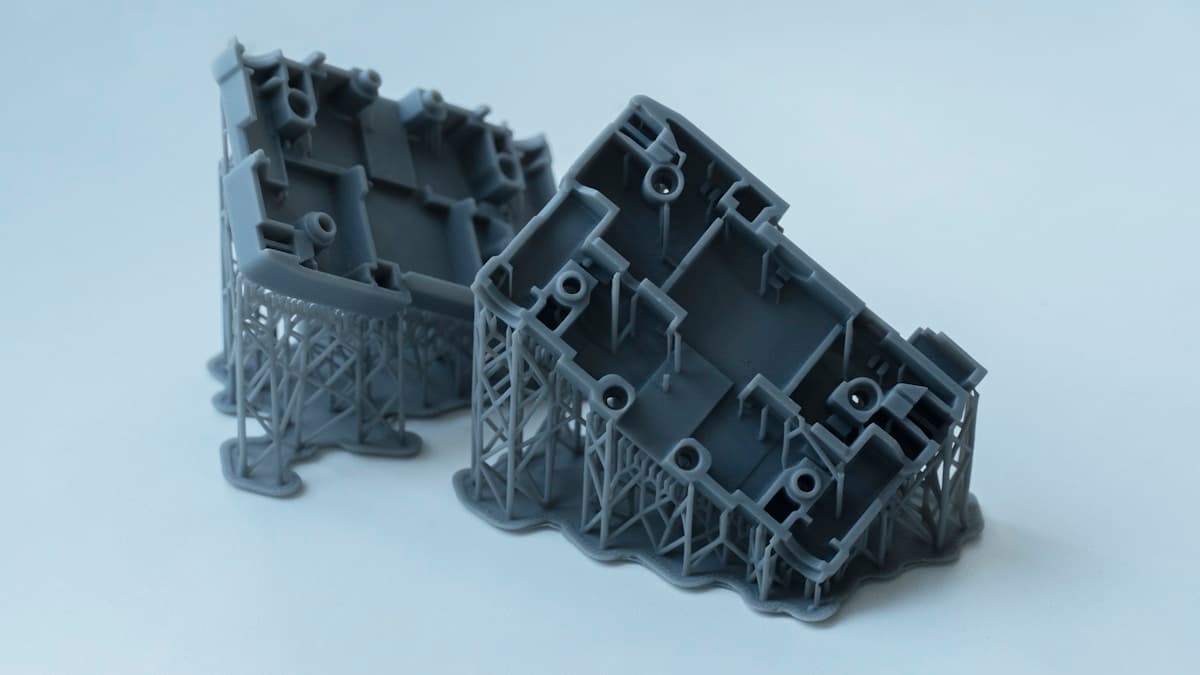
3D printing services for dental labs get hired for a specific reason: the plate is full, the case is due Thursday, and buying a second machine to cover a two-week spike is not a plan. Additive is already the default in this trade — models, dies, custom trays, aligner molds and splint blanks are printed rather than poured in most labs that have modernised — so the question is rarely whether to print. It is which work stays on your own machines, which goes out, and how to hand a case to an outside shop without discovering on delivery that they placed supports across an intaglio surface. This guide covers what a general bureau can and cannot legitimately do for a dental lab, how to specify accuracy, and what to check before the first case leaves the building. Start with the 3D printing provider directory when you are ready to shortlist.
What Dental Labs Actually Send Out
The outsourced work falls into four groups, and knowing which group a case belongs to settles the material and the vendor question before anyone quotes.
Models, dies and articulation. Working models, sectioned die models, orthodontic study models, aligner and thermoforming molds. This is the bulk of it — high volume, no patient contact, and the geometry is fully defined by your design file. Any competent resin bureau can run it.
Non-contact lab hardware. Custom impression trays, base plates, bite fixtures, casting and pressing patterns in burnout resin, model articulator adapters. Same story: it is production support, not a device.
Prototypes for dental products. If you are developing a device, an appliance concept or a piece of clinic hardware, this is ordinary low-volume prototyping work and a general bureau is exactly the right vendor.
Overflow of your own routine work. Not a different kind of job, just capacity — the reason most labs first pick up the phone.
What is not on that list is the finished patient-contact appliance, and the next section is why.
The Line a General Bureau Cannot Cross
A model is a tool. A surgical guide, a denture base, a splint, a try-in or a temporary crown is a medical device, and printing one is manufacturing.
That distinction carries real obligations. The resin has to be cleared for the intended contact — short-term mucosal and bone contact for a guide, long-term intraoral contact for a splint or denture base — and clearance attaches to the system, not the bottle: the specific resin, on a validated printer, with the wash solvent, wash time and cure cycle the manufacturer validated, and traceability back to the lot. Deviate on any one of those and you no longer have the device the clearance describes. A cheaper compatible resin, a longer cure "to be safe", or an alcohol swap all break it.
Most general-purpose printing services hold none of this, and it is not a gap they can close for one customer. So the practical rule: outsource the tooling, keep the device. Send models, molds, trays, patterns and prototypes to a bureau. Produce patient-contact appliances on a validated in-house workflow or through a partner lab that can show you the clearance documentation and the validation records — and ask to see them rather than taking the claim. The same reasoning applies more broadly to 3D printing for medical devices, and to anatomical models built from CT data, where the model is a planning aid and everything that enters the patient is a separate regulatory question.
Specifying Accuracy So the Case Comes Back Usable
Dental work fails on tolerances that most engineering jobs would not notice. Four things to state on the order.
Which surfaces are critical. Intaglio surfaces, margins and die shoulders carry the fit; the base does not. Say so explicitly, because it drives orientation and support placement. A support nub on a margin is a remake, and a shop that has never printed dental work will not know that on its own.
Orientation and support policy. Ask for supports off the critical surfaces and for the arch tilted rather than laid flat — flat arches trap suction forces on an LCD machine and distort. If the shop wants to reorient for plate density, ask them to tell you first.
Post-cure, stated as a cycle. Under-cured models are soft and drift for days; over-cured ones shrink. "We cure them" is not a spec. Get the cure unit, the time and the temperature, and expect them to be the resin manufacturer's numbers.
A trueness figure they have measured. Not the printer's datasheet. A full-arch model within roughly 50–100 microns of the design file is a reasonable expectation from a well-run resin workflow; scanning a printed arch back and reporting the deviation is the only way anyone actually knows. Our guide to tolerances and accuracy covers how to write this into an order without over-specifying and paying for precision the case does not need.
Materials and Processes
| Job | Typical material | Notes |
|---|---|---|
| Working and study models, dies | Rigid model resin, non-contact | Colour choice is about scanning contrast, not aesthetics |
| Aligner and thermoforming molds | High-heat model resin | Must hold shape under the forming machine's heat and vacuum |
| Custom impression trays, base plates | Tray resin | Non-contact in the lab, brief clinical contact — check the grade |
| Casting and pressing patterns | Burnout / castable resin | Must burn out ash-free or the framework is scrap |
| Lab fixtures, storage, articulator adapters | FDM in PETG or ASA, or SLS nylon | Cheap, tough, and no reason to spend resin on it |
| Patient-contact appliances | Cleared device resins only | Validated workflow — see the section above |
On process, vat photopolymerisation does nearly all of it. Masked stereolithography — the LCD and DLP machines — dominates dental because the whole layer images at once, so a full plate of arches costs the same time as one. Laser SLA trades throughput for a slightly cleaner small-feature result. Material jetting earns its place where you need multi-material or a soft gingival mask on a rigid model, at a materials cost that only makes sense for implant and presentation cases. SLA versus FDM is not a real contest here: filament cannot resolve a margin, and its place in a dental lab is fixtures and boxes. Cobalt-chrome frameworks printed by laser powder bed fusion are a specialist dental-metal service, not something a general prototyping bureau should be quoting.
What to Check Before the First Case Goes Out
- Do they already run your resin? A shop that has to buy and calibrate a new material for you will be slower and less consistent on the first few plates.
- Will they accept customer-supplied resin? Some will, some will not, and it changes who owns the result if a print fails.
- Support removal and finishing. Ask what arrives — parts on supports, or cleaned, washed, cured and ready. Dental supports come off by hand, and the labour is a real line item. Post-processing and finishing services explains where that cost sits.
- Traceability. Resin lot and cure cycle recorded per job, even on non-contact work. If you ever need to explain a batch of bad-fitting models, this is the only record that helps.
- Data handling. An NDA covers the commercial risk; a business associate agreement covers the patient data. Get both if identifiers are travelling.
- Packaging. Thin dies and unsupported arches break in transit. Ask how they pack before you find out.
Pricing: What Actually Drives the Number
Resin jobs price on plate occupancy and height, not part count — twelve arches nested on one plate cost close to what four cost, because the machine images each layer regardless. That has a direct consequence for you: batch cases and send them together rather than drip-feeding one at a time, and expect an expedite fee for a single urgent arch, because it takes a whole plate.
The other drivers are material class (device-grade resins run several times the price of model resin), post-processing labour (usually the largest hidden cost, and the one shops quote most loosely), and turnaround. Everything else is noise. If a quote is wildly cheaper than the rest, check what it excludes — nine times out of ten it is supports still attached and no post-cure.
Getting Started
Send one representative case first, not a batch: a full arch with dies, printed to your spec, and scan it back against the design file when it arrives. That single job tells you more about a vendor than any capability list, and it costs less than a week of remakes. When it checks out, browse providers in the directory to line up a second source — capacity you have not tested is not capacity.
Hero image: EnCata PD, via Unsplash.