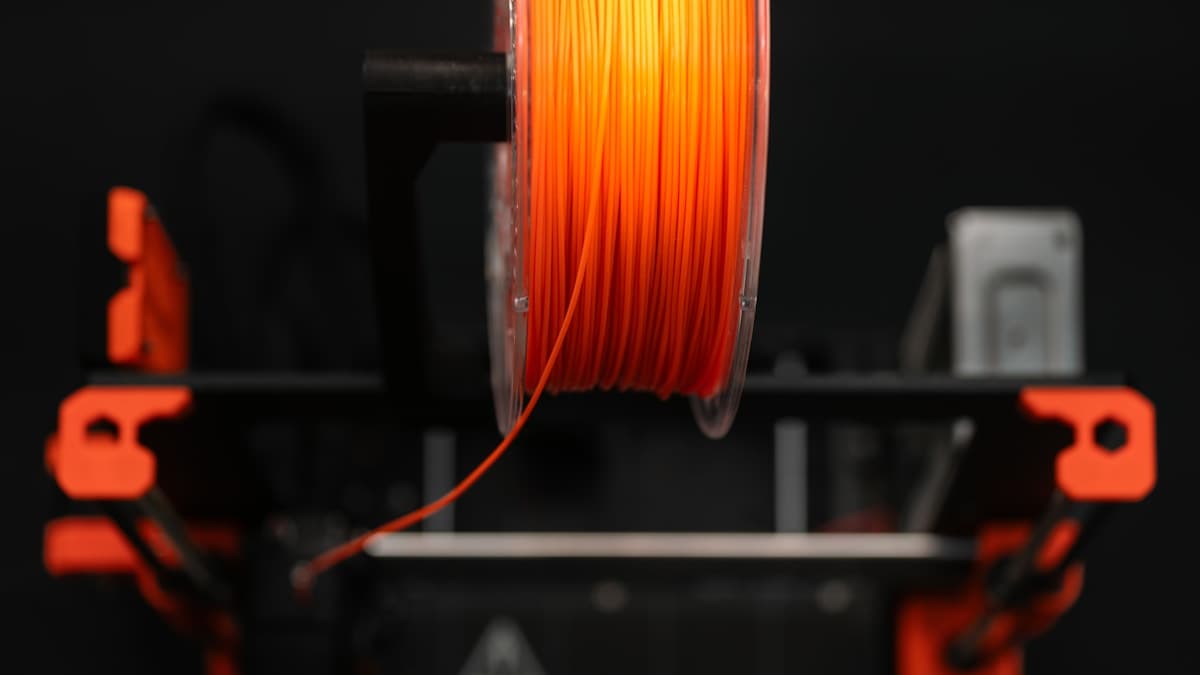
The short version: the best silk PLA filament for most people is eSUN eSilk PLA, because its sheen is the most consistent from the start of a spool to the end and its colours match the photographs. Buy SUNLU Silk PLA when you are printing gifts in volume, Overture Silk PLA when a spool has to still print well three months after you opened it, ERYONE Silk Dual-Colour when you want a two-tone finish out of a single nozzle, and AMOLEN Silk Rainbow for gradients on tall vase-mode prints.
Silk PLA is the one filament people buy purely for how it looks. It is standard PLA with an additive that leaves the extruded surface glossy and semi-translucent instead of matte, and on the right model it produces a finish that reads as glazed ceramic or anodised metal straight off the plate, with no sanding, priming or painting. It is also weaker than the PLA underneath it, it strings more, and it shows every seam and blob the gloss can catch. This guide covers the trade-off, the settings that decide the result, and which spools are worth the money.
This post contains affiliate links. If you purchase through these links, 3D Prototyping Hub may earn a small commission at no extra cost to you.
This post also contains Amazon affiliate links. As an Amazon Associate I earn from qualifying purchases.
What silk PLA is, and what it costs you
Silk PLA is PLA with a few percent of a co-polymer modifier mixed in. The additive slows how fast the skin of the extruded strand sets, so each line settles flat and semi-translucent instead of freezing into the matte micro-texture normal PLA leaves. Light then reflects off a continuous surface rather than scattering off thousands of small ridges. That is the whole trick, and it is why the effect is strongest on curved, single-walled prints and weakest on flat plates and sharp corners.
The same additive that buys you the gloss costs you the strength. Layers weld less well to each other, so silk parts snap at the layer line under load that plain PLA would flex through — plan on 20–30% less layer adhesion, and more brittleness in thin walls. There is no way to have both: every silk spool on the market makes the same trade.
So the material choice is really a part choice. Vases, lamp shades, planters, ornaments, display figures, cosplay pieces and gifts are silk PLA's job. Brackets, jigs, enclosures, clips and anything that lives in a car or a workshop are not — print those in plain PLA or PETG and read how to choose 3D printing filament if you are deciding between the two.
The settings that decide the finish
More people are disappointed by silk PLA than by any other decorative filament, and it is nearly always settings rather than the spool. Four changes from a standard PLA profile:
- Nozzle temperature: 215–230°C. Higher than plain PLA. Sheen builds with heat, because the surface needs to stay mobile a moment longer. Start at 220°C and go up in 5° steps until stringing becomes annoying, then back off one step.
- Part cooling: 30–50%. This is the setting most people never touch, and it matters more than temperature. Full fan chills the skin before it can level, which is exactly the matte finish you were trying to avoid. Less cooling also recovers some of the lost layer adhesion.
- Speed: slower on outer walls. 30–40mm/s on the perimeter gives the surface time to settle. Interior speed can stay wherever your machine is happy — nobody sees the infill.
- Seam position: aligned and hidden, or random. Gloss shows the Z-seam far more than matte plastic does. Put it on a corner or a back edge and it disappears; leave it on a smooth curved face and it is the first thing anyone notices.
A larger nozzle also helps, counter-intuitively. Fewer, wider lines mean fewer boundaries for light to break across, so a 0.6mm nozzle often looks glossier than a 0.4mm one on the same model. That is the opposite of the advice you would give for detail work, and it is why silk and miniatures are a poor match.
The picks
Best overall — eSUN eSilk PLA
The default recommendation, on consistency rather than peak shine. eSilk's gloss holds from the first metre of a spool to the last, the colours look like the listing photos instead of a paler cousin of them, and the diameter is steady enough that a twelve-hour vase print does not show extrusion banding halfway up. The colour range is wide, the metallic shades are the best of the mainstream options, and it is stocked well enough that you can re-buy the same colour a year later. Start here and only move if you have a specific reason.
Check eSUN eSilk PLA pricing
Best budget — SUNLU Silk PLA
The spool to buy when you are printing forty ornaments in December. The sheen sits a step behind eSilk and the colour selection is more hit-and-miss, but on a curved decorative print at arm's length the difference is not something a recipient will ever see. It is also the right spool to learn the material on: burn a kilo finding your temperature and fan numbers on something cheap before you commit an expensive colour to a long print.
Check SUNLU Silk PLA pricing
Best for a spool you keep — Overture Silk PLA
Tight diameter tolerance and, more importantly, vacuum packaging with desiccant in the bag. Silk PLA is the material where moisture is most visible: a damp spool prints a fine matte pitting across the surface, and the surface is the entire product. Overture's packaging plus a resealable bag means the spool you open in March still prints the way it did in January. Print quality is a close match for eSilk; you are buying the storage discipline.
Check Overture Silk PLA pricing
Best two-tone — ERYONE Silk Dual-Colour PLA
Two colours co-extruded into one strand, so the finished surface shifts between them as the nozzle turns. It gives a single-nozzle machine an effect that otherwise needs a multi-material unit, and on a spiralised print the two tones sweep around the model rather than banding. Copper-and-silver and blue-and-purple are the combinations that read best. If you want genuine per-object colour control rather than an effect, that is a multi-colour printer question instead.
Check ERYONE Silk Dual-Colour PLA pricing
Best gradient — AMOLEN Silk Rainbow PLA
The colour changes gradually along the length of the filament, so a tall print transitions from one shade to the next as it grows. On a vase or a lamp shade it produces a gradient no slicer setting could reproduce. The catch is that the transition is tied to filament length, not model height: a short print gets one colour, a wide print cycles quickly, and you cannot choose where a change lands. Use it on tall, thin, single-walled models and let the material do what it does.
Check AMOLEN Silk Rainbow PLA pricing
What else you need
- A smooth PEI or glass plate — a textured sheet embosses its pattern into the one face of the print that could have come out mirror-flat. Our build plate guide covers the surfaces in detail.
- A filament dryer — four hours at 45–50°C brings the gloss back on a spool that has been sitting out. Cheaper than replacing it, and see dry boxes for keeping it that way.
- A sample multipack — silk colours photograph very differently from how they print, particularly the metallics. Small spools are the cheap way to find out.
If you are still choosing the machine, silk PLA wants controllable part cooling and a tidy retraction rather than raw speed or a hardened hotend. Anycubic's and ELEGOO's desktop FDM ranges both do this, and Flashforge's direct-drive machines hold the short retractions that keep strings off a glossy surface.
Getting the last 10% of the shine
Two habits separate a good silk print from a great one, and neither costs anything.
Design the seam out rather than tuning it down. Vase mode removes the seam entirely, which is why almost every showcase silk print you have seen is spiralised. Where the model needs walls and infill, set the seam to a rear corner and keep it there; on a cylinder, "random" scatters small blemishes rather than stacking one visible line.
Deal with strings after the print, not during it. Backing the temperature off far enough to eliminate stringing also removes the sheen you paid for, so accept a few wisps and take them off afterwards with a heat gun on its low setting, held about 20cm away and kept moving. The strings flash away well below the temperature that would dull the surface.
For anything large — a display piece, a run of retail props, an architectural model in a metallic finish — printing it yourself in silk is usually the slow path. A shop with large-format FDM capacity runs it in one piece with the fan and seam control already dialled in. Compare that against your own machine time before starting a week-long print.
Where to go next
Hero photo by Jakub Żerdzicki via Unsplash. This post contains affiliate links — 3D Prototyping Hub may earn a commission if you purchase through them, at no cost to you. As an Amazon Associate, we earn from qualifying purchases.
Ready to find a 3D printing service provider?
Browse 2,000+ verified providers across the United States and submit your quote request free.
Browse Providers