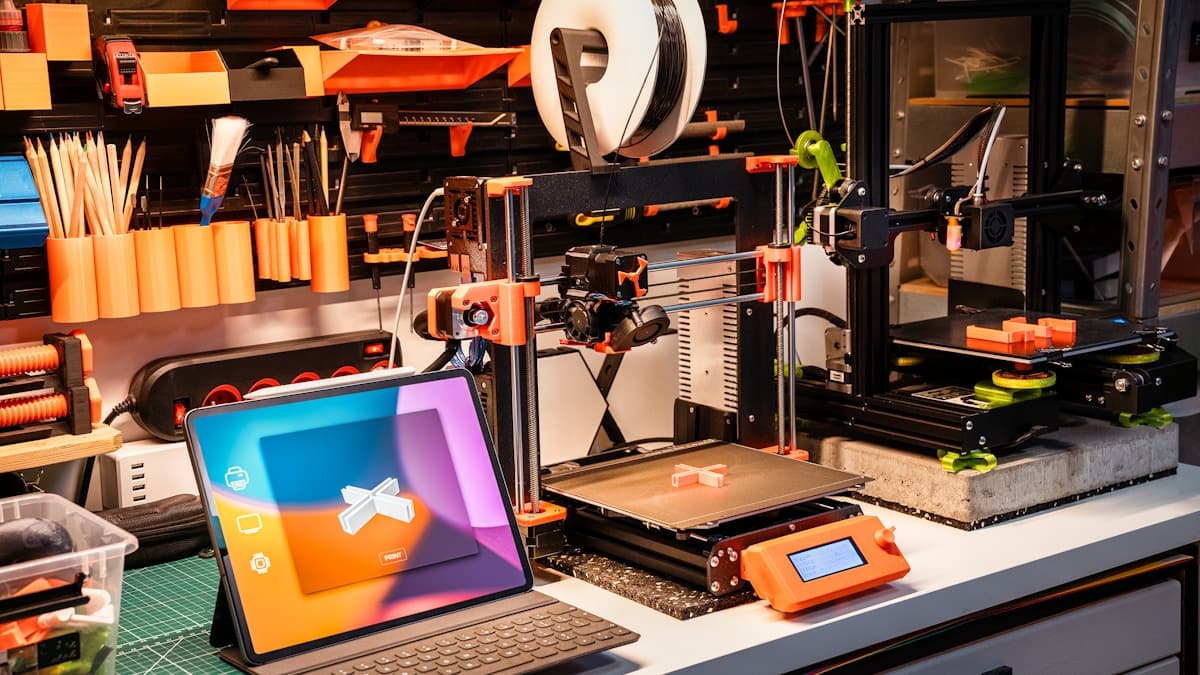
Looking for 3D printing services in Vermont? The 3D Prototyping Hub directory lists 19 providers across the state, and the fastest route to a quote is the Vermont provider directory — filter by city and material, then send your file to the shops that actually fit the part. This is a small market made up almost entirely of independent operators, which has one useful consequence: you will usually be talking to the person who runs the machine.
If you want to understand the market first — where the capacity sits, what Vermont's industry base means for the work local shops take, and how to choose between them — this guide covers it.
Where Vermont's 3D Printing Capacity Actually Is
Vermont's listings cluster in three places, and the raw counts need a caveat before you read anything into them.
| City | Listed providers | Directory page |
|---|---|---|
| Montpelier | 14 | /providers/location/vt/montpelier |
| Burlington | 4 | /providers/location/vt/burlington |
| Springfield | 1 | /providers/location/vt/springfield |
Montpelier carries the most listings and is the smallest state capital in the United States, with a population under 8,000. Those two facts do not coexist by accident. Montpelier is the address of record for a large number of Vermont businesses that do their actual work somewhere else, so treat that count as central Vermont broadly — Barre, Waterbury, Northfield, Randolph, the Mad River valley — rather than as fourteen shops on State Street.
Burlington is the real centre of gravity. Greater Burlington — the city plus South Burlington, Winooski, Essex Junction and Colchester — holds Vermont's largest concentration of engineering, manufacturing and design employment, its research university, and the state's only genuine startup scene. Four listings understate it, because a "Burlington" shop may sit anywhere in that ring and because much of the region's printing capacity lives inside companies rather than being sold as a service.
Springfield is a single listing in the Black River valley, and it is the most historically loaded address on the list. Springfield and neighbouring Windsor were the heart of Precision Valley, the machine-tool cluster that made Vermont a manufacturing name — Jones & Lamson, Fellows Gear Shaper, Bryant Grinder. The industry contracted hard, but the machining culture, the skills and a real base of precision suppliers are still there.
If your town carries no listing of its own — Rutland, Bennington, Brattleboro, St. Albans, St. Johnsbury, Middlebury — start from the statewide page rather than filtering to your city and concluding there is nothing near you. In a state of 19 providers, statewide is local.
What Drives Demand Here
Vermont's industrial mix decides what local shops are genuinely good at, and matching the shop to the work is worth more than shaving ten percent off a quote.
Semiconductor manufacturing. The fab in Essex Junction — the former IBM Burlington plant, now GlobalFoundries — is the largest private manufacturing employer in the state, and semiconductor work is a reliable generator of additive demand: wafer and substrate handling aids, tool fixtures, guarding, sensor and camera mounts, cleanroom-compatible carriers and trays. Most of it is low-quantity, functional, and needed faster than a machine shop can quote.
Electric aviation and advanced engineering. The eVTOL and electric-aircraft work centred in South Burlington has pulled a serious engineering supply chain into the Champlain valley over the last decade. That work runs on iteration: functional prototypes, ducting and harness routing mock-ups, test rigs, tooling for composite layup. It is the single biggest reason Vermont engineers are more additive-fluent than a state this size would suggest.
Precision machining and industrial maintenance. The Springfield–Windsor corridor and the machine shops scattered along I-89 generate the most practical additive work there is: workholding and soft jaws, inspection gauges and go/no-go checks, assembly fixtures, and replacement parts for equipment whose original supplier disappeared decades ago. 3D printing services for jigs, fixtures and manufacturing aids and 3D printed replacement and spare parts go deeper on both.
Outdoor and sporting goods. Snowboard and ski hardware, packs, fly-fishing tackle, technical apparel — Vermont's outdoor brands are concentrated, design-led and export well beyond the state. Their additive demand is form studies, fit models, binding and hardware prototypes, and the printed part that has to be on a table at a design review tomorrow morning.
Food, beverage and maple. Craft brewing, cheese, ice cream and the sugaring industry all run processing lines, and processing lines break. Custom guides, chutes, handling aids, tank and line fittings, and packaging and label mock-ups are steady work. Ask about food-contact material choices explicitly if the part touches product.
Health care, education and makerspaces. The university hospital and medical school in Burlington generate surgical planning models, lab fixtures and instrument mounts — see 3D printing for medical devices for what that work demands of a supplier. Alongside them, Vermont has an unusually strong community-workshop culture: Burlington's makerspace appears directly in this directory. For a one-off personal part, a makerspace is often the cheapest and fastest route in the state.
What You Can Get Printed Locally
- Functional prototypes — parts that have to fit, load or seal before you commit to tooling. See functional and end-use 3D printed parts.
- Jigs, fixtures and shop aids — the highest-volume category in most working shops and the one with the fastest payback.
- Replacement and obsolete parts — the standing job in Vermont's machining, processing and equipment work.
- Concept and appearance models — form studies and design reviews, usually resin for surface finish.
- Short production runs — bridge quantities between prototype and injection moulding; low-volume 3D printing services covers where that crossover sits.
- Large parts — printed whole if the shop has the build volume, otherwise sectioned and bonded. Large-format 3D printing services explains the trade.
- High-detail small parts — fine mechanical components, dental and medical models, miniatures.
Processes and When to Use Each
| Process | Best for | Trade-off |
|---|---|---|
| FDM | Functional prototypes, jigs and fixtures, larger parts, engineering plastics | Visible layer lines; weaker across layers |
| SLA / resin | Fine detail, smooth surfaces, small precise parts, appearance models | More brittle; needs post-processing; costs more per part |
| SLS / MJF nylon | Durable functional parts, complex geometry, no supports needed | Grainy finish; fewer providers; higher minimums |
| Metal | End-use metal components, tooling inserts, high-temperature parts | Most expensive; longest lead time; often subcontracted |
Process coverage is recorded for only a handful of Vermont listings, so treat the directory filters as a starting point and confirm capability with the shop directly. FDM 3D printing services covers the process most Vermont shops actually run; SLS 3D printing services and metal 3D printing services go deeper on the two most likely to be subcontracted out of a market this size, and how much 3D printing costs explains what actually drives the number on a quote.
How to Choose a Vermont Provider
Search the state, not just your town. Burlington to Springfield is about two and a half hours, and most of Vermont's population sits within an hour of the US-7 and I-89 line. Ruling out a shop over a ninety-minute drive narrows a 19-provider market to almost nothing for no good reason.
Check what kind of shop you are talking to. Several Vermont listings are print, sign and repro businesses that added 3D printing to an existing service menu. That is perfectly good for a display model or a straightforward part, and it is the wrong place to send a loaded structural component. Ask what machines they run and what they print in a normal week.
Ask whether the capability is in-house. Especially for SLS, metal and anything genuinely large. Subcontracting is common and legitimate, but you should know before you commit, because it changes lead time and accountability.
Specify the material, not just the process. "FDM" spans PLA and glass-filled nylon. If the part is going near sunlight, heat, sustained load, cleaning chemicals or food, name the polymer rather than the process and say what it has to survive. For stiffness under load, carbon fiber 3D printing services covers the reinforced end of the range.
Ask about tolerances up front. Additive tolerances are process-dependent and not what a machinist would assume — which matters more than usual in a state with this much machining heritage, where expectations are calibrated to milling. Tolerances and accuracy in 3D printing covers what is realistic to ask for.
Get turnaround in writing, and ask how it ships. "A few days" means different things in July and in February. If the part is crossing the state in winter, agree a committed date and a carrier rather than assuming.
Nearby Markets
If Vermont's capacity does not cover your part, the region is well served. Massachusetts is the nearest deep market and the sensible first check for SLS, metal and anything requiring certification — Boston is about three and a half hours from Burlington and closer to Brattleboro than Burlington is. New York is a short hop across the lake and adds the widest material and process menu in the Northeast. Maine is the closest comparable small-state market if you are working the northern New England corridor. For the work most likely to stay local — fixtures, replacement parts, fast iteration — a Vermont shop will almost always be faster.
Get Quotes From Vermont Providers
Browse the Vermont provider directory to see all 19 listed providers, filter by city and material, and send your part to the shops that fit it. If you would rather compare across the region, start from the full provider directory.
Hero photograph by Jakub Żerdzicki via Unsplash.