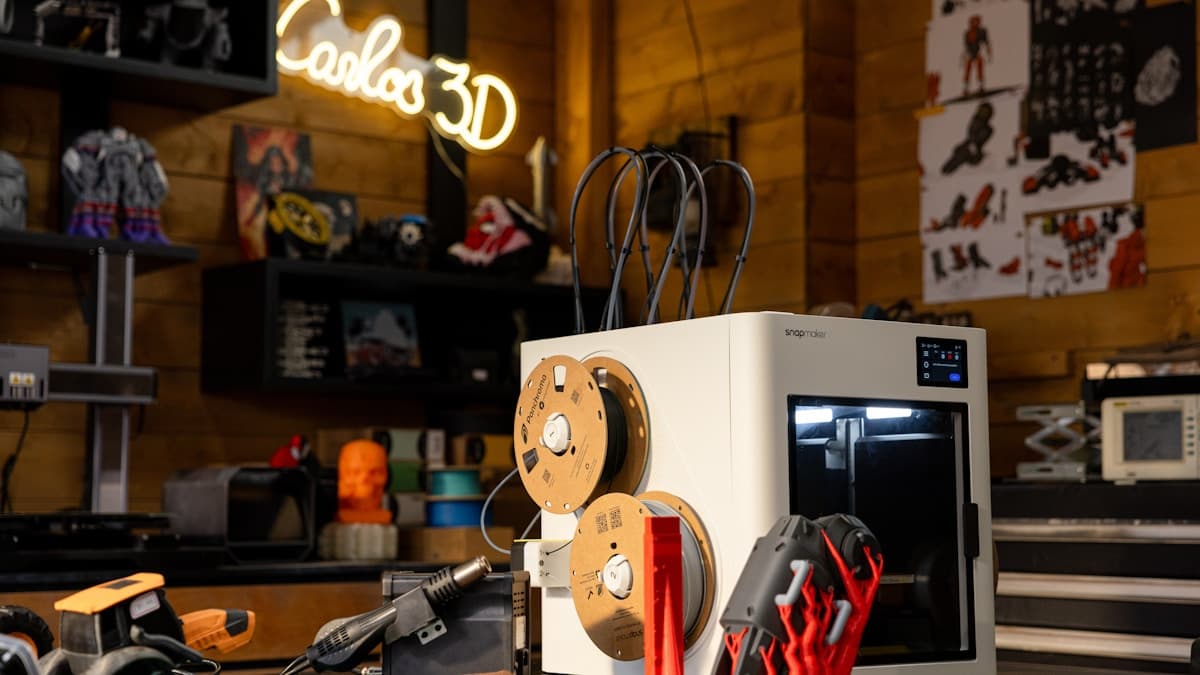
Looking for 3D printing services in Maine? The 3D Prototyping Hub directory lists 26 providers across the state, and the fastest route to a quote is the Maine provider directory — filter by city and material, then send your file to the shops that actually fit the part. Nearly all of them are small independent operations, and most will answer within a day.
If you want to understand the market first — where the capacity sits, what Maine's industry base means for the work local shops take, and how to choose between them — this guide covers it.
Where Maine's 3D Printing Capacity Actually Is
Maine's listings sit almost entirely along the I-95 spine between Portland and Bangor, with Augusta in the middle.
| City | Listed providers | Directory page |
|---|---|---|
| Augusta | 13 | /providers/location/me/augusta |
| Portland | 6 | /providers/location/me/portland |
| Bangor | 6 | /providers/location/me/bangor |
| Turner | 1 | /providers/location/me/turner |
Augusta carries the most listings, and it is worth understanding why before you read too much into it. Augusta is the state capital, not its industrial centre, and its count reflects the fact that a lot of central-Maine businesses are recorded there. Treat it as the middle third of the state rather than as one city.
Portland is the largest economy in Maine and the deepest genuine market for design-led work — product development, consumer goods, medical and life-science instrumentation, marine. Its listings extend into the Westbrook and South Portland ring, so a "Portland" shop may be a fifteen-minute drive out of the peninsula.
Bangor anchors everything north and east. It is the practical base for the forest products belt, Downeast and coastal work, and the University of Maine campus at Orono a few miles up the river. If you are anywhere above Waterville, this is your local market.
Turner is a single rural listing in the Androscoggin valley, and it is a useful reminder that some of the state's capability is not in a metro at all.
The whole corridor is under two and a half hours end to end, and the state is long — Kittery to Fort Kent is a full day's drive. If you are in Aroostook County, Downeast or the western mountains, work on the assumption that you will be shipping or making a trip, and factor that into turnaround rather than discovering it late.
If your town carries no listing of its own — Lewiston-Auburn, Brunswick, Rockland, Ellsworth, Presque Isle — start from the statewide page rather than filtering to your city and concluding there is nothing near you.
What Drives Demand Here
Maine's industrial mix decides what local shops are genuinely good at, and matching the shop to the work is worth more than shaving ten percent off a quote.
Boatbuilding and marine composites. This is the state's signature manufacturing sector and the biggest single influence on what gets printed here. The yards along the mid-coast and around Mount Desert Island, plus the naval shipbuilding at Bath, sustain a supply chain that wants plugs and moulds, layup and drilling fixtures, deck hardware prototypes, and one-off replacement fittings for boats that are decades old. Marine parts are a materials conversation before they are a printing one: saltwater, UV and constant vibration rule out a lot of easy answers. Carbon fiber 3D printing services covers the reinforced end of that work.
Large-format and bio-based additive research. The University of Maine's Advanced Structures and Composites Center in Orono operates one of the largest polymer 3D printers in the world, has printed a patrol-boat hull and a habitable house module with it, and works extensively with wood-derived, cellulose-filled feedstocks — a natural pairing for a state built on forest products. You will not order a one-off bracket from a research centre, but its presence is why large-format thinking is unusually normal in Maine engineering circles. Large-format 3D printing services covers what that means commercially.
Forest products, pulp and paper. The mills are Maine's heavy industry, and heavy industry generates the most reliable additive demand there is: guarding, brackets, sensor and enclosure mounts, handling fixtures, and replacement parts for machinery whose original supplier is long gone. Practical, functional, tolerance-tolerant work — usually the fastest and cheapest thing on this list to have printed.
Life sciences and diagnostics. Greater Portland and Bar Harbor carry a real cluster of veterinary diagnostics, biomedical research and instrumentation. That work generates lab fixtures, custom sample handling, optical and sensor mounts, and enclosures for instruments that do not exist commercially — small, precise, one-off, and often needed this week.
Aquaculture and fishing gear. Maine's working waterfront is an underrated source of prototype demand: hatchery and grow-out hardware, trap and gear components, sorting and handling aids, sensor housings for equipment that lives in cold salt water. Almost all of it is low-quantity functional work.
Outdoor and consumer products. The state's outdoor-goods and footwear heritage keeps a steady flow of form studies, fit models and packaging mock-ups moving — the work that wants a printed part on a table at a design review tomorrow morning.
What You Can Get Printed Locally
- Functional prototypes — parts that have to fit, load or seal before you commit to tooling.
- Jigs, fixtures and shop aids — the highest-volume category in most working shops and the one with the fastest payback. 3D printing services for jigs, fixtures and manufacturing aids goes deeper.
- Replacement and obsolete parts — the standing job in Maine's mill, marine and equipment work.
- Patterns, plugs and layup tooling — printed tooling for composite work, which is where the marine cluster and additive meet most often.
- Concept and appearance models — form studies and design reviews, usually resin for surface finish.
- Short production runs — bridge quantities between prototype and injection moulding; low-volume 3D printing services covers where that crossover sits.
- High-detail small parts — fine mechanical components, dental and medical models, miniatures.
Processes and When to Use Each
| Process | Best for | Trade-off |
|---|---|---|
| FDM | Functional prototypes, jigs and fixtures, larger parts, engineering plastics | Visible layer lines; weaker across layers |
| SLA / resin | Fine detail, smooth surfaces, small precise parts, appearance models | More brittle; needs post-processing; costs more per part |
| SLS / MJF nylon | Durable functional parts, complex geometry, no supports needed | Grainy finish; fewer providers; higher minimums |
| Metal | End-use metal components, tooling inserts, high-temperature parts | Most expensive; longest lead time; often subcontracted |
Process coverage is recorded for only a handful of Maine listings, so treat the directory filters as a starting point and confirm capability with the shop directly. SLS 3D printing services and metal 3D printing services go deeper on the two processes most likely to be subcontracted out of a market this size, and how much 3D printing costs explains what actually drives the number on a quote.
How to Choose a Maine Provider
Search the corridor, not just your town. In a 26-provider state, ruling out shops on a ninety-minute drive narrows your options to almost nothing for no good reason. Portland, Augusta and Bangor are one market in practice.
Check what kind of shop you are talking to. Several Maine listings are print, sign and repro businesses that added 3D printing to an existing service menu. That is perfectly good for a display model or a straightforward part, and it is the wrong place to send a loaded structural component. Ask what machines they run and what they print in a normal week.
Ask whether the capability is in-house. Especially for SLS, metal and anything genuinely large. Subcontracting is common and legitimate, but you should know before you commit, because it changes lead time and accountability.
Specify the material, not just the process. "FDM" spans PLA and glass-filled nylon. If the part is going near salt water, sunlight, heat or sustained load — which in Maine it very often is — name the polymer rather than the process and say what it has to survive.
Ask about tolerances up front. Additive tolerances are process-dependent and not what a machinist would assume. Tolerances and accuracy in 3D printing covers what is realistic to ask for.
Get turnaround in writing, and ask how it ships. "A few days" means different things in August and in February. If the part is coming to you from the other end of the state in winter, agree a committed date and a carrier rather than assuming.
Nearby Markets
If Maine's capacity does not cover your part, the region is well served. Massachusetts is the nearest deep market and the sensible first check for SLS, metal and anything requiring certification — Boston is roughly two hours from Portland. New York adds the widest material and process menu in the Northeast if you are willing to ship. For the work most likely to stay local — fixtures, replacement parts, marine one-offs — a Maine shop will almost always be faster.
Get Quotes From Maine Providers
Browse the Maine provider directory to see all 26 listed providers, filter by city and material, and send your part to the shops that fit it. If you would rather compare across the region, start from the full provider directory.
Hero photograph by Snapmaker 3D Printer via Unsplash.