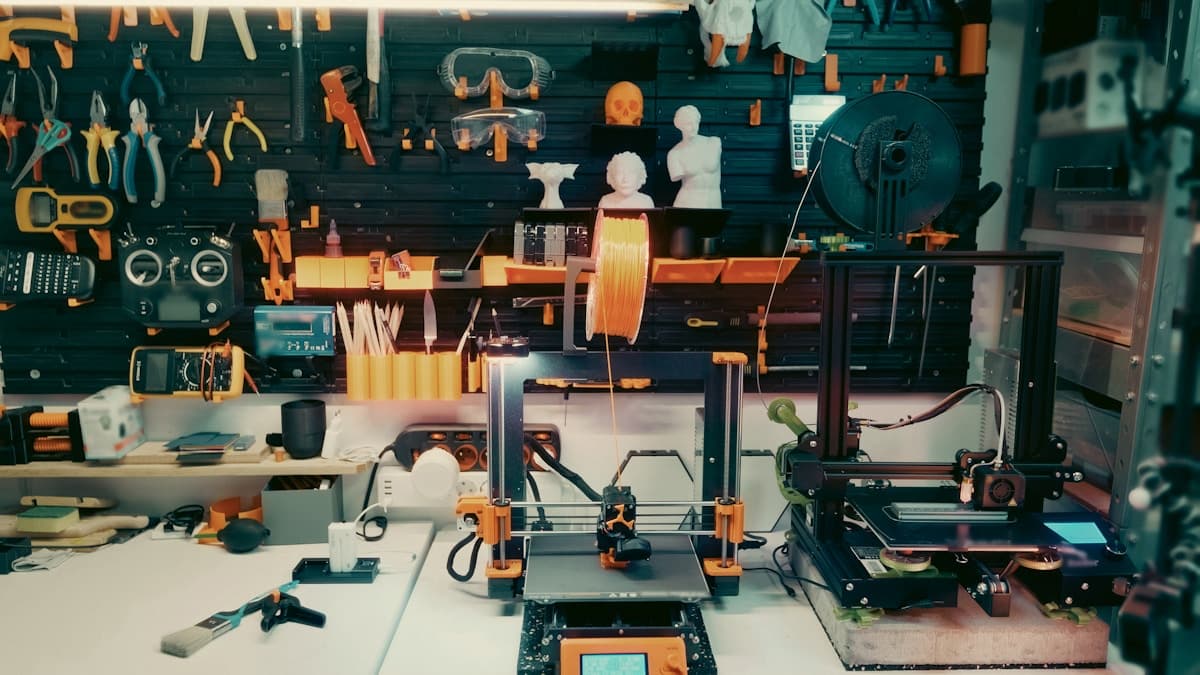
Looking for 3D printing services in Richmond? The 3D Prototyping Hub directory lists 11 providers with Richmond addresses, and the shortest path to a quote is the Richmond provider directory — pull up the list, qualify two or three by phone, and send your file to the ones that run the process your part actually needs.
Richmond is the second-largest pool in Virginia behind Virginia Beach's thirteen. But the raw count undersells it, because the two cities are made of different things. This guide covers what the Richmond pool is really composed of, what drives demand in the capital region, and when the honest answer is to send the job somewhere else.
Richmond Has Fewer Listings and More Actual Additive Shops
| City | Listed providers | Directory page |
|---|---|---|
| Virginia Beach | 13 | /providers/location/va/virginia-beach |
| Richmond | 11 | /providers/location/va/richmond |
| Roanoke | 7 | /providers/location/va/roanoke |
| Mechanicsville | 1 | /providers/location/va/mechanicsville |
Read the names rather than the totals. Six of Richmond's eleven trade under names that describe an additive business — a 3D-printing shop, a digital fabrication lab, a print-and-design operation built around the process. That is the highest proportion of dedicated additive businesses in any Virginia city we list, and a better ratio than Virginia Beach, where roughly half the pool turns out to be print, copy, sign and garment-decoration companies.
The other five Richmond listings are exactly that: established commercial print, screen-print and graphics businesses that have added a printer or two. They are not a problem — a finished, watertight file printed in PLA is well within their reach and they are often the ones with same-week capacity — but they are a poor fit if you need someone to look at your geometry and tell you which face to put on the bed.
The directory will not tell you which is which beyond the name. None of the Richmond listings is claimed, and exactly one records any material with us at all. That material is PLA. Capability comes from the call, not the listing — so make the call a qualifying one.
What Drives Demand in the Capital Region
Government and the institutional buyer. Richmond is the seat of state government, and around it sits the usual capital-city layer of agencies, associations, law firms and consultancies. That produces exhibit pieces, presentation models, architectural massing studies and one-off demonstration hardware — work that needs to be explained or shown rather than manufactured in quantity.
VCU and VCU Health. The university's engineering school and its downtown medical campus are the largest single generator of additive demand in the city: research fixtures, lab hardware, anatomical and surgical planning models, custom apparatus that no catalogue sells. A great deal of that gets printed inside the institution, but it also seeds the labour pool the commercial shops hire from, and it spills over into startup and spinout work that does come to market.
Corporate headquarters. Richmond carries an unusually dense cluster of large-company head offices for a metro its size — energy, insurance, retail, food distribution and consumer goods among them. Head offices generate packaging mock-ups, display and fixture prototypes, trade-show hardware and internal tooling, not production parts. That is short-run, deadline-driven, presentation-grade work, which suits a small local shop well.
The advertising and branding trade. Richmond has a genuine agency scene, and agencies print props, concept models, packaging comps and set pieces on short notice. It is also the demand most likely to reach the commercial print shops in the pool, because the agency already buys from them.
The corridor south toward Petersburg. The pharmaceutical and advanced-manufacturing investment in the Petersburg area sits inside Richmond's supplier catchment. It is not yet visible in our listings, but if you are sourcing for a regulated manufacturer, note that "regulated" changes the questions you ask a shop — material traceability, documentation and data handling — more than it changes which shop you call.
What You Can Realistically Get Printed Locally
- Prototypes and design iterations — the pool's core competence; next-day is realistic on a simple FDM part.
- Presentation and exhibit models — architectural, anatomical, product. The capital-region staple.
- Replacement and legacy parts — reproducing a fitting nobody makes any more.
- Jigs, fixtures and manufacturing aids — the highest-return use for most local manufacturers; see 3D printing for jigs and fixtures.
- Short runs in the tens to low hundreds — low-volume 3D printing explains where printing stops being cheaper than moulding.
- Functional end-use parts — possible, but material selection stops being a detail; functional and end-use printed parts covers the trade-offs.
Processes and Where They Sit in Richmond
| Process | Best for | Trade-off | Availability in Richmond |
|---|---|---|---|
| FDM | Functional parts, fixtures, fast prototypes, larger geometry | Visible layer lines, weaker across layers | The default; assume every listing runs it |
| Resin (SLA/DLP/LCD) | Fine detail, smooth surfaces, models and patterns | Brittle, needs post-curing, small build volumes | Realistic at the dedicated additive shops — ask |
| SLS / MJF nylon | Durable functional parts, complex geometry, no support scars | Higher cost, grainy finish | Assume subcontract; confirm before you rely on it |
| Metal | Load-bearing and high-temperature parts | Expensive, long lead times | Broker or out-of-region territory |
If you are still choosing between the first two, SLA vs FDM printing explained works the decision through on a real part, and how to choose a 3D printing material covers what to specify once you have picked a process.
Print Here, or Ship It In?
This is the question Richmond buyers actually face, and geography makes it a fair fight. Richmond sits roughly a hundred miles from Hampton Roads and roughly a hundred from the Washington suburbs. Neither is a comfortable there-and-back in a working day, and both are a next-morning courier. So proximity is worth paying for only when proximity does something.
Stay local when the closeness is the point: an iterating prototype where you want to hand a part back across a desk, a fix somebody needs this week, a short run you would rather collect than track, or a job where you want a person to look at the geometry with you.
Widen the search when the capability is the point: powder-bed nylon, metal, a build volume no desktop machine has, certified or traceable material, or a compliance posture a two-person shop cannot offer. Start at the Virginia provider directory, which covers all 43 listings in the state, or the full provider directory if the process matters more than the postcode. The Virginia state guide sets out how the three regional markets compare, and the Washington, DC guide covers the northern end of the corridor.
Two habits save a day each, wherever the job goes: call out critical dimensions with a number and a direction rather than the word "tight", and send a file the shop can open without a conversation — how to prepare files for a 3D printing quote takes five minutes and prevents most quoting delays.
Get Quotes From Richmond Providers
Browse the Richmond provider directory, qualify by trade rather than by keyword, and send your file to two or three. If the local pool is thin for what you need, widen to the Virginia directory — and if your part is going to be printed somewhere you cannot walk into, read how to choose a 3D printing service before you commit to one.
Hero photograph by Jakub Żerdzicki via Unsplash.