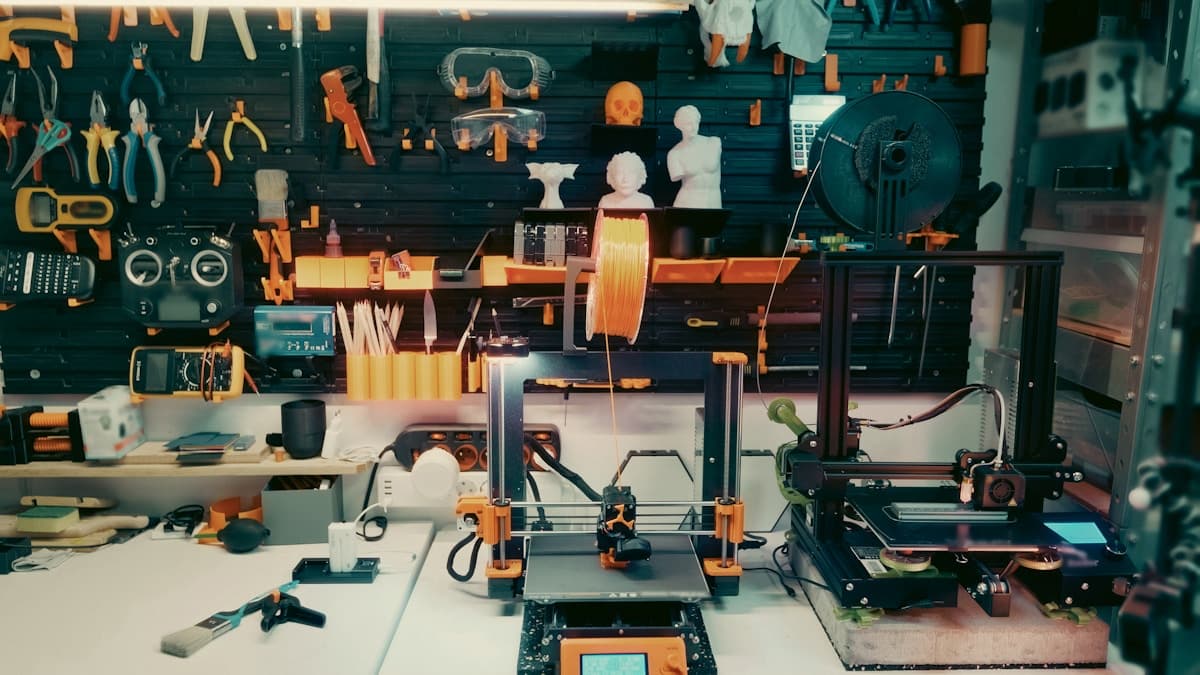
Looking for 3D printing services in Montana? The 3D Prototyping Hub directory lists 23 providers across the state, and the fastest route to a quote is the Montana provider directory — filter by city and material, then send your file to the shops that actually fit the part. Almost all of them are small independent operations, and most will come back to you within a day.
If you want to understand the market first — where the capacity sits, what Montana's industry base means for the work local shops take, and how to choose between them — this guide covers it.
Where Montana's 3D Printing Capacity Actually Is
Montana's listings cluster in three cities strung along the I-90 and I-15 corridors, plus one in the northwest.
| City | Listed providers | Directory page |
|---|---|---|
| Billings | 11 | /providers/location/mt/billings |
| Helena | 8 | /providers/location/mt/helena |
| Missoula | 3 | /providers/location/mt/missoula |
| Flathead County | 1 | /providers/location/mt/flathead-county |
Billings is the largest city in Montana and the commercial and medical hub for a region that reaches well into Wyoming and the Dakotas. It has the deepest listing count and the widest mix — dedicated 3D printing businesses alongside established print and sign shops that added additive to an existing service menu. If you are anywhere in eastern or south-central Montana, this is your market.
Helena carries a surprising eight listings for a city of its size, and it is worth understanding why before you read too much into it. Helena is the state capital and the address of record for a great many Montana businesses, so treat its count as covering the central corridor rather than as a measure of industrial capacity concentrated in one town.
Missoula anchors the west. It is a university city with a design and outdoor-products bent, and its listings lean toward creative and prototype work rather than heavy industrial fabrication.
Flathead County appears once, recorded at the county rather than the city level, which is how some rural listings arrive. The Flathead Valley around Kalispell carries a genuine precision-manufacturing legacy, so treat that single listing as an entry point to the northwest rather than the whole picture.
Two absences matter more than any of these counts. Bozeman is the fastest-growing manufacturing and engineering centre in the state — home to Montana State University and a well-established optics, photonics and outdoor-equipment cluster — and it carries no listing of its own in the directory. Great Falls and Butte are the same story: real engineering demand, no listing yet. If you are in one of those cities, start from the statewide page and expect to work with a shop in Billings, Helena or Missoula, all of which regularly take work from across the state.
Distance is the thing to plan around. Montana is the fourth-largest state by area, and Billings to Missoula is roughly 340 miles — a five-hour drive on a clear day. Kalispell is farther still. Nobody here is choosing a shop by drive time, so choose on capability and shipping terms instead, and read the whole state as one market.
What Drives Demand Here
Montana's industrial mix decides what local shops are genuinely good at, and matching the shop to the work is worth more than shaving ten percent off a quote.
Agriculture and ranching equipment. This is the state's economic backbone and the most reliable source of additive demand there is: replacement parts for grain handling, irrigation and haying equipment, guarding and sensor mounts, and one-off fittings for machinery whose original supplier disappeared two decades ago. Practical, functional, tolerance-tolerant work — usually the fastest and cheapest thing on this list to have printed. 3D printing replacement and spare parts covers how that job normally runs.
Mining, energy and heavy industry. Butte, Colstrip and the eastern oil counties sustain a supply chain that wants handling fixtures, wear-part prototypes, enclosures for field instrumentation and gauges, and pattern work for cast replacements. Downtime is expensive in this sector, which is why printed interim parts earn their place.
Optics, photonics and precision instrumentation. The Bozeman-Gallatin corridor carries an unusually dense cluster of laser, optics and scientific-instrument companies for a state this size, along with the engineering programmes at Montana State. That work generates small precise parts, optical and sensor mounts, lab fixtures and enclosures for instruments that do not exist commercially — often needed this week rather than this quarter.
Outdoor and recreation products. Montana's outdoor-goods sector — fishing, packs, hunting, ski and bike hardware — runs on form studies, fit models, mould and pattern work and packaging mock-ups. This is the work that wants a printed part on a table at a design review tomorrow morning, and it is the reason Missoula and Bozeman keep a steady flow of appearance-model demand.
Aerospace, defence and composites. Malmstrom Air Force Base at Great Falls, the aviation and composites work in the Flathead Valley, and a scattering of unmanned-systems firms generate tooling, layup fixtures and drone airframe components. 3D printing services for drone and UAV parts covers that end of the work, and carbon fiber 3D printing services covers the reinforced materials it usually asks for.
Healthcare and life sciences. Billings is the region's medical centre, and hospital and clinical demand shows up as surgical planning models, custom fixtures and device prototypes. 3D printing for medical devices goes deeper on what that work requires of a provider.
Tourism, museums and interpretive work. Glacier and Yellowstone underwrite a real market for display models, replicas, signage components and interpretive props — small-batch work that sits naturally with the state's print-and-sign shops.
What You Can Get Printed Locally
- Functional prototypes — parts that have to fit, load or seal before you commit to tooling.
- Jigs, fixtures and shop aids — the highest-volume category in most working shops and the one with the fastest payback. 3D printing services for jigs, fixtures and manufacturing aids goes deeper.
- Replacement and obsolete parts — the standing job in Montana's agricultural, mining and equipment work.
- Patterns and tooling — printed patterns for casting and layup, where additive meets the state's older fabrication trades.
- Concept and appearance models — form studies and design reviews, usually resin for surface finish.
- Short production runs — bridge quantities between prototype and injection moulding; low-volume 3D printing services covers where that crossover sits.
- High-detail small parts — fine mechanical components, dental and medical models, miniatures.
Processes and When to Use Each
| Process | Best for | Trade-off |
|---|---|---|
| FDM | Functional prototypes, jigs and fixtures, larger parts, engineering plastics | Visible layer lines; weaker across layers |
| SLA / resin | Fine detail, smooth surfaces, small precise parts, appearance models | More brittle; needs post-processing; costs more per part |
| SLS / MJF nylon | Durable functional parts, complex geometry, no supports needed | Grainy finish; fewer providers; higher minimums |
| Metal | End-use metal components, tooling inserts, high-temperature parts | Most expensive; longest lead time; often subcontracted |
Process coverage is recorded for only a handful of Montana listings, so treat the directory filters as a starting point and confirm capability with the shop directly. SLS 3D printing services and metal 3D printing services go deeper on the two processes most likely to be subcontracted out of a market this size, and how much 3D printing costs explains what actually drives the number on a quote.
How to Choose a Montana Provider
Treat the state as one market. In a 23-provider state spread across 600 miles, ruling out shops on drive time leaves you with almost nothing. Ask what a shop charges to ship a finished part to your town and add it to the quote — it is usually a rounding error next to the difference between two shops' machine time.
Check what kind of shop you are talking to. Several Montana listings are print, sign and repro businesses that added 3D printing alongside an existing service. That is perfectly good for a display model, a sign component or a straightforward part, and it is the wrong place to send a loaded structural component. Ask what machines they run and what they print in a normal week.
Ask whether the capability is in-house. Especially for SLS, metal and anything genuinely large. Subcontracting is common and legitimate, but you should know before you commit, because it changes lead time and accountability.
Specify the material, not just the process. "FDM" spans PLA and glass-filled nylon. If the part is going to live outdoors in Montana — UV all summer, well below freezing all winter, often both in the same week — name the polymer rather than the process and say what it has to survive.
Ask about tolerances up front. Additive tolerances are process-dependent and not what a machinist would assume. Tolerances and accuracy in 3D printing covers what is realistic to ask for.
Get turnaround in writing, and ask how it ships. "A few days" means one thing in July and another in January when a pass closes. If the part is coming from the other end of the state in winter, agree a committed date and a carrier rather than assuming.
Nearby Markets
If Montana's capacity does not cover your part, the region is reachable. Colorado is the nearest deep market and the sensible first check for SLS, metal and anything needing certification. Utah adds a strong medical-device and composites base, and Idaho is the closest neighbour for western Montana — Missoula to Coeur d'Alene is under three hours. For the work most likely to stay local — fixtures, replacement parts, agricultural one-offs — a Montana shop will almost always be faster.
Get Quotes From Montana Providers
Browse the Montana provider directory to see all 23 listed providers, filter by city and material, and send your part to the shops that fit it. If you would rather compare across the region, start from the full provider directory.
Hero photograph by Jakub Żerdzicki via Unsplash.