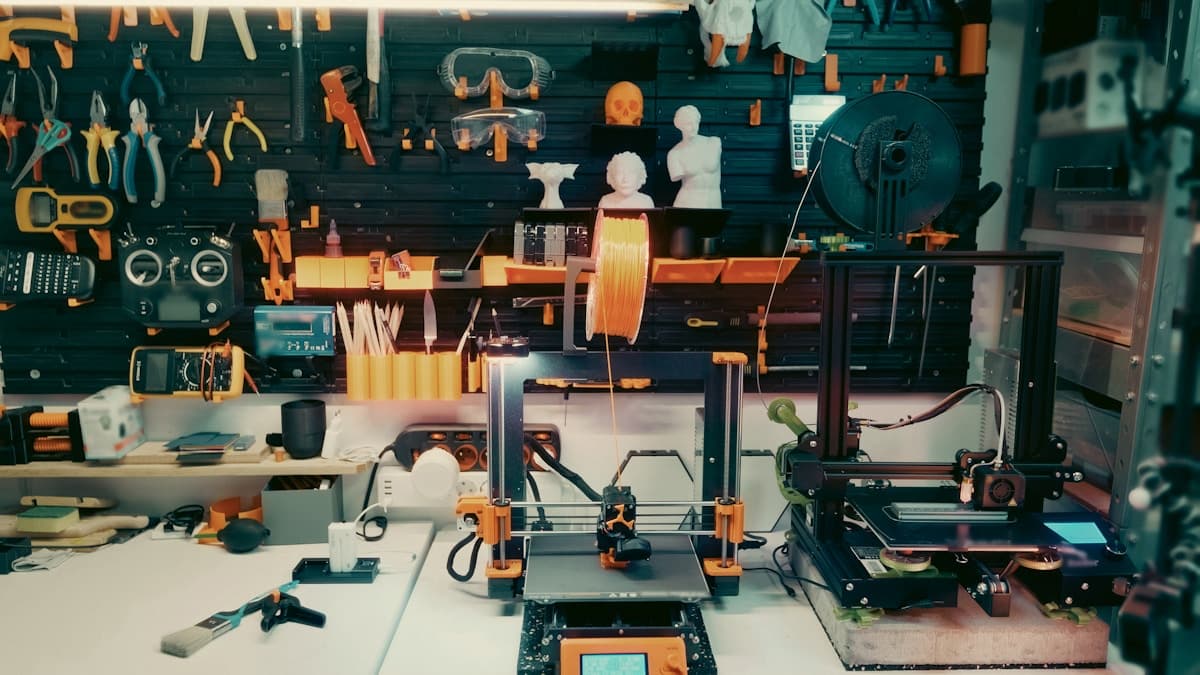
Looking for 3D printing services in Utah? The state's listed capacity has an unusual shape, and knowing it changes how you should search. The 3D Prototyping Hub directory lists 34 providers across Utah, but only three cities hold more than one — the rest are spread one at a time across twelve separate towns. The fastest route to a quote is the Utah provider directory — filter by city, technology and material, then send your file to the shops that match your part.
If you would rather understand the market before you start calling, this guide covers where the capacity actually is, why a city-level search will mislead you here, and what to ask before you hand over a file.
Where Utah's Capacity Actually Sits
| City | Listed providers | Directory page |
|---|---|---|
| Salt Lake City | 10 | /providers/location/ut/salt-lake-city |
| St. George | 8 | /providers/location/ut/st-george |
| Provo | 4 | /providers/location/ut/provo |
| Lehi, Alpine, Herriman, West Jordan, Saratoga Springs, South Ogden, Roy, Woodland Hills, Davis County, Tooele, Tremonton, Price | 1 each | /providers/location/ut |
Salt Lake City is the deepest single pool at 10 and the most varied in kind — dedicated additive and prototyping businesses, an engineering firm doing design and printing together, a 3D scanning specialist, a community makerspace, and several commercial print and reprographics operations that added a printer. That breadth is useful and it means you have to qualify harder, because "3D printing" on a Salt Lake listing covers a much wider spread of capability than it does in a smaller market.
St. George at 8 is the genuine surprise in the data — second in the state, in a metro a fraction of Salt Lake's size and roughly 300 road miles away. Southern Utah's growth has pulled in the sign, print, design and custom-fabrication businesses that serve a fast-expanding population, and a university makerspace anchors the local hobbyist and small-business end. If you are in Washington County, this is a real market and you do not need to look north.
Provo has 4, which understates the area badly. The Utah County technology corridor running through Provo, Orem, Lehi and Draper is one of the densest concentrations of hardware and software companies in the interior West, and several of the state's single-listing towns — Lehi, Alpine, Saratoga Springs, Woodland Hills — sit inside or beside it.
The twelve single-listing towns are the story here. Herriman, West Jordan, South Ogden, Roy, Davis County and Tooele are all Wasatch Front suburbs — none of them is a separate market, and all of them are a short drive from somewhere else on this list. Only Price, in Carbon County, and Tremonton, up in Box Elder County, sit genuinely apart from the corridor.
Search the Corridor, Not the City
This is the single most useful thing to take from the data. Aggregate the Wasatch Front — Salt Lake City, Provo and the ten suburb and satellite listings around them — and the corridor holds 24 of Utah's 34 providers, within roughly 90 minutes end to end. Read the same data city by city and Salt Lake looks like a modest 10-shop market with a thin fringe.
Practically, that means:
- Do not stop at your own city's page. A one-listing town like Herriman or Roy is not your market; the corridor is.
- Filter by process and material first, then by distance. In a corridor this compact, the shop 40 minutes away that runs the right process beats the one down the street that does not.
- The exception is southern Utah. St. George is its own market and should be searched as one. The drive to Salt Lake is not a commute.
What Drives Demand Here
Utah's industrial mix determines what local shops are practised at, and matching a provider to your kind of work is worth more than shaving ten percent off a quote.
Technology and hardware in Utah County. The corridor through Lehi, Provo and Draper generates steady demand for enclosures, fixtures, test rigs and iteration-stage prototypes — the work where a two-day turnaround matters more than a perfect surface finish.
Medical devices in Salt Lake. Utah has a long-established medical device and life sciences cluster. It is demanding work in the best sense: parts with real dimensional requirements, documented materials and a low tolerance for "close enough". Shops that serve it are worth finding if your part has actual specifications.
Aerospace and defence in northern Utah. The Ogden and Box Elder area carries a substantial aerospace, propulsion and composites presence. Shops in that orbit tend to be comfortable with drawings, revision control and tolerance callouts.
Outdoor recreation products statewide. Utah's outdoor gear industry is unusually large for the state's population, and it produces exactly the kind of iterative, form-and-fit prototyping that local FDM and resin shops handle well.
Mining and energy in the east. Carbon and Emery counties run heavy equipment, and heavy equipment generates replacement parts, brackets and fixtures — which is the most plausible reason a town the size of Price supports a listed provider at all.
What You Can Get Printed Locally
- Prototypes and design iterations — the most common job and the one local shops handle best. Same-day or next-day turnaround is realistic on a straightforward FDM part; see quick 3D printing service if speed is the constraint.
- Jigs, fixtures and tooling aids — the highest-value use for most manufacturers, because a printed fixture made in a day replaces a machined one that takes weeks.
- Functional end-use parts — brackets, housings, mounts, guards. Widely available along the corridor, but material selection matters far more than for a visual prototype.
- Short production runs — realistic in the tens to low hundreds. Past that, run the numbers against tooling; low-volume 3D printing services covers where the crossover sits.
- High-detail models and display work — resin is well represented among the smaller custom shops in Salt Lake, Provo and St. George.
- Scanning and reverse engineering — Salt Lake has dedicated 3D scanning capability, which matters if you need to reproduce a part you do not have a file for.
Processes and When to Use Each
| Process | Best for | Trade-off | Availability in Utah |
|---|---|---|---|
| FDM | Functional parts, fixtures, fast prototypes, larger geometry | Visible layer lines, weaker across layers | Widely available along the whole corridor |
| Resin (SLA/DLP/LCD) | Fine detail, smooth surfaces, display models, patterns | More brittle, needs post-cure, smaller build volumes | Available, mostly at the smaller custom shops |
| SLS / MJF nylon | Durable functional parts, complex geometry, no support scarring | Higher cost, grainy surface finish | Limited — confirm in-house capability before committing |
| Metal | Load-bearing and high-temperature parts | Expensive, long lead times | Broker or subcontract territory here |
Still deciding between the first two? SLA vs FDM printing explained walks the choice through on a real part. For the powder-bed options, see SLS 3D printing services. If you are going the resin route yourself, resin safety and post-processing basics covers what the finished part still needs after it comes off the plate.
Neighbouring States Worth Searching
Utah's corridor is deep enough that most buyers will not need to leave it, but two cases justify widening:
- Specialist processes. If you need powder-bed nylon or metal and want it in-house rather than subcontracted, Colorado and Arizona both carry more capacity than Utah does.
- Northern Utah and the Idaho border. If you are in Logan, Tremonton or Brigham City, the southern Idaho pool is worth a look alongside Ogden — see 3D printing services in Idaho.
How to Choose Among Them
Separate the print shops from the engineering shops. Several Utah listings are reprographics, copy or sign businesses that added additive as a service line. That is genuinely useful for a straightforward part from a finished file, and a poor fit if you need someone to catch a problem in your geometry. Read what the business does first, not just what technologies it lists.
Ask what runs in-house. A shop that subcontracts nylon or metal is not disqualified — subcontracting is normal — but it changes lead time, cost and accountability. Know before the quote, not after the part is late.
Match the material to the environment, not just the drawing. Utah's climate is genuinely hard on parts: high-altitude UV, hot dry summers and cold winters. PLA is the most commonly available material and the least suited to heat, UV or sustained load — a bracket that is fine on a bench will creep in a car in July and go brittle outdoors within a season. Say where the part lives and let the shop steer you to PETG, ABS, ASA, nylon or TPU.
Be explicit about tolerances. "Tight" means different things to a service bureau and a machinist. If a dimension is critical, call it out with a number and a direction. Tolerances and accuracy in 3D printing covers what is achievable per process.
Send a file the shop can actually use. Most quoting delays are file problems, not shop problems. STL vs STEP files for 3D printing explains which format to send and when the difference matters.
Get two quotes on the same file. Not to squeeze the price, but because the difference in how two shops read the same geometry tells you which one is paying attention. The full checklist is in how to choose a 3D printing service.
Get Quotes From Utah Providers
Browse the full Utah directory, filter to your process and material, and send your file to two or three shops along your stretch of the corridor. If nothing fits — and for powder-bed or metal work it may not — widen to the whole provider directory rather than settling for a shop that is close but wrong. Plenty of providers quote out of state, and for a settled file that is often the better outcome.
Hero photograph by Jakub Żerdzicki.