You hear the extruder click, the print goes hollow, and when you open the lid there is a bare stub of filament in the tube and a loose end hanging off the spool. Then the same thing happens on the next print. When filament snaps on the spool, almost everyone reaches for the same explanation — it got damp — and roughly two times in three that explanation is wrong. Filament breaks for three quite different reasons, they need three different responses, and one of them is not repairable at all. This guide is about telling them apart in about two minutes, before you throw away a spool that was never the problem.
This post contains affiliate links. If you purchase through these links, 3D Prototyping Hub may earn a small commission at no extra cost to you.
This post also contains Amazon affiliate links. As an Amazon Associate we earn from qualifying purchases.
The Three Faults, and How They Differ
| What you see |
What it actually is |
Recoverable? |
| Clean break near the spool; the rest of the spool bends fine |
A crossover — one wrap trapped under another, cinched tight by the extruder |
Yes, in minutes |
| Cracks at a gentle bend anywhere on the spool, including deep wraps |
Hydrolysis: water has broken the polymer chains over months |
No |
| Breaks only at the tightest bend in the feed path |
Mechanical stress — drag, bend radius, a tired tube |
Yes |
| Popping and steam at the nozzle, rough surface, no break at all |
Absorbed water, which is a printing fault rather than a strength fault |
Yes, by drying |
Notice that the last row is the one people call "wet filament", and it does not snap. That mismatch is the root of the confusion: moisture has two entirely separate effects on a spool, a fast reversible one and a slow permanent one, and the word "dry it" only addresses the first.
Fault One: It Is a Tangle, Not the Material
This is the most common cause and the easiest to misread, because the break looks dramatic and the filament is blameless.
Filament arrives wound under tension. Every time the free end is released — at the end of a print, or when a spool is swapped out — the outer wraps relax, and a loose loop can slip sideways and lie underneath a neighbouring wrap. Nothing happens for hours. Then the extruder pulls, the trapped wrap cinches down into a knot, tension climbs from a few hundred grams to well past what a 1.75mm strand will take, and the filament parts. Usually at the spool, sometimes at the extruder gears.
The tell is that the broken ends are clean and square, and filament taken from the same spool bends into a tight loop without complaint. Material that is chemically degraded is brittle everywhere; a tangle breaks a strand that is otherwise perfectly healthy.
The fix, in order:
- Do not pull. Unwind the spool backwards past the crossover until the trapped wrap lifts free, then re-wind by hand keeping steady tension.
- Cut the damaged end back a few centimetres and clip the tip at roughly 45 degrees so it feeds.
- Never let the end go again. Secure it against the outside of the winding with a clip or a piece of tape. Pushing the end through the hole in the flange is the habit that causes this — it drags the final wrap down under the ones beside it, which is exactly the geometry you were trying to avoid.
A spool that does not turn freely makes all of this worse, because the extruder is fighting friction as well as pulling filament. Heavy 1kg spools and cardboard cores binding on a bare steel rod are the usual offenders, and a holder running on bearings removes a load that otherwise shows up as intermittent breaks and as the patchy under-extrusion that precedes them.
Fault Two: Hydrolysis, the One You Cannot Undo
This is the one worth understanding properly, because it is the only fault on the page that destroys a spool permanently.
PLA is a polyester. Given water and time — accelerated by warmth — the water molecules attack the ester bonds and cut the polymer chains into shorter pieces. Shorter chains mean lower molecular weight, and lower molecular weight means less elongation before fracture. That is the definition of brittle. It happens slowly, over months of sitting on an open shelf, and it is a chemical change rather than a physical one.
Which means drying does not fix it. A dryer drives off free water and stops the steam, the popping and the stringing that come with it. It cannot reassemble a broken polymer chain. This is the single most useful thing to know about brittle PLA, and it is the opposite of the advice usually given.
The bend test, which takes thirty seconds and settles it:
- Pull about 150mm off the spool and bend it into a loop roughly 50mm across.
- Healthy PLA takes that curve, often whitening at the outside of the bend as it stretches, and either springs back or eventually creases rather than shattering.
- Degraded PLA cracks with a sharp snap well before that radius, and the fracture face looks glassy.
- Now repeat with filament from several wraps deeper in. If only the outermost metre is brittle, the damage is superficial and the spool underneath is usable. If a deep wrap snaps too, the whole spool has gone.
Ultraviolet light and heat do the same job faster. A spool on a windowsill, in a car, or in a loft over summer can be unusable in weeks — PLA's glass transition sits near 60 degrees Celsius, and a closed car in the sun goes past that comfortably.
What to do with a degraded spool: demote it. Draft prints, test fits, tolerance checks and throwaway geometry are all fine. Do not put it in anything structural — low molecular weight shows up directly as weak layer bonding, which is its own failure mode covered in why prints snap along the layer lines.
Fault Three: The Feed Path Is Breaking It
If the break always happens in the same place, the material is probably a passenger.
A marginal strand fails at the highest-stress point in its path, and on most machines that is wherever the filament turns the tightest corner — commonly just as it enters the PTFE tube, or at the entry to the extruder on a direct-drive head with an awkward routing. Three things raise the stress there, and all three are cheap to remove.
- Bend radius. Re-route so the tube takes the gentlest curve the frame allows. A large lazy arc costs nothing and loses a surprising amount of peak stress.
- Tube condition. A kinked or internally scored PTFE bowden tube adds drag along its whole length, and drag is tension. Tubes are consumables; a metre of replacement is a few dollars.
- Spool drag. As above — free the spool before blaming the filament.
One further case belongs here rather than with the chemistry. If a break happens while the hotend is hot and then the printer will not feed at all, the stub left inside the heat break has cooked. Cooked filament goes crumbly and sheds fragments, which is how a snap becomes the clog described in why nozzles clog. Pull the tube, clear the stub completely, and purge through with cleaning filament before loading a new spool on top of it.
Drying: Temperatures That Work and One That Ruins Spools
Drying is the right response to wet, which is not the same as brittle. Symptoms of genuinely wet filament are audible popping and hissing at the nozzle, visible wisps of steam, a furred or pitted surface, stringing that was not there last month, and poor layer adhesion.
| Material |
Dryer temperature |
Time |
Notes |
| PLA |
45–55°C |
4–6h |
Stay clear of 60°C or the wraps soften and weld together |
| PETG |
60–65°C |
4–6h |
Absorbs readily; stringing is the first symptom |
| ABS / ASA |
65–75°C |
4h |
Comparatively tolerant |
| TPU |
45–55°C |
4–8h |
Low and slow; it deforms and sticks to itself easily |
| Nylon (PA) |
70–80°C |
8–12h |
The thirstiest common polymer — print from a sealed box |
| PC |
70–80°C |
6–12h |
Same discipline as nylon |
| PVA |
45–50°C |
6–10h |
Water-soluble by design, so it drinks from the air |
The failure to avoid is the kitchen oven. Domestic thermostats swing 15 to 20 degrees around the set point and many will not go below 70 degrees at all, which puts PLA past its glass transition and turns a spool into a solid disc. A purpose-built filament dryer holds its set point and vents the moisture it drives off rather than recirculating it, which is what makes a cycle repeatable. Our round-up of filament dry boxes and dryers compares the ones worth owning.
For nylon, PC, PVA and TPU, drying and then mounting the spool in open air undoes the work before a long print finishes — these re-absorb in hours, not weeks. The arrangement that holds is a sealed box you feed from while printing. Our nylon filament guide goes further into what that material demands.
Storage That Actually Prevents This
The whole problem is a storage problem, and it is solvable for about the price of one spool.
Measure, do not guess. Ambient relative humidity is the variable that decides whether an open shelf is fine or ruinous, and it varies enormously by room and season. A few-dollar hygrometer inside your storage box turns this into a reading. Below 20 percent inside the sealed volume is the target; above 45 percent in the room means open shelving is an active choice with a cost.
Desiccant has to be sealed in with the spool. Silica gel in an open tub is decoration — it saturates against the whole room and stops. Rechargeable indicating beads change colour when spent and regenerate in an oven, so you can see the state rather than assume it. Replace or regenerate on the colour, not on a schedule.
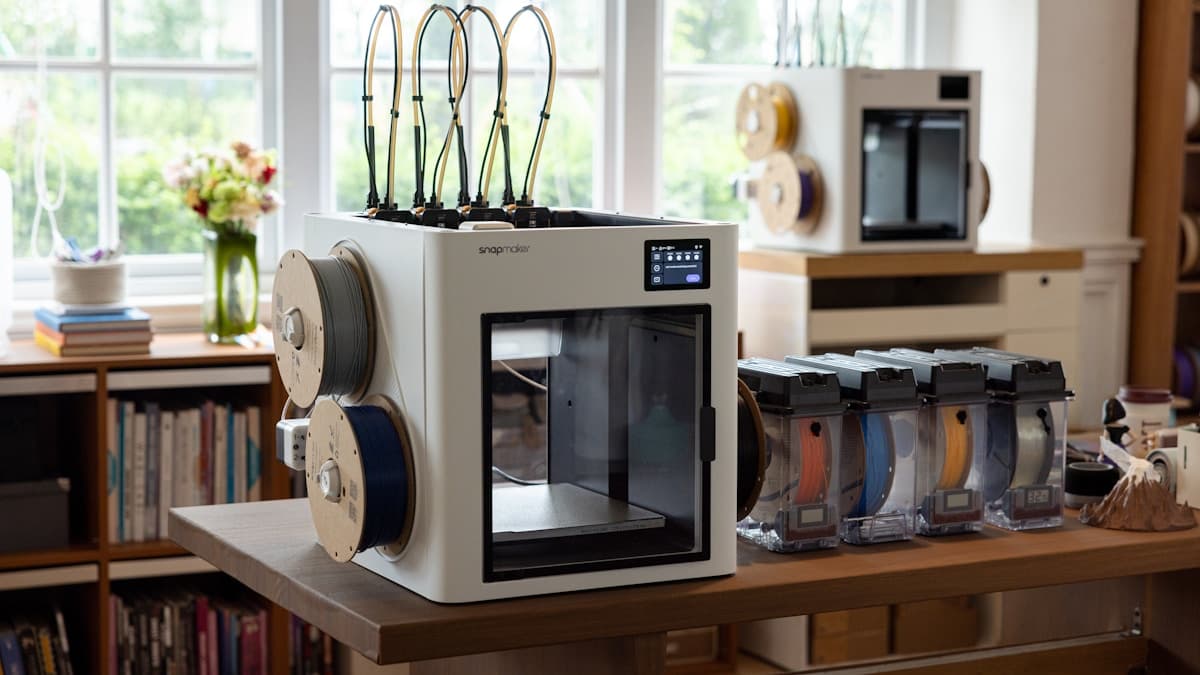
Vacuum bags for the long tail. Most workshops have far more spools than they print in a month. Vacuum bags with a desiccant pack remove the reservoir of humid air that otherwise sits inside a loosely closed tub and slowly re-wets everything in it. Look at the photograph at the top of this page: the sealed cartridges on the right and the bare spools on the shelf behind are the same workshop making two different decisions.
Keep the manufacturer's sealed bag when you open a spool, and put the spool back in it with its own desiccant pack. Manufacturer-direct stock is usually the freshest you can buy for exactly this reason — ELEGOO's filament and FDM machines and Anycubic's filament and printer range both ship vacuum-sealed with desiccant, and a known-fresh spool is the control you need when you are trying to decide whether an old one is finished. If you are re-buying anyway, our filament selection guide covers which material the job actually wants.
The Two-Minute Diagnostic
- Look at the break. Clean and square near the spool, with the rest of the spool healthy? Tangle. Go to step 5.
- Bend a sample from the outer wrap into a 50mm loop. Snaps easily? Suspect degradation.
- Bend a sample from five wraps deeper. Also snaps? The spool is hydrolysed — demote it. Only the outer metre? Cut back and carry on.
- If nothing snaps but prints are rough, stringy or popping, the spool is wet rather than degraded. Dry it at the temperature in the table, then re-test.
- Check the mechanics regardless: spool turns freely, tube unkinked, gentlest bend radius you can route.
- Clear the hotend if a break happened hot, before the fragment becomes a clog.
- Fix the storage, or you will be back here in three months.
When to Stop Fighting the Spool
There is a point where the arithmetic turns. A spool of engineering-grade nylon or polycarbonate costs real money, wants an 8-hour dry cycle before every use, needs a sealed feed, and still prints badly on a machine without a heated chamber. If you need a handful of parts in that material rather than a hobby in it, buying the material, the dryer and the machine to suit it is the expensive path to a part you could have ordered.
For a functional part in an engineering polymer, a large part where a failure at hour 30 costs the whole run, or anything on a deadline, get a quote before you commit. Service bureaus run dried feedstock as a matter of routine, in chambers that hold temperature, and the quote frequently comes in under what you were about to spend on consumables. Browse providers by location and process, send the same STL or STEP to two or three, and compare.
Hero photograph by Snapmaker 3D Printer on Unsplash.