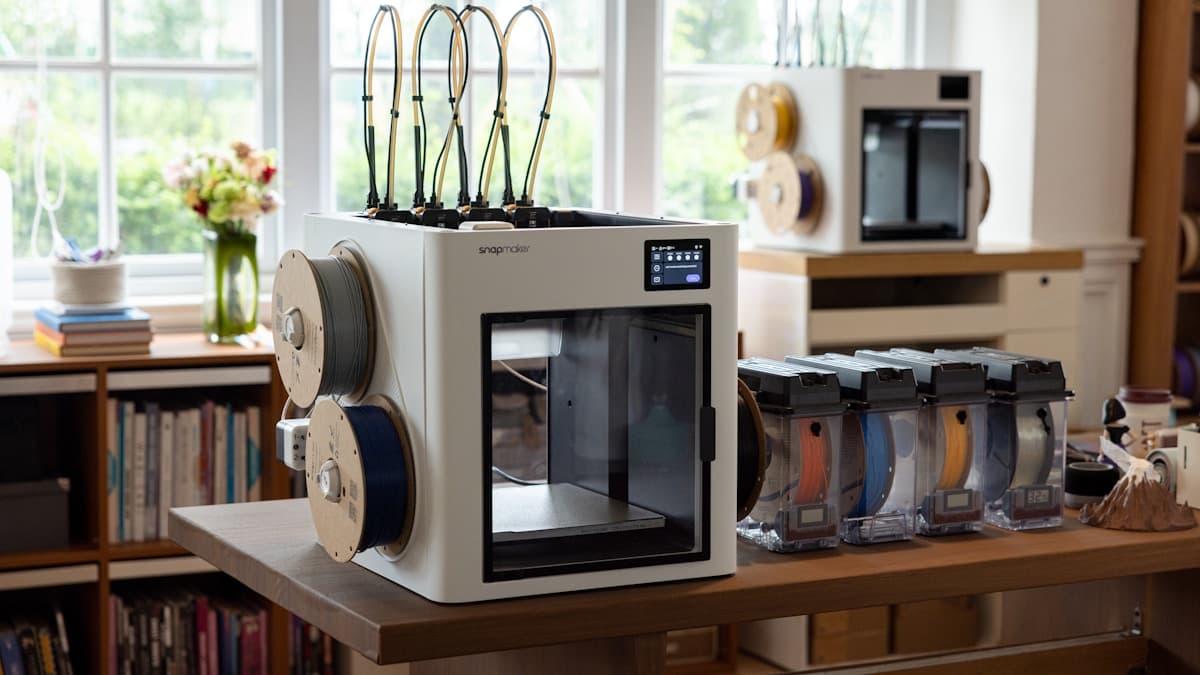
You bought the dryer, ran the spool at the recommended temperature for six hours, loaded it warm, and the stringing, the rough surface and the layers that split under a thumbnail are all exactly where they were. Drying filament is the most-recommended fix in the hobby, and when it does nothing the usual response is to dry it again, for longer. There are only three reasons a drying run fails to change anything — the defect was never moisture, the run did not actually dry the spool, or the spool reabsorbed before the nozzle saw it — and each has a test that takes minutes.
This post contains affiliate links. If you purchase through these links, 3D Prototyping Hub may earn a small commission at no extra cost to you.
This post also contains Amazon affiliate links. As an Amazon Associate we earn from qualifying purchases.
First Prove the Defect Was Ever Moisture
Moisture has a signature, and most of what gets blamed on it does not match that signature. Heat the hotend to printing temperature, unload nothing, and push 100mm of filament through by hand with the part cooling off. Then listen.
Wet filament pops and crackles as trapped water flashes to steam inside the melt zone. The strand comes out foamed, rough or visibly steaming, and it curls away to one side rather than falling straight. Dry filament extrudes quietly, smoothly and straight down. That is the whole test, and it is better evidence than any print, because several unrelated faults produce prints that look identical to a wet-filament print.
| What you are seeing |
Moisture? |
More likely |
| Popping, hissing or steam at the nozzle |
Yes |
Nothing else does this |
| Foamed, rough or bubbled extrudate |
Yes |
— |
| Fine stringing between towers |
Sometimes |
Retraction distance, temperature too high |
| Blobs and zits on the surface |
Rarely |
Retraction and coasting settings |
| Layers splitting under light load |
Sometimes |
Print temperature, cooling, thin walls |
| Inconsistent extrusion width |
Sometimes |
Partial clog, worn nozzle, extruder tension |
| Rough or pitted top surfaces |
Rarely |
Over-extrusion, flow calibration |
If your symptom is in the bottom half of that table and the hand-extrude test is silent, drying was never going to help, and our walkthroughs of stringy prints and under-extrusion are the right pages instead.
The Run Was Too Cool, Too Short, or Both
Drying works by holding the plastic above the temperature at which absorbed water will leave it, for long enough that it does — and the right number is a property of the polymer, not of the dryer.
| Material |
Typical published drying range |
Notes |
| PLA |
~45–55°C |
Softens not far above this; too hot fuses a spool solid |
| PETG |
~60–65°C |
Slow to wet, but hydrolyses in the melt when it is |
| ABS / ASA |
~70–80°C |
Beyond many budget dryers |
| Nylon (PA) |
~70–80°C |
The fastest absorber; usually the longest run |
| Polycarbonate |
~70–80°C |
Long runs, high temperature |
| TPU |
~50–60°C |
Hygroscopic and often forgotten |
Four to eight hours is the common quoted window, with nylon and polycarbonate at the top. Take the figure off the spool or the manufacturer's page first — formulations differ enough to matter, which is one practical argument for buying filament from the maker's own storefront, like ELEGOO's US store or Anycubic's US store, where the material data sits with the product rather than in a third-party listing.
Two failure modes hide in this table. The first is a dryer whose maximum is 50 or 55°C: it cannot dry nylon, polycarbonate, ABS or ASA properly at all, no matter how long you run it, and that is a hardware ceiling rather than a technique problem. The second is the opposite — drying PLA too hot. PLA starts to soften close above its drying range, and a spool that has deformed or welded to itself on the reel will bind on the holder and under-extrude for mechanical reasons that look exactly like wet filament.
A Sealed Heated Box Has Nowhere to Put the Water
This is the part most buyers never read on the specification sheet. Heating the air inside a chamber raises how much moisture that air can hold, which is what draws water out of the plastic. But in a sealed box with no vent and no desiccant, the water that leaves the spool is still in the box — and as the chamber cools, a good share of it goes straight back where it came from.
A dryer that works has a route out: a vent, active air circulation, or an internal desiccant chamber that captures what the heat released. A heated dryer with a vent and a maximum temperature that covers your materials is doing a different job from a warm sealed tub, even though the two can look similar in a listing.
You can settle it for the price of a coffee. Put a mini hygrometer inside during a run. Relative humidity in the box should fall and stay low — under roughly 20% is the usual working target. If it climbs and sits there, the box is redistributing moisture, not removing it, and six more hours will not change that.
It Dried, Then It Drank It Back
Drying removes the water. It does not change how badly the polymer wants more. Nylon and PVA take measurable moisture back within hours in a humid room; PETG, ABS and polycarbonate are slower; PLA is the slowest of the common materials and still gets there.
Now count the hours in your actual workflow. Dry overnight, mount the spool on an open holder at eight in the morning, start a fourteen-hour print — the last layers of that part are printed from filament that has been absorbing moisture all day. The drying run was real and the print still fails, which is precisely the experience that makes people conclude drying does not work.
Three changes, in order of how much they buy you:
- Print from the sealed box. Feed through a short length of PTFE tube from the box outlet to the extruder so the spool never sits in room air. This is the single change that makes drying stick on long jobs.
- Seal everything you are not printing. Vacuum bags with desiccant cost a few dollars per spool and mean a dried spool is still dry next month.
- Treat an open shelf as a wet shelf. It is, and a cardboard spool core holds humidity of its own that it will hand back to the filament it is wound on.
Material that has been through this cycle repeatedly also gets brittle enough to snap in the feed path, which is a separate failure with the same root cause — see why filament snaps on the spool.
The Desiccant Stopped Working Months Ago
Silica gel has a capacity. The sachet that came in the bag with the spool was saturated within weeks of being opened, and after that it is a small bag of beads taking up space in your dry box.
Use rechargeable indicating desiccant, which changes colour as it loads up, so "is it still working?" becomes something you can see rather than assume. When the colour has turned, dry the beads in a low oven and reuse them — the running cost of dry storage after the first purchase is close to nothing.
A dry box with exhausted desiccant and no hygrometer is where most of the confidence in this hobby comes from, and it is confidence in a container that stopped doing anything in the spring.
When the Cause Was the Printer, Not the Plastic
If the hand-extrude test is quiet and the box reads low, the plastic is not your problem. The faults that get misdiagnosed as moisture all produce inconsistent extrusion, and inconsistent extrusion is what people recognise as a wet-filament print:
- A partial clog. The commonest answer by a wide margin. Push cleaning filament through first, then go to a needle and a cold pull. Why nozzles clog separates a dust clog from a heat-creep one.
- A worn nozzle, particularly after any abrasive filament. The bore opens up, flow stops matching the slicer's model, and nothing about the material is at fault.
- Extruder tension or a chewed drive gear, which skips under load and leaves gaps that read as damp.
- Filament diameter out of tolerance. Measure at several points along a metre with calipers. A spool that wanders outside its quoted band will never print consistently, dry or not.
- A thermistor reading high, so the melt is genuinely colder than the display claims — poor layer bonding that survives every material change you try.
The honest control experiment is a sealed, never-opened spool of a known material. If the defect follows the machine across two spools, stop buying dryers. Our piece on why a new spool prints worse covers the re-qualification sequence in full.
What Drying Genuinely Fixes, and What It Cannot
Drying fixes the filament. It does not fix a slicer profile that was wrong while the filament was dry, and it does not repair parts already printed.
That last point is worth being precise about, because it is the one that costs money. With PETG, nylon and polycarbonate, printing wet does more than foam the extrudate: water in the melt zone hydrolyses the polymer, shortening its chains, and the part comes out measurably weaker and more brittle than the same geometry printed from dry material. No post-process recovers it, and a part that will carry load or seal has to be printed again. That is also why the engineering materials are the ones a printer struggles with most — they demand dry stock and chamber heat at the same time.
The Sequence, in Order
- Hand-extrude 100mm hot. Popping and foam means moisture; silence means move on.
- Check your dryer's maximum against the material's published drying temperature.
- Put a hygrometer in the box and confirm the humidity actually falls.
- Print from the sealed box, not from an open holder.
- Replace or recharge the desiccant, and seal every spool you are not using.
- Still there? Clog, nozzle, extruder, diameter, thermistor — in that order.
- Prove it with a sealed control spool before you buy anything else.
If you are choosing storage rather than diagnosing a defect, our filament dry box buyer guide compares the passive and active approaches and what each is genuinely for.
When the Part Matters More Than the Spool
There is a point where this stops being worth your evenings. If the part has to seal, carry load, or exist by Friday, the material condition is somebody's process problem and it should not be yours — a production shop stores engineering filament dry as a matter of routine and prints from it the same day, because the consequences of not doing so land on them.
That is the trade: a dryer, desiccant and sealed storage are worth owning if printing is a regular part of how you work, and a quote is worth getting if this particular part is urgent or structural. You can browse providers by location and process and send the same file to two or three for comparison.
For everything else, work the list above in order. Most of the time the answer is that the defect was never moisture, and the twenty minutes you spend proving it saves the next six hours you were about to spend drying.
Hero photograph by Snapmaker 3D Printer, via Unsplash.