All articles
Buyer GuideFilamentSupport MaterialPVAHIPSFDMMulti-Material

Best Support Filament in 2026 — PVA, HIPS and Breakaway

3D Prototyping Hub·
Best Support Filament in 2026 — PVA, HIPS and Breakaway

The short version: the best support filament for most people is eSUN PVA, because it dissolves in plain tap water, bonds reliably to PLA and is stocked everywhere. Step up to Polymaker PolyDissolve S1 when you need supports under PETG or TPU as well, drop to SUNLU PVA while you are learning the workflow, use HATCHBOX HIPS whenever the model is ABS or ASA, and reach for Polymaker PolySupport when you want a clean interface without an overnight soak.

Support filament is the material you print around the part rather than into it. A second extruder lays it down under overhangs and inside cavities, and when the job finishes you dissolve it or snap it off, leaving surfaces that ordinary supports would have scarred. It solves geometry a single nozzle genuinely cannot — captive moving parts, internal channels, enclosed voids — and it is wasted money on anything you could have supported with the model material and cleaned up with pliers.

This post contains affiliate links. If you purchase through these links, 3D Prototyping Hub may earn a small commission at no extra cost to you.

This post also contains Amazon affiliate links. As an Amazon Associate I earn from qualifying purchases.

Three kinds of support material, and which one your printer can run

The category splits by how the support leaves the part, and that decision is made for you by what the model is printed in.

Water-soluble (PVA and its cousins) goes into a bucket of warm water and disappears. It bonds well to PLA, prints in the same 190–215°C range, and needs no solvent, no ventilation and no special handling beyond keeping it dry. Its limit is heat: PVA starts to degrade and char somewhere above 220°C, so it cannot sit next to an ABS nozzle running at 245°C in a hot chamber. The upgraded soluble materials — Polymaker's PolyDissolve S1 and the BVOH-based spools — widen that window and adhere to PETG and TPU, which plain PVA does inconsistently.

Limonene-soluble (HIPS) is high-impact polystyrene, and it exists for ABS and ASA. It prints at 230–245°C on a hot bed inside an enclosure, exactly where those materials live, and it dissolves in d-limonene — a citrus solvent that leaves ABS completely untouched. It costs roughly what a spool of PLA costs, so it is the cheapest soluble support by a wide margin. The trade is the solvent: you need ventilation, a sealed container and the patience for an eight-to-twenty-four-hour soak.

Breakaway is neither. It is a material engineered to bond just well enough to hold an overhang and just poorly enough that the interface fails under thumb pressure. Nothing dissolves, nothing dries, and the part is finished the moment it comes off the plate. It will not reach into a sealed internal cavity, because your fingers cannot either — but for external overhangs on a cosmetic face, it is the fastest clean result available.

Support Model material Removal Rough cost Best for
PVA PLA (PETG/TPU variably) Warm water, 4–12 h High Internal cavities, captive parts
PolyDissolve S1 / BVOH PLA, PETG, TPU Warm water, 2–6 h Highest Mixed-material shops
HIPS ABS, ASA d-Limonene, 8–24 h Low Enclosed ABS work
Breakaway PLA, PETG By hand, seconds Medium Cosmetic external overhangs

Before any of this, check the machine. Support filament needs a second material path — a dual extruder, an IDEX carriage or a multi-material unit feeding one hotend. A single-extruder printer with one spool cannot use it at all. If you are still choosing, our guide to the best multi-colour 3D printers is the same hardware question from the other direction: every machine that can print two colours can print a support material instead of the second colour.

The picks

Best overall — eSUN PVA

The default because it is the one you can actually buy. eSUN's PVA is stocked by every major retailer, arrives vacuum-sealed with desiccant, and holds tolerance well enough that a multi-material unit will not jam on it mid-job. It bonds to PLA firmly, releases in plain warm water, and behaves the same way spool after spool — which matters enormously on a material whose failure mode is discovered eleven hours into an overnight print. Print it at 195–205°C with the bed no hotter than the PLA needs, and keep it in a dry box the entire time.

Check eSUN PVA pricing

Best material range — Polymaker PolyDissolve S1

Buy this when PLA is not the only thing you print. PolyDissolve bonds to PETG and TPU as well as PLA, which plain PVA does unpredictably — PETG in particular has a habit of either refusing to stick to PVA or fusing to it permanently, and neither outcome is recoverable. It also clears noticeably faster in warm water, cutting a twelve-hour soak to a few hours. You pay for both properties, so keep a spool for the awkward jobs rather than running it as your everyday support.

Check PolyDissolve S1 pricing

Best budget — SUNLU PVA

Support filament has a learning curve that is mostly paid in ruined spools, and this is the one to ruin. Dialling in interface layers, purge volumes and Z-gaps takes several attempts, and so does discovering how fast PVA goes wet in your particular room. SUNLU's is consistent enough for that education and cheap enough that the first mistakes do not sting. Once the workflow is settled, most people move up — but not before.

Check SUNLU PVA pricing

Best for ABS and ASA — HATCHBOX HIPS

If the model is ABS or ASA, this is not a preference, it is the only workable answer — PVA cannot survive the temperatures those materials print at. HIPS runs happily at 230–245°C on a 100°C bed inside a closed chamber, bonds to ABS well without welding to it, and dissolves in d-limonene while leaving the model completely alone. It is also a perfectly good model material in its own right, so a spool is never wasted. Ventilate the soak, keep the solvent in a sealed jar, and reuse it — limonene lasts across many parts. Our ABS filament guide covers the model side of the same setup.

Check HATCHBOX HIPS pricing

Best breakaway — Polymaker PolySupport

For the job where you want a second extruder's clean interface and you want the part tonight. PolySupport holds an overhang through the print and then peels away under thumb and pliers, leaving a surface far smoother than same-material supports because the interface was designed to fail. No water, no solvent, no drying, no waiting. Its limit is reach — anything your hands cannot get to, breakaway cannot leave. Use it for external cosmetic overhangs and keep PVA for the sealed internal geometry.

Check PolySupport pricing

Does It Actually Need Drying?

Tell moisture from the faults that imitate it. Then dry it without wrecking it.

The file downloads on this page as soon as you submit. No waiting on an email.

What else you need

  • A heated dry box — the single purchase that decides whether PVA works for you. Print from it, do not just store in it. Compare options in our dry box guide.
  • Vacuum bags and desiccant — for the spool between jobs. An open shelf ruins PVA in days.
  • An ultrasonic cleaner — or any way to keep the water moving. Agitation halves or thirds the soak time.
  • d-Limonene — only if you are running HIPS under ABS. One quart goes a long way and is reusable.

On the machine side, both Anycubic's and ELEGOO's desktop ranges include multi-material options that will feed a support spool, and Flashforge's enclosed dual-extruder machines are the direct route to HIPS under ABS, where an open frame cannot hold the chamber temperature that job needs.

Settings that decide the result

Three slicer numbers matter far more than the brand on the spool.

Interface layers. Set two or three solid support-interface layers in the support material and none in the model material. This is the entire point of the exercise: the interface is what touches the part, and it should be the material that leaves cleanly.

Z-gap of zero. With same-material supports you leave a deliberate air gap so they snap off. With soluble support you close it completely — a gap here only produces a rough surface, because the support is leaving chemically rather than mechanically.

Purge volume, if you have a single-nozzle multi-material unit. Every switch flushes the hotend, and on a tall part with supports on hundreds of layers, the purge tower can consume more filament than the model does. Group the switches by printing support only where it is genuinely needed, and check the slicer's material estimate before you start — this is where PVA gets expensive, not at the checkout. A machine with two independent nozzles has no purge cost at all, which is most of the argument for dual extrusion.

Nozzle choice is easy: 0.4mm is fine for all of these, and none of them are abrasive. If you are picking sizes for the model side, our nozzle guide covers the trade-offs.

When to skip support filament entirely

Most prints do not need it, and the honest recommendation is to check three things first. Can the model be reoriented so the overhang disappears? Can it be split into two pieces that each print flat and glue back together invisibly? Is the supported surface somewhere anyone will ever look? A yes to any of those is cheaper and faster than a second material.

Where soluble support is genuinely irreplaceable is enclosed geometry: a housing with internal ribs, a manifold with curved channels, a hinge or gearbox printed assembled in one piece. There is no orientation trick for a cavity that has no opening. That is the job PVA exists for, and on that job it is worth every cent.

For one-off complex parts, pricing it out with a service bureau is worth five minutes before you buy a second extruder. Shops running industrial FDM have the dry storage and solvent tanks that make this routine, and many also run SLS, which needs no support material at all — the unfused powder holds the part. Browse the providers directory and send the model with a note about which surfaces must come out clean.

Where to go next


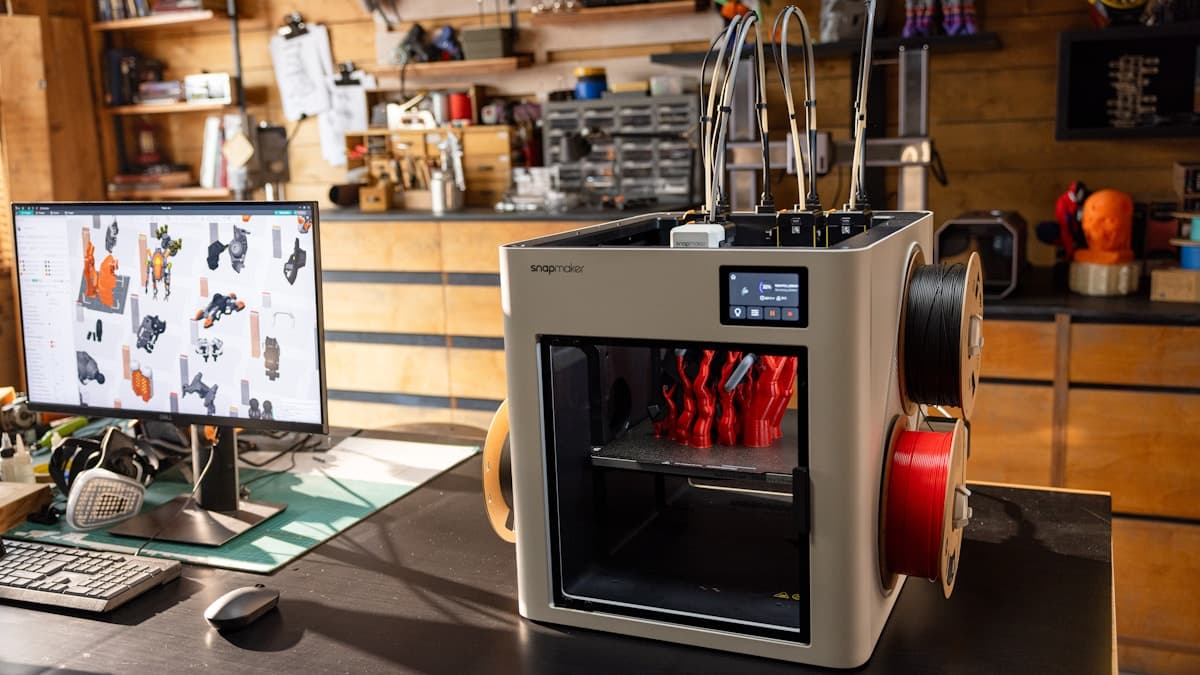
Hero photo by Snapmaker 3D Printer via Unsplash. This post contains affiliate links — 3D Prototyping Hub may earn a commission if you purchase through them, at no cost to you. As an Amazon Associate, we earn from qualifying purchases.

Does It Actually Need Drying?

Tell moisture from the faults that imitate it. Then dry it without wrecking it.

The file downloads on this page as soon as you submit. No waiting on an email.

Recommended Resources

Disclosure: Some links below may be affiliate links. We only recommend services we have personally evaluated or that are used by providers in our directory. Clicking earns us a small commission at no cost to you.

eSUN PVA — Water-Soluble, 1.75mm
The default soluble support for PLA. Widely stocked, sealed with desiccant from the factory, and predictable enough to trust on an overnight job.
Polymaker PolyDissolve S1 — 1.75mm
Premium soluble support with a wider material window than plain PVA — it bonds to PETG and TPU as well as PLA, and clears faster in warm water.
SUNLU PVA — 1.75mm
Budget PVA for learning the workflow. Cheap enough that a ruined spool from one humid weekend is a lesson rather than a loss.
HATCHBOX HIPS — 1.75mm
The support material for ABS and ASA. Dissolves in d-limonene, survives an enclosure at 100°C bed temperature, and costs about what a spool of PLA does.
Polymaker PolySupport — Breakaway, 1.75mm
Snaps off by hand with no solvent and no soak. The right answer when you want a second extruder's clean surface without an overnight bath.
Filament Dry Box with Heater
Not optional with PVA. Wet PVA foams in the hotend, prints furry and refuses to stick to the model — most first-spool failures are moisture, not settings.
Vacuum Storage Bags with Desiccant
For the spool between jobs. PVA left on an open shelf can be unusable inside a week in a humid room.
d-Limonene Solvent — 1 Quart
What dissolves HIPS. Reusable across many parts, needs ventilation, and leaves ABS and ASA untouched.
Ultrasonic Cleaner — 2L+
Turns a twelve-hour PVA soak into two or three. Agitation and warm water do more than any additive.
Browse Anycubic FDM Printers
Support filament needs a second material path — a dual extruder or a multi-material unit. Check the machine takes one before you buy the spool.
Browse ELEGOO FDM Printers
Single-nozzle multi-material systems work with PVA, but budget for the purge tower — it can outweigh the part.
Flashforge FDM Printers
Flashforge's enclosed dual-extruder machines are the straightforward route to HIPS supports under ABS, where an open frame will not hold temperature.

Frequently Asked Questions

Ready to find a 3D printing service provider?

Browse 2,000+ verified providers across the United States and submit your quote request free.

Browse Providers