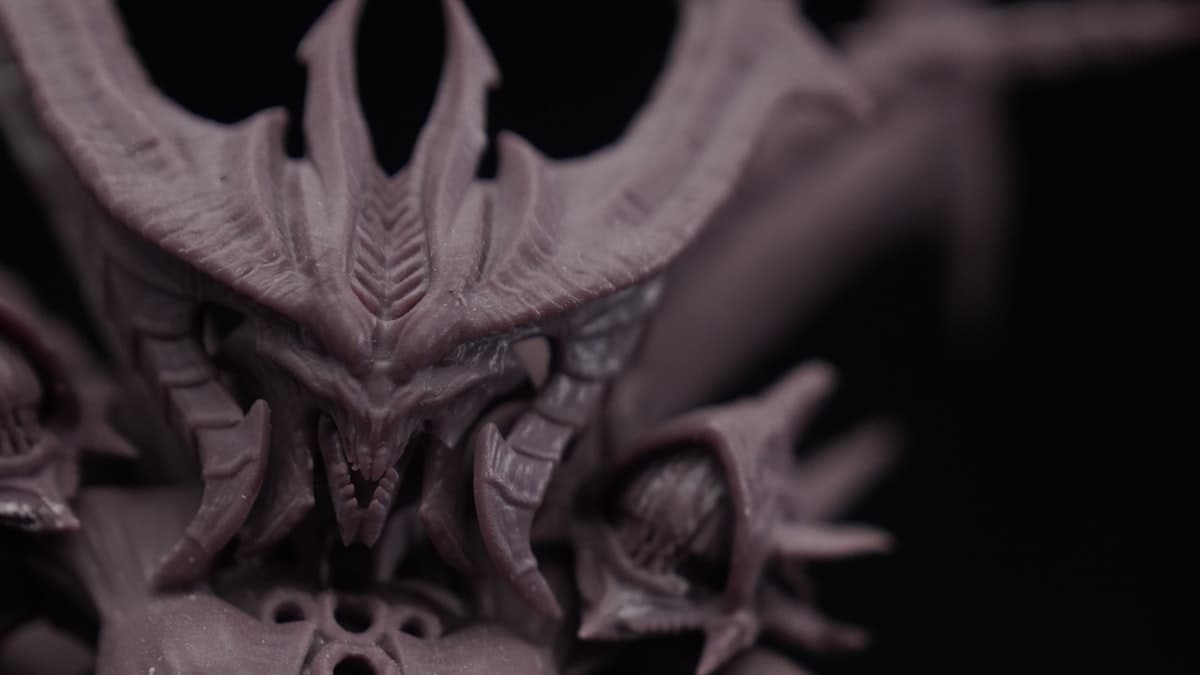
You bought it to get the alcohol out of the spare room, and that part worked. Then the prints started arriving wrong: a surface that stays slightly tacky however long you rinse it, a chalky white bloom in every recess after curing, crisp engraved detail that has gone soft and rounded, a horn or a spine that snapped while you were trimming supports. Water-washable resin is not standard resin with a different cleanup step — it is a different material with different chemistry and a much narrower process window, and almost every failure people blame on the bottle is actually one of four steps being run as though it were standard resin.
This post contains affiliate links. If you purchase through these links, 3D Prototyping Hub may earn a small commission at no extra cost to you.
This post also contains Amazon affiliate links. As an Amazon Associate I earn from qualifying purchases.
Find Your Symptom First
Six failures, four different moments. The fixes point in opposite directions, so identify yours before you change anything.
| What you see |
When it happened |
What it is |
| Surface stays tacky or greasy however long you rinse |
In the wash |
Saturated or cold water |
| Fine detail rounded, edges gone soft |
In the wash |
Over-soak — water swelled the green part |
| Part bowed or twisted a day or two later |
After the wash |
Absorbed water leaving unevenly |
| Chalky white bloom, worst in recesses |
In the cure |
Cured while still wet |
| Thin sections snapping during cleanup or later |
Material |
Low elongation at break, made worse by a full cure |
| Prints suddenly off after months on the same profile |
In the vat |
Moisture pickup shifting the exposure window |
The first three are the rinse and are solved by less time in less contaminated water. The fourth is drying. The last two are the material itself, and no process change fixes them.
Water Does Not Dissolve Resin — It Carries It
This is the part that gets skipped, and it explains four of the six rows above.
Isopropyl alcohol is a solvent for uncured photopolymer: it dissolves the surface layer and then evaporates in minutes, leaving nothing behind and taking almost no water into the part. Water-washable resin works differently. It is formulated with hydrophilic, water-compatible components so that uncured resin disperses in water rather than dissolving — the water becomes a suspension carrying resin away, which is why it turns milky.
Three consequences follow directly, and they are not opinions about the format:
- Water saturates. A dispersion holds only so much before it stops cleaning and starts depositing. Cloudy water is a resin suspension you are dipping a clean part into.
- Water soaks in. It does not flash off. A green part left sitting in it takes water up into the surface, and that is the dimensional damage in rows two and three.
- The same chemistry that makes it rinse makes the cured part more polar. It is also, in most formulations, the chemistry that makes it brittle. You do not get hydrophilic and tough out of the same bottle.
If you have been treating a water rinse as a gentler version of an alcohol rinse, the rest of this post is mostly about unlearning that.
The Rinse: Short, Warm, and Twice
Most water-washable failures live in this step, and all of them are free to fix.
- Keep total contact under about ten minutes. Not a target — a ceiling. The surface stops feeling slick long before that on most parts.
- Split it into two baths. A dirty first bath does the bulk of the work; a clean second bath makes sure the last liquid touching the part is not a resin suspension. One dirty bath is the single most common cause of a tacky finish.
- Room temperature, not garage temperature. Below about 20°C the rinse slows down badly, and people respond by soaking for longer — which is the over-soak failure. If the water is cold enough to be unpleasant on your hand, it is too cold to clean properly.
- Agitate rather than soak. Movement is what carries dispersed resin off the surface. A still part in still water is just absorbing.
- Change the water on a schedule you decide in advance, not when it looks bad. By the time it is obviously milky it has been underperforming for several prints.
- Use distilled water if your tap water is hard. It removes one variable from a process that already has several, and it costs very little.
A wash and cure station with a timer is genuinely useful here for one unglamorous reason: it stops you over-soaking by accident. The over-soak almost never happens on purpose — it happens because the part went in and you went to do something else. The equivalent comparison across chamber size and agitation type is in our guide to wash and cure stations.
Do all of it in nitrile gloves. Rinse water looks like washing up and is not: it is uncured photopolymer in suspension, and photopolymer sensitisation builds with exposure rather than announcing itself on the first contact. The full handling routine is in resin safety and post-processing basics.
Drying Is a Step, Not a Pause
With alcohol, drying happens on its own while you walk to the cure station. With water it does not, and curing a wet part is what produces the chalky white bloom.
Water sitting on and just under the surface interferes with the cure. The surface polymerises unevenly, sets pale and faintly powdery, and holds that finish permanently — it is worst in recesses, undercuts and between closely spaced details, which is precisely where water pools and air cannot reach. It also refuses primer, so you find out again at the painting stage.
What works: shake the part out hard over the sink, blow the water out of recesses with compressed air or a bulb blower, blot flat surfaces, and then leave it twenty to thirty minutes before it goes under UV. On a part with deep cavities, longer. If you can see a meniscus anywhere on it, it is not ready.
The adjacent failure — a surface that stays sticky rather than chalky — comes from the opposite cause and is covered from the other direction in why resin prints stay sticky after curing.
The Brittleness You Cannot Wash Out
Here is the limitation to plan around rather than fix.
Water-washable formulations are, as a class, low on elongation at break — the specification that decides whether a thin section bends a little or snaps. Post-curing makes that worse in every photopolymer: a fully cured part is harder, more dimensionally stable and more brittle than a green one, which is why a horn that survived support removal fails three weeks later on a shelf. Add absorbed water, which softens the part while it is in and leaves internal stress behind when it goes, and thin features on water-washable prints have a genuinely bad time.
That is acceptable on a display model. It is the wrong trade for a clip, a bracket, a jig, a mount, a hinge or anything handled daily. If your parts keep breaking, the fix is a material change, not a process change — an ABS-like or tough resin is specified for exactly this, and none of them are water-washable, which is the whole point. ELEGOO publishes standard, water-washable and ABS-like lines side by side, so the elongation and hardness figures can be compared across formulations before you buy rather than after. The broader by-job breakdown is in our resin buyer's guide, and the way all photopolymers stiffen and yellow with age is in why resin prints go brittle and yellow.
Going back to standard resin means going back to solvent, and that is a real cost rather than a footnote — 99% isopropyl by the gallon has to be bought, stored away from heat, and eventually disposed of. What you get for it is a clean that takes two minutes, does not soak into the part, and preserves detail at the scale the printer is actually capable of.
The Water You Now Have to Deal With
The format trades a solvent storage problem for a waste water problem, and the second one is easier to ignore until it matters.
Used rinse water is resin-contaminated and does not go down the drain — not into a sink, not onto the garden, not into a storm drain. Uncured photopolymer is a skin sensitiser and is toxic to aquatic life, and a municipal plant is not designed to take it.
The standard route is to cure it out. Leave the container in direct sunlight or under a UV lamp until the suspended resin flocculates and settles into visible solids, which usually takes a day or two of sun. Separate the solids with paper filter funnels, dispose of them as cured plastic waste, and handle the remaining water according to your local rules. Keep a dedicated, lidded, labelled container for it; the failure mode here is a bucket of cloudy water on the floor that someone assumes is water.
Count that time when you decide whether the format is saving you anything. For a few prints a month it is trivial. For a cupboard full of parts every week, you are running a small waste-treatment process in your spare room.
When It Is Still the Right Call
None of the above makes water-washable resin a mistake. It is the right choice when:
- You print display pieces — busts, figures, terrain — where brittleness never gets tested.
- You print indoors, where a gallon of flammable solvent is a genuine problem and a jug of water is not.
- Your parts are chunky rather than needle-fine, so the rinse has margin for error.
- Your volume is low enough that the waste water is a minor chore.
It is the wrong choice for functional parts, for anything dimensionally critical, for very thin or very detailed work, and for high throughput. If that is your mix, the honest cheaper move is one standard formulation you have calibrated properly and buy in a size you finish — Chitu Systems sells its Conjure standard resin in 10kg, and one exposure calibration across ten kilos beats twenty calibrations across twenty bottles.
When the Part Belongs Somewhere Else
There is a point where this stops being a cleanup problem. A part that must hold a tolerance, survive handling for years, or arrive as twelve identical units is asking for a process with a controlled wash and cure cycle behind it, not a bucket and a timer. Industrial SLA and DLP shops run washing as a validated step with monitored solvent and a programmed post-cure, which is why their parts come out the same on Friday as they did on Monday.
If that is the part you are holding, browse providers by process and location and get a quote against the file you already have. It is routinely cheaper than the fourth attempt plus a new bottle of resin.
Tonight, though, start with the cheapest diagnosis there is: look at your rinse water. If it is milky, that is the whole answer, and it has been the answer for several prints already.
Hero photograph by Azeez Maree, via Unsplash.