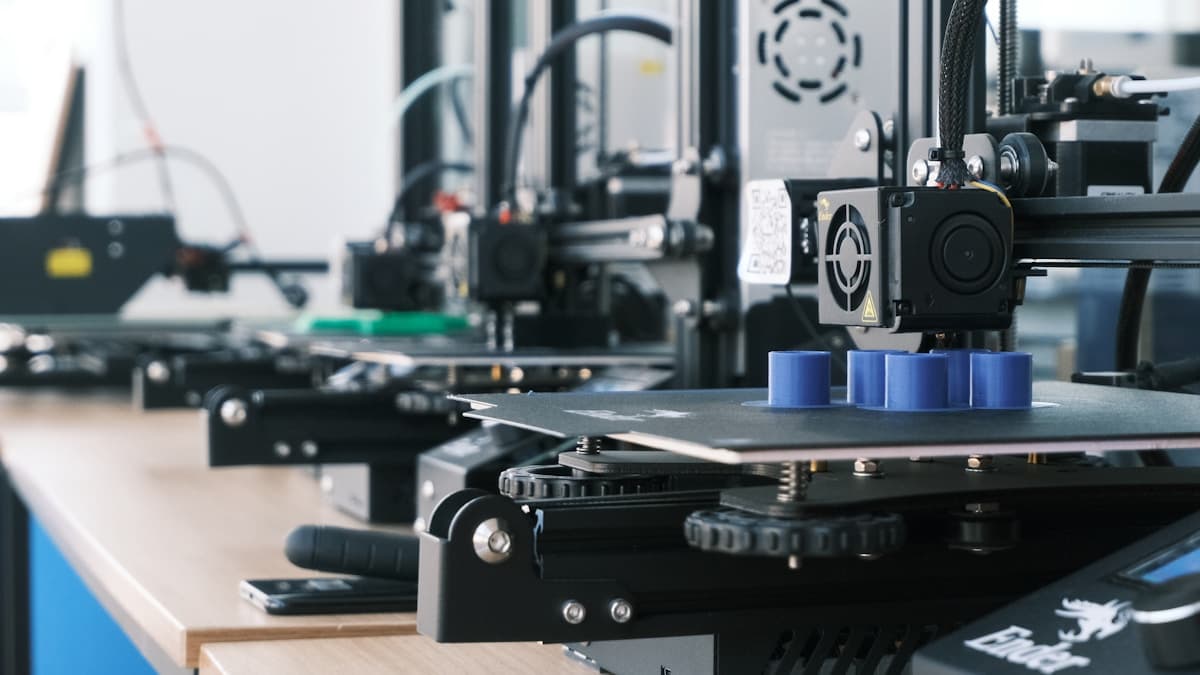
The short version: buy an enclosed FDM printer that runs PLA, and buy more than one. Enclosure handles the safety case, PLA handles the air-quality case, and quantity handles the constraint that actually defeats school 3D printing programs — a single machine cannot serve a class of thirty. If the choice is one premium printer or three modest ones, take the three.
Choosing the best 3D printer for a school is not the same problem as choosing one for yourself. The machine will be operated by novices, touched by dozens of hands, left unsupervised, and judged by whether it works on the morning of the lesson. Reliability and safety beat speed and specifications every time, and the failure mode is not a bad print — it is a printer that quietly stops being used by March.
This post contains affiliate links. If you purchase through these links, 3D Prototyping Hub may earn a small commission at no extra cost to you.
This post also contains Amazon affiliate links. As an Amazon Associate I earn from qualifying purchases.
What a classroom demands that a home lab does not
| Requirement |
Why it is different at school |
What to buy |
| Enclosure |
Unsupervised students, hot nozzle, moving gantry |
Enclosed machine, or an aftermarket enclosure |
| Novice-proof setup |
Many operators, no dedicated expert |
Auto-calibration, touchscreen or cloud queue |
| Uptime |
A dead printer stops the lesson, not a hobby |
Spare nozzles and plates on the shelf from day one |
| Air quality |
Occupied room, all day, many people |
PLA only; ventilate regardless |
| Throughput |
30 students, one deadline |
Several machines, small parts, overnight queue |
Best overall: an enclosed FDM machine
For a general classroom, an enclosed printer is worth the premium. Flashforge's Adventurer line is a common sight in school labs for exactly this reason — the enclosure is standard rather than an add-on, the workflow runs from a touchscreen without a laptop, and the filtered exhaust addresses the question every facilities department eventually asks.
The enclosure does two jobs at once. It puts a physical barrier between curious hands and a 200°C nozzle on a moving gantry, and it contains the ultrafine particles that any melted thermoplastic releases. Neither is a reason to skip room ventilation, but both are much easier to defend in a safety review than an open frame on a table.
If your machines are open-frame already, a separate enclosure retrofits most of that benefit at lower cost.
Best for equipping a whole lab: buy several cheap ones
This is the recommendation most schools resist and most successful programs land on eventually. Do the arithmetic: a modest student part takes 30 to 90 minutes. Thirty students at 30 minutes each is 15 hours on one machine — three or four class periods of continuous printing for a single assignment. No amount of printer quality fixes that. Parallelism does.
The Bambu Lab A1 mini at around $199 is the clearest example of the trade: it calibrates itself before every print, which is the single most valuable feature when a dozen different people operate the machine. Three of them cost less than one mid-range printer and deliver roughly triple the throughput. Anycubic and ELEGOO are both worth quoting against each other on a multi-unit purchase; our guide to the best budget printers under $300 covers that tier in detail, and the beginner printer guide is a reasonable proxy for classroom ease of use.
The trade-off is honest: open-frame machines mean you are relying on rules and supervision rather than a physical barrier, and they cannot print ABS. For PLA coursework in a ventilated room, that is usually an acceptable exchange for triple the capacity.
Materials: PLA, and essentially only PLA
PLA prints at lower temperatures, does not need a heated chamber, barely warps, is derived from plant starches, and releases substantially fewer ultrafine particles and VOCs than ABS or ASA. It is also the cheapest and most forgiving option, which matters when students submit models with paper-thin walls and unsupported overhangs.
ABS and ASA belong in a ventilated CTE shop with an enclosed machine and adult supervision, not a general classroom. PETG is a defensible step up for older students who need tougher functional parts, though it is fussier about bed adhesion — see our build plate guide if you go that route. Buy PLA in bulk multi-packs; our PLA filament guide covers which brands hold tolerance well enough to feed reliably.
Keep resin printers out of the K-12 classroom
Worth stating plainly, because the price of resin machines makes them tempting. Uncured photopolymer resin is a skin sensitizer and irritant. Handling it properly requires nitrile gloves, eye protection, good ventilation, isopropyl alcohol for washing parts, UV curing, and a disposal process for contaminated alcohol and failed prints — none of which is realistic in a room of unsupervised teenagers. The detail is genuinely better; the risk profile is not one a K-12 program should take on. Resin belongs in supervised post-secondary or professional labs.
What else to budget for
- Spare nozzles, at purchase time. A clog takes a machine out of service for as long as procurement takes. A multi-pack per printer costs almost nothing against the cost of a dead machine.
- A spare build surface per machine. Students remove parts by prying, and prying with metal ruins plates.
- A tool kit with plastic scrapers, and a standing ban on metal blades near the plate.
- Staff time. The real cost. One person needs to own the machines, or they will drift out of service.
Design the curriculum around the constraint
The programs that work treat print time as a fixed budget rather than an afterthought. Keep student parts small and deliberately constrained. Batch several students' parts onto one build plate in a single job. Run long prints overnight on a queue. And build the failure into the lesson — a warped first layer is a better teaching moment than a perfect part, and it costs twenty cents.
For anything the classroom machines genuinely cannot do — parts beyond the build volume, nylon or metal, a high-detail showcase piece for an open evening — a local 3D printing service is cheaper than buying a second class of machine for one project a year.
Hero photograph by Minku Kang via Unsplash.
Ready to find a 3D printing service provider?
Browse 2,000+ verified providers across the United States and submit your quote request free.
Browse Providers