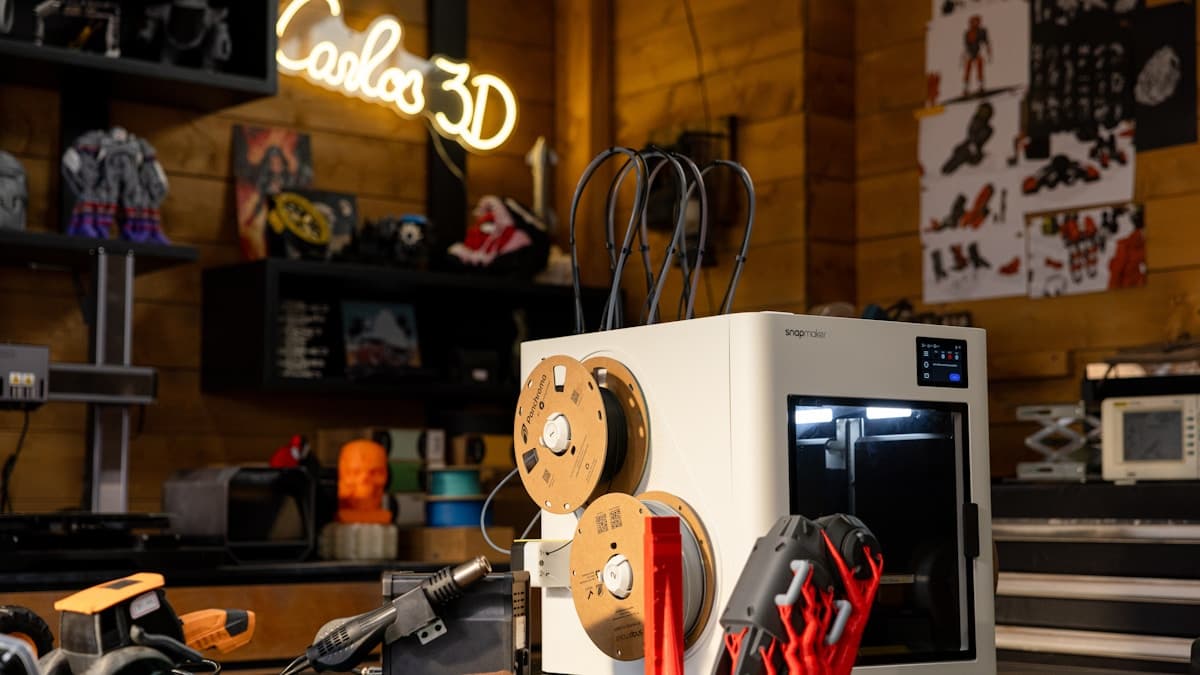
Looking for 3D printing services in Anchorage? You are looking at most of Alaska's listed additive capacity in one city, and it is smaller and stranger than the population suggests. The 3D Prototyping Hub directory lists 9 providers with an Anchorage address — roughly two thirds of the state's 14 listings — and the Anchorage provider directory puts all of them on a single page. Filter, shortlist two or three, send your file.
The second thing to know matters more than the count. Not one of the nine records its processes or materials in the directory, and most of them did not start out as 3D printing businesses at all. This guide covers what the Anchorage market is actually made of, what the city's employers order, and what being 1,400 air miles from the nearest deep market changes about how you buy.
Where the Capacity Sits
Nine listings is a genuine market for a city of 290,000, but its composition tells you more than its size. The Anchorage entries fall into four recognisable kinds of business:
| What it looks like | What it usually means | First question to ask |
|---|---|---|
| Commercial print, repro or duplicating house | An established print business that added a filament machine to an existing menu | What can you print that is not flat? |
| Sign, screen-print or apparel shop | Fabrication and graphics work, with additive used for fixtures, letters and one-offs | Do you print functional parts, or display pieces? |
| Office-equipment and machines dealer | Sells and services machines; printing may be a demo capability rather than a service | Do you print parts for customers, or only sell printers? |
| Precision manufacturing or machine shop | Real engineering capability where printing supports machining and fabrication | Can you hold a tolerance, and will you tell me which ones? |
There is also a community makerspace among the nine, which is a different proposition again: machine access, member expertise and a reasonable chance of help with a one-off, rather than a shop that will quote a production run. For a prototype, a jig or a single replacement part that is worth your own afternoon, that can be the fastest route in town. For twenty parts to a drawing, it is not.
That spread is normal for a market this isolated and it is not a criticism. A print house with one well-maintained machine will make you a clean bracket. The mistake is reading the category off the name — the only shop on the list with "manufacturing" in its name is a precision engineering business, while several of the others sell printing of a kind that was not originally additive at all.
Because none of the nine publishes a process list, treat the first email as a qualifying step rather than an RFQ. Ask what runs in-house, what build volume, and which polymers are actually stocked in Anchorage. Nine becomes three in an afternoon.
What Anchorage Actually Orders
The demand here is unusual, and it explains why the capacity looks the way it does. Anchorage is a logistics and services city rather than a manufacturing one. Ted Stevens Anchorage International is one of the busiest cargo airports in the world, Lake Hood is the busiest seaplane base, Joint Base Elmendorf-Richardson sits inside the municipality, and the oil, mining, fishing and tourism industries that drive the state's economy run their offices, their supply chains and their maintenance operations out of this city even when the work happens somewhere else.
What that produces is a steady demand for parts that keep equipment running, rather than for new product development. A bracket for a cargo handler, a cowling clip for a float plane, a bushing for a processing line, a housing for a sensor on a remote site, a fixture that holds something awkward while somebody welds it. The common thread is that the original part is either obsolete, discontinued or four weeks away — which is exactly the case 3D printing for replacement and spare parts is built around, and it is a far better fit for this market than prototyping is.
Marine and small-boat work is the other recurring theme: Anchorage is where Southcentral's boat owners and commercial operators buy, and plastic parts on boats fail predictably. 3D printing services for marine and boat parts covers which polymers survive salt and UV, and that guide is worth reading before you specify anything that lives on deck.
Then there is the demand the directory cannot see: the university, the two major hospital systems, the architecture practices and the Alaska Native corporations, all of which order models, fixtures and presentation pieces at a steady low volume. Several of those run machines in-house precisely because the local service market is thin.
Processes, and Which Ones Are Actually Here
| Process | Use it for | Realistic in Anchorage? |
|---|---|---|
| FDM | Functional parts, brackets, housings, jigs, anything large or cheap | Yes — assume this is what every listing runs |
| SLA / resin | Fine detail, smooth surfaces, small models and patterns | Possibly, at the makerspace or a dedicated shop — ask |
| SLS / MJF nylon | Durable, isotropic functional parts without supports | Expect brokered to the Lower 48 |
| Metal | Load-bearing, high-temperature or certified parts | Not local — Seattle or beyond, on a long schedule |
Treat the right-hand column as the planning column. If your part genuinely needs SLS nylon or metal, you are buying a Lower 48 service with an Alaska freight leg attached, whoever takes the order — so you may as well know that at the quoting stage and decide whether an FDM part in a tougher polymer would do the job instead. In a lot of maintenance cases it will, and it will be in your hand this week rather than next month.
What the Freight Line Changes
Everything about buying here comes back to shipping. Carriers treat Alaska as an exception to ground rates and to most free-shipping offers, air freight is priced accordingly, and the barge is slow. That single fact flips the usual local-versus-online calculation: in most states an online bureau is the cheap default and the local shop is the convenience premium, while in Anchorage a local shop can be the cheaper answer outright once freight is on the invoice. Online vs local 3D printing services sets out the trade in general terms, and in this city it tilts further toward local than anywhere else on this site.
Two practical consequences. First, collection is a real tool here — Anchorage is compact enough that collecting a part from a shop removes the shipping leg completely, which is not an option for most of the state. Second, if the part is genuinely urgent, decide early, because same-day and rush 3D printing services are only meaningful when the machine is in the same city as you. A rush fee on a part that still has to fly north buys you very little.
Winter is a schedule risk rather than a printing one. The machines are indoors and indifferent. Air freight into and out of Anchorage is more reliable than most people expect, but weather holds happen, and between November and March it is worth building a buffer into any date that matters.
Materials, Because the Default Is Wrong Here
If the part lives outside, say so in the first email. PLA is what most shops run by default, and it is the wrong polymer for an Anchorage winter or a sun-soaked summer dashboard — it goes brittle in the cold and creeps when it is warm. PETG, ASA, polycarbonate and filled nylons all hold up better across the range this climate actually produces. Why 3D printed parts fail outdoors explains the failure modes, and how to choose a 3D printing material is the one to read before you accept a shop's house default.
Ask specifically about low-temperature impact resistance rather than room-temperature strength, and mention UV, salt and fuel exposure by name if they apply. A shop that stocks only PLA and one PETG is not a bad shop — it is a shop you now know to ask about ordering lead time, which in Alaska is a question about freight again.
Beyond Anchorage
Anchorage carries 9 of Alaska's 14 listings. Fairbanks has 4 and Juneau has 1, which is the whole of the rest of the state as far as the directory is concerned — the statewide Alaska page shows all of them together, and 3D printing services in Alaska covers the state-level picture including what Fairbanks does differently.
The absences are worth naming. Wasilla and Palmer in the Mat-Su Valley, the Kenai Peninsula, Kodiak, Ketchikan, Sitka and Bethel carry no listings of their own despite real demand, and in the Mat-Su case that is inside a commute. If you are in one of those places, Anchorage is your market and it is a gap in the directory rather than in the ground truth. Anyone off the road system should read the Anchorage listings as their first stop and plan the onward leg separately.
How to Choose Between Them
With nine candidates and no published process data, the qualifying call does the work a filter normally would:
- What runs in-house, and what goes south? This decides lead time, price and who is accountable when a part comes back wrong.
- What build volume? Ask in millimetres. It is the most common reason a local quote comes back as a no.
- Which polymers do you have in the building today? Stocked in Anchorage and orderable from Seattle are different answers on a deadline.
- Who prepares the file? If the shop expects a print-ready STL and you have a STEP file with a tolerance callout, find that out before you send it.
- Can I collect? In this city that is worth real money, not just convenience.
Start Here
Nine providers, one page: the Anchorage provider directory is the shortest path from a file to a quote. Shortlist on build volume and stocked material first, ask what runs in-house second, and widen to Alaska statewide only when the part needs something this city cannot make — knowing that, in practice, widening usually means Seattle and a freight bill.
Hero photograph by Snapmaker 3D Printer.