The quote came back, you approved it, and a week later nothing has printed. The shop is waiting on a purchase order. Your purchasing department is waiting on a vendor form. Somewhere in the middle, the sales engineer has mentioned a deposit. A 3D printing service asking for a PO or a deposit before it starts is not stalling and it is not a sign the shop is struggling — it is the point at which a quote stops being a conversation and becomes a job with a number attached to it. This guide covers what each document is actually for, which ones you can skip, and how to clear the whole thing in an afternoon instead of a fortnight. If your current shop's terms do not fit the way your company buys, browse the 3D printing provider directory and shortlist one that does.
What the Shop Is Actually Underwriting
Custom parts have no resale value. That single fact explains almost every commercial term a bureau will put in front of you.
A machine shop that gets stiffed on a run of standard brackets can sell them to someone else. A print bureau that gets stiffed on your enclosure is left with a box of parts shaped like your product, which is worth exactly nothing to the next customer and may be legally awkward to keep. Between accepting your job and getting paid, the shop has bought material, booked machine hours it turned other work away for, and spent technician time on build prep and post-processing — all of it unrecoverable.
So the paperwork is not bureaucracy for its own sake. The PO defines what was ordered, the terms define when the money moves, and the deposit covers the part of the risk that the shop cannot insure against. Understanding which is which tells you which ones are negotiable.
The Three Gates Between "Approved" and "In the Queue"
| Document | What it does | Who it protects | When it appears |
|---|---|---|---|
| Purchase order (or signed quote) | Fixes revision, quantity, price and the legal entity ordering | Both sides | Almost always |
| Credit terms / account setup | Lets you pay 30 days after delivery instead of now | You | Repeat or larger accounts |
| Deposit | Covers material and machine commitment on custom work | The shop | First orders, material-heavy jobs |
They are separate gates, and conflating them is where the delay usually comes from. A buyer who says "we don't pay deposits" to a request for a PO has answered a question nobody asked, and the job sits for another three days.
The Purchase Order: Mostly About Getting Paid, Not About Trust
A PO is less a credit instrument than a routing label. Your own accounts payable team will match the shop's invoice against a PO number, and an invoice arriving with no PO to match goes into a queue that nobody is accountable for clearing. The shop has learned this the slow way, which is why the request often arrives before the machine is switched on rather than after.
A usable PO carries five things: the file revision, the quantity, the agreed unit and total price, the ship-to and bill-to entities, and the delivery date you were quoted. Leave the revision off and you have reintroduced the single most common cause of an invoice that does not match its quote — see why your 3D printing invoice doesn't match the quote for what happens when a revised file arrives after pricing and nobody re-quotes it.
If your company has no PO system, say so early and ask whether a countersigned quote is accepted. For jobs in the low thousands, most bureaus take one without comment.
Deposits: Which Jobs Attract Them and Which Do Not
A deposit is not a verdict on your creditworthiness. It tracks what the shop has to spend before it can start.
Jobs that commonly attract one:
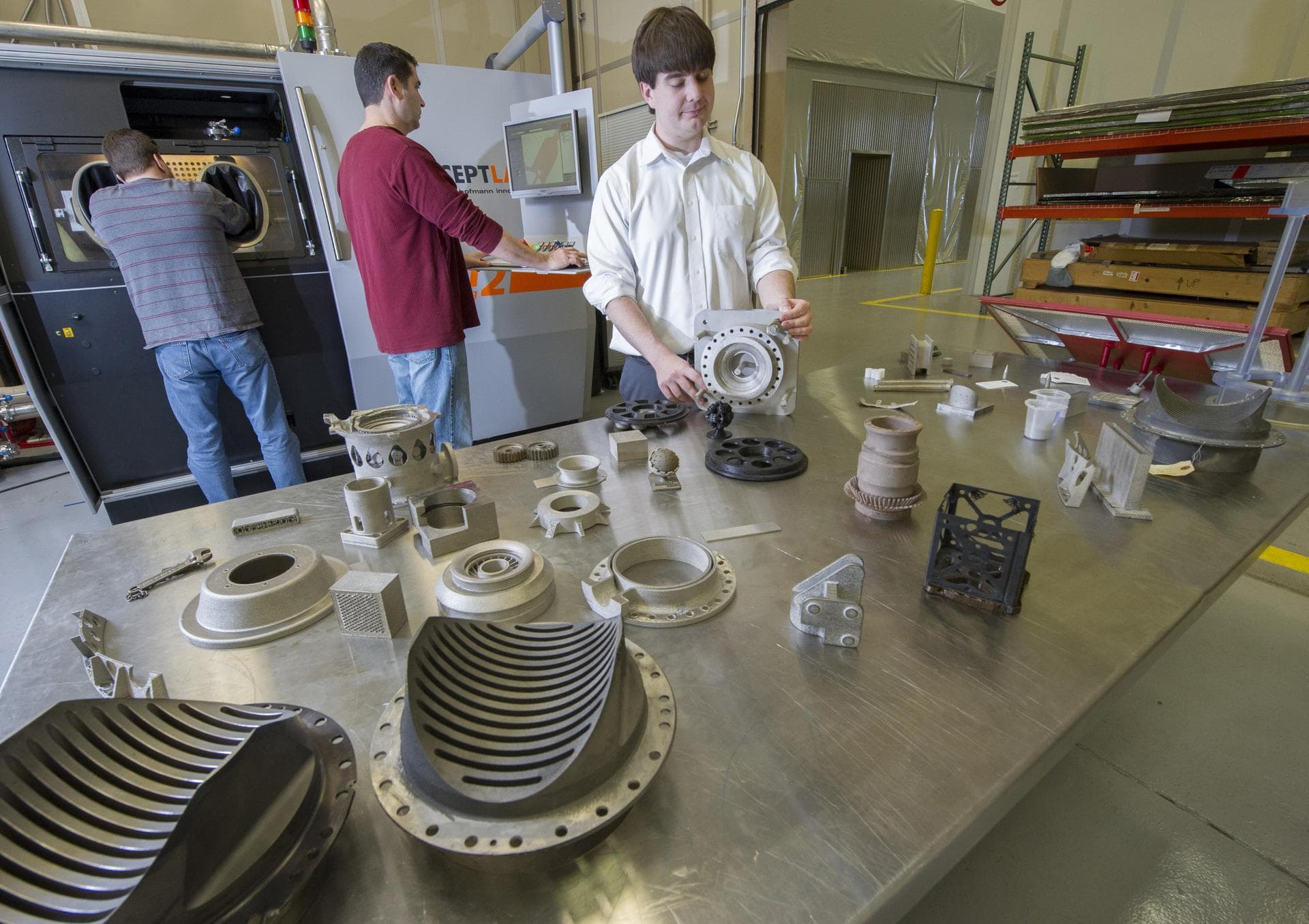
- Material bought specifically for you. A metal powder lot, an engineering resin, a colour-matched filament run. The machine in the photograph at the top of this page is a metal powder-bed system, and a powder lot purchased for one customer's job is the textbook case — the shop is spending real money on inventory it did not want.
- Long machine occupancy. A multi-day build on an industrial system is a week of that machine's capacity, turned away from other work.
- Tooling, fixtures or silicone moulds created as part of the job.
- Large first orders from an unknown account, where the exposure is simply bigger than the shop's appetite.
Jobs that usually do not: small plastic prototypes on standard material, repeat work from an established account, anything a card can cover in a single transaction.
Thirty to fifty percent is the usual range. What matters more than the percentage is the sentence underneath it: what happens to the deposit if the job is cancelled, and at what point it becomes non-refundable. Material purchased and machine time booked are the normal triggers. Ask for that in writing; a shop with a real process answers it in one line.
Why the First Order Is Different From the Fifth
New accounts get the strictest version of every term, and it is almost never personal. A shop that has never worked with you has no payment history, no idea whether your drawings match your expectations, and no sense of how your procurement process behaves under pressure.
The sequence most bureaus run is predictable: first job on a card or with a deposit, second job on the same basis, and somewhere around the third or fourth a credit application appears and you move to net-30. If you expect to become a repeat customer, start that application early rather than at the moment you need a rush job — credit checking takes a week or two and cannot be hurried by the person you are emailing. How to choose a 3D printing service covers the qualifying questions worth asking before you are three jobs deep, and 3D printing service certifications covers the shops that run documented commercial processes as standard.
Clearing It All in a Day
Most of the delay is avoidable, and almost all of it is on the buyer's side. Have these ready before you approve the quote:
- Your vendor onboarding pack — W-9 or local equivalent, a completed new-supplier form, remittance details.
- A tax exemption certificate, if you hold one. Send it before the invoice is raised. Reversing sales tax afterwards means a credit note and a second approval cycle.
- A certificate of insurance request, if the parts are going into an insured or regulated environment.
- The PO itself, with the five fields above.
- A decision on how you are paying — card now, or terms later. Pick one and tell the shop; ambiguity here costs more days than either option.
One honest warning about cards: paying by card on a custom order gives you less recourse than people expect, because the goods were made to your specification and delivered as ordered. The protection you actually have is the written spec, not the chargeback. That makes the acceptance criteria worth more than the payment method — why 3D printing orders come back wrong covers what to state so a dispute never needs a bank.
Where the Terms Are Telling You Something
Most requests are routine. A few are not, and the pattern is consistent:
- 100 percent upfront on a large order from a shop you cannot independently verify.
- No itemised quote behind the deposit figure.
- Wire-only payment to a personal account, or a bank detail that changed by email mid-job.
- Deposit terms stated verbally and never written down.
- No answer to "what happens to the deposit if we cancel?"
Equally, terms that are unusually loose from a shop you do not know are not automatically good news — a bureau with no commercial process tends to have no change-order process either, and that one shows up later as a surprise on the invoice.
There is a related question about what the shop does with your files once the commercial side is settled; NDAs and IP protection for 3D printing services covers who owns the part, the CAD and the build file, and which clauses matter before you upload anything.
Match the Shop's Terms to How You Actually Buy
This is a real selection criterion, not an afterthought. A shop that only takes POs is friction for a startup paying on a founder's card. A shop that only takes cards is a dead end for a buyer whose company cannot issue one. Neither is wrong; they are aimed at different customers.
Ask three questions before you commit to a shortlist: Do you accept a signed quote in place of a PO? What triggers a deposit, and what are its cancellation terms? How many orders before net-30 is available? Three answers tell you whether the shop fits your purchasing reality.
If the answers do not fit, change the shop rather than the process. Browse 3D printing providers to build that shortlist, or narrow it geographically — Texas, for example — if having a buyer and a shop in the same time zone would make the paperwork move faster. Online versus local 3D printing services covers the rest of that trade-off, and low-volume 3D printing services covers where terms start mattering more than unit price, because by then you are placing the same order every month.
Related Resources
- Why Your 3D Printing Invoice Doesn't Match the Quote — what the PO's revision field prevents
- Why Your 3D Printing Quote Is Higher Than the Calculator — the costs a deposit is sized against
- Why Your 3D Printing Order Is Late — where the time goes once the job is actually released
- Why 3D Printing Services Turn Down Your Job — when the answer to an RFQ is no rather than a form
- How to Choose a 3D Printing Service — the qualifying questions, commercial terms included
- Browse 3D Printing Providers — shops whose terms you can read before you commit
Hero photo: EMMETT GIVEN, NASA / MSFC (public domain). Shown as an illustration of industrial additive production; no endorsement by NASA is implied.