The parts arrived on time and they look fine. The packing slip says a company you have never heard of, in a state your supplier does not operate in. Your 3D printing job was subcontracted to another shop — and depending on how it was handled, that is either good sourcing or a problem you now own without knowing it. This guide covers why jobs get routed out, what genuinely changes when they are, how to tell before the box arrives, and the four lines in a purchase order that settle it. If you would rather buy from the shop that owns the machines, browse the 3D printing provider directory and ask the question in the section below before you send a file.
The Three Reasons a Job Leaves the Building
Subcontracting is not one behaviour. It is three, with very different implications for you.
The broker model. Some suppliers own no production equipment at all. They own a quoting engine, a vetted supplier list and a customer relationship, and they place your job with whichever shop in their network fits the price and the date. This is a legitimate business — it is how online manufacturing marketplaces work, and it is why they can quote any process in four seconds. It also means nobody at the company you paid has ever seen your part.
Overflow capacity. A shop that does own machines still has a finite number of them. When a large order lands or a machine goes down, the second half of your quantity goes to a trusted partner so the date holds. This is usually invisible and usually fine, and it is also the version most likely to produce a batch where half the parts do not quite match the other half.
A process gap. The most common and most defensible reason. Most bureaus run FDM and resin in-house. Far fewer own metal powder bed fusion, SLS, or a 1-metre build volume, and almost none own anodising, heat treatment, CNC finishing or a calibrated CMM. So a job that is 80% in-house gets its one specialist operation done elsewhere, as it should be — a shop that insists on doing everything itself is generally the one to worry about.
How to Tell It Happened
The parts do not tell you. The logistics do.
- The return address and the carrier origin. The single clearest signal, and the one almost nobody checks. Parts shipping from a city 1,200 miles from your supplier's facility were not made at your supplier's facility.
- A packing slip from a different company, or on different stock from last time, or with a job number in a format that does not match your invoice.
- A lead time that is longer than the shop's own published turnaround for the same process, with no explanation of a specific stage.
- DFM feedback that arrives late, vague, or not at all. A shop looking at your geometry on its own machine tells you about the thin boss on day one. A broker relays a comment on day four, or does not relay it.
- Finish and colour that vary within one shipment — different support witness marks, different surface sheen on nominally identical parts.
- An unanswered question. "Which process and machine class ran this?" has an instant answer in a shop that owns machines.
None of these is proof on its own. Two together usually are.
What Actually Changes When a Job Is Brokered
| What you are buying |
In-house |
Brokered or subcontracted |
| Lead time |
One queue |
Two queues, plus an extra shipping leg |
| DFM feedback |
Direct from the operator, often same day |
Relayed, delayed, sometimes lost |
| Traceability and material certs |
Available on request |
Only if the broker contracted for it upfront |
| Consistency across reorders |
Same machine, same hands |
Can change shop between orders |
| Remake liability |
Clear |
Clear on paper, slow in practice |
| Your IP and NDA |
Covered by the agreement you signed |
Covered only if the NDA was flowed down |
| Price |
Shop margin |
Shop margin plus broker margin |
Read the right-hand column as "slower and less visible", not "worse". Brokered parts can be excellent. What you lose is the short feedback loop and the ability to ask a question of the person who was standing at the machine.
The Parts of This That Can Genuinely Bite
Traceability. If you need a material certificate, a lot number, or a first-article inspection report, that has to be contracted at the point of production. A broker who did not buy it from the subcontractor cannot produce it afterwards, and "we will ask them" six weeks later rarely ends in a document. This is the same problem that sits underneath 3D printing service certifications: a certification belongs to a facility, not to a company's homepage, and if your parts were made in a different facility, that facility's status is the one that matters.
Your files. An NDA binds the party who signed it. If your supplier emails your STEP file to a subcontractor without a flow-down clause, your agreement does not reach the building your geometry is now sitting in. Established bureaus handle this as routine — see NDAs and IP protection for 3D printing services for the language that covers it.
The reorder. This is the one that surprises buyers most. A second order placed through a broker can land at an entirely different shop, on a different machine, in a different material lot. The parts pass the drawing and still do not match batch one, which is exactly the failure described in why your 3D printing reorder doesn't match. Nothing was done wrong; the source simply moved.
The date. Every handoff adds a queue, and at the subcontractor you are behind their direct customers. That mechanism is a reliable contributor to a 3D printing order running late, and it is invisible from outside because the only visible number is the one the broker quoted.
Five Questions That Settle It Before You Order
Ask these in the RFQ email, not after the parts arrive. They take a supplier thirty seconds to answer and they sort the field fast.
- "Which of these operations happen in your facility, and which are outsourced?" The honest answer is usually a mix. A supplier who says "all of it" while quoting metal powder bed fusion, SLS and anodising is telling you something either way.
- "What process and machine class will run this part?" You are not auditing them. You are checking that someone can name it without asking a partner.
- "If any of it is produced outside your facility, will you tell me which shop and where?" Many brokers will, if asked directly. The refusal is informative.
- "Will the same source run my reorders?" The only question that protects batch-to-batch consistency, and it must be asked before the first order, not after the second.
- "Does my NDA flow down to any subcontractor, in writing?" One sentence in the agreement. Never assume it is implied.
A shop that owns its machines enjoys these questions. A broker that handles them straight is still worth buying from. Only the evasive answer tells you to keep looking — and it is worth remembering that shops also turn work away for reasons that have nothing to do with capability, which is covered in why 3D printing services turn down your job.
Four Lines for the Purchase Order
Email answers are not controls. Put it in the PO, where it binds:
- Name the process and machine class, not just the material. "SLS, nylon PA12" leaves a substitution visibly out of spec rather than arguably within it.
- Require written notification before any portion of the order is produced outside the supplier's facility. Note that this does not forbid subcontracting — it just makes it visible, which is all you actually need.
- Single-source the part number. The same facility runs every order for this part unless you approve a change in writing. This is the single highest-value clause for anything you will buy twice.
- Flow the NDA down to any subcontractor, explicitly.
This is ordinary commercial language. A supplier who objects to the notification clause is objecting to you finding out, which is the thing you were trying to learn.
When to Buy Direct, and When Not To
Buy direct from the shop that owns the machines when the part repeats, when the tolerance is tight enough that a conversation with the operator changes the outcome, when you need certificates, or when you want DFM feedback fast enough to act on before the build starts.
Use a broker when you need a process you cannot source locally, when you want one invoice across four processes, when the quantity is one and the part is simple, or when you have no time to qualify anyone. Those are real advantages and it is not a lesser choice — it is a different one, and for a one-off bracket it is frequently the right call.
The error is not picking the wrong model. It is not knowing which one you picked.
Find Out Who Is Actually Running Your Parts
If the answer matters for your part — and it does the moment that part repeats, carries a tolerance, or needs a certificate — start from a list of actual production shops rather than a quoting front end. Browse 3D printing providers by process and location, send the same package to two or three, and open with question one above. The replies will sort themselves into shops describing their own machines and companies describing their network, and both answers are useful.
Related Resources
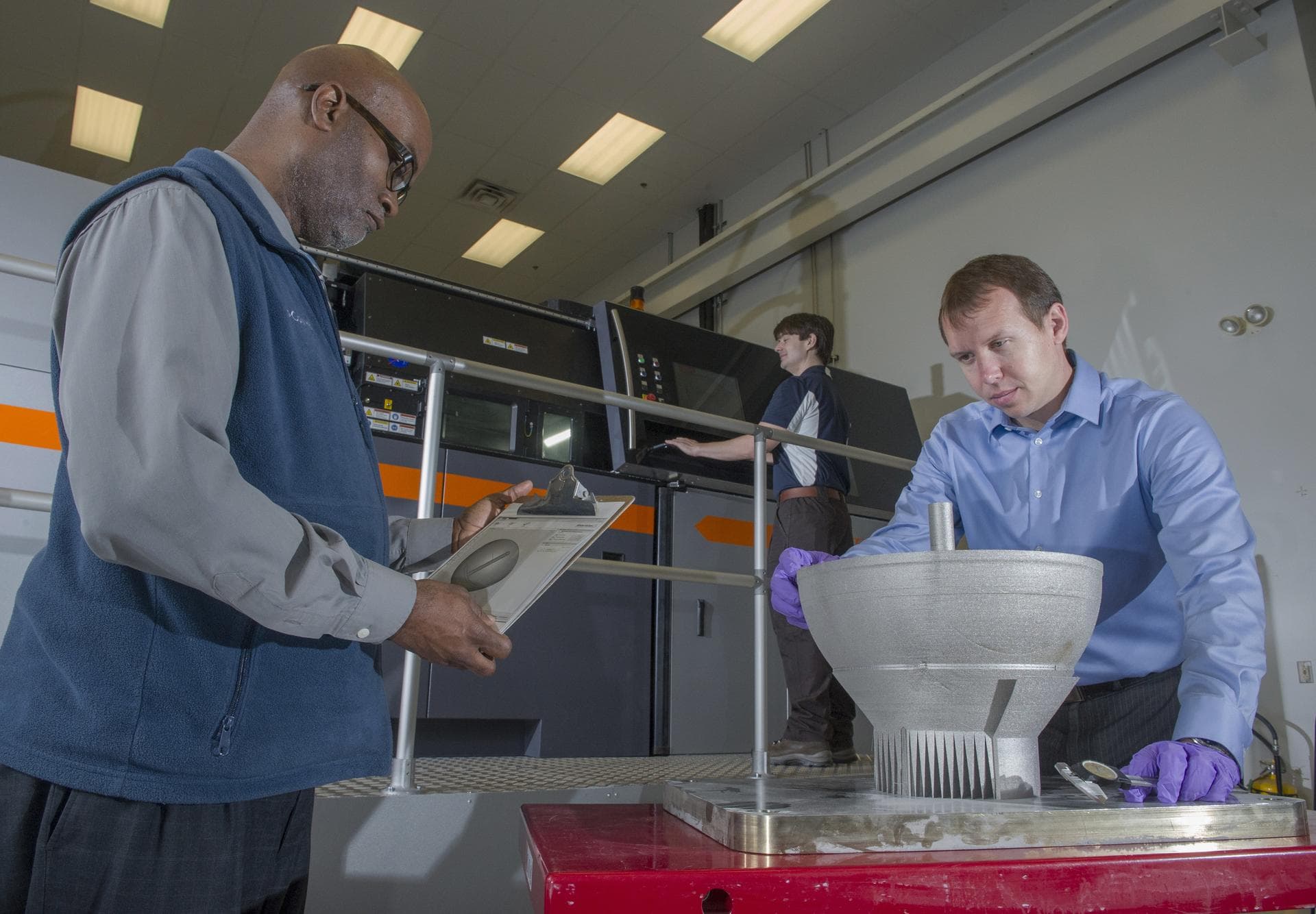
Hero photo: EMMETT GIVEN / NASA Marshall Space Flight Center.
Ready to find a 3D printing service provider?
Browse 2,000+ verified providers across the United States and submit your quote request free.
Browse Providers