Looking for 3D printing services in Madison? The 3D Prototyping Hub directory lists 8 providers in Madison, the second-deepest single-city pool in Wisconsin behind Milwaukee's 16. The fastest route to a quote is the Madison provider directory: filter by technology and material, then send your file to the shops that actually fit the part.
Before you do that, there is one thing about this particular pool worth knowing, because it decides who you should be calling.
What Madison's 8 Listings Actually Are
Madison's directory entries are not interchangeable. They fall into two broad groups:
Additive-focused operations. About half the listings are businesses whose output is printed parts or the equipment and materials behind them — digital manufacturing bureaus that run additive alongside machining and sheet metal, printing-equipment and materials specialists, and small dedicated printing businesses. These are the ones set up to discuss layer height, engineering thermoplastics, tolerance callouts and repeatability. Start here for anything functional.
Commercial print and document-services firms. Madison has a long-established commercial printing, reprographics and wide-format trade, and several of those businesses appear in the directory under the broader printing category. One listing is a self-service print kiosk. They are genuinely useful for display pieces, signage and simple one-off models, and they are not the right call for a glass-filled nylon bracket that has to hold a tolerance.
Neither group is better than the other — they are suited to different jobs. One qualifying question on first contact sorts all eight: what machines are on your floor, and what do you print most weeks?
What Drives Demand Here
Madison is a research-grade market, which is a genuinely different thing from a production market. Its industrial base determines what local shops are good at.
University research. UW–Madison is one of the largest public research universities in the United States, with a large engineering college and a dense cluster of research institutes. Research groups are a constant source of additive work, and the work has a distinctive shape: one-off lab fixtures, custom sample holders and jigs, instrument enclosures, optical and microfluidic mounts, and experimental hardware that exists in a quantity of one and is revised three times before it is right.
Life sciences, diagnostics and laboratory instrumentation. Madison and the surrounding communities carry a substantial biotech, molecular-diagnostics and scientific-instrument presence, built in part on the region's long history in analytical instrumentation. That generates housings, fluidic fixtures, bench hardware and pre-production prototypes — small parts where dimensional accuracy and surface finish matter more than throughput.
Medical and anatomical work. A major academic medical centre and a device-oriented supplier base mean steady demand for surgical planning models, anatomical replicas and research phantoms. If that is your application, our guide to 3D printed anatomical models from CT scans covers how the files are prepared and what to brief a provider on.
Product design and premium manufacturing. Appliance design, bicycle and outdoor-equipment engineering and consumer-product development sit in and around the metro, driving form models, fit checks, ergonomic mock-ups and functional prototypes.
The upshot: Madison is strong on precise, low-quantity, iteration-heavy work and thinner on volume production. If your part is one of fifty and has to be right, this is a good market. If you need three thousand of them, widen the search.
What You Can Get Printed Locally
- Research and lab hardware — fixtures, holders, mounts and enclosures, usually a quantity of one, usually needed this week.
- Prototypes and design iterations — the bulk of commercial work, mostly FDM or resin, turned around in days.
- High-detail models — dental, anatomical and miniature work, where surface finish is the whole point.
- Functional end-use parts — brackets, housings and manifolds in engineering materials rather than standard PLA.
- Short production runs — dozens to low hundreds, where tooling cannot be justified. See low-volume 3D printing services for how to scope one.
- Architectural and display models — where the commercial print listings genuinely compete.
Processes and When to Use Each
| Process | Best for | Trade-off |
|---|---|---|
| FDM | Functional prototypes, lab fixtures, larger parts, engineering plastics | Visible layer lines; weaker across layers |
| SLA / resin | Fine detail, smooth surfaces, small precise parts, models | More brittle; needs post-processing; costs more per part |
| SLS / MJF nylon | Durable functional parts, complex geometry, no supports needed | Grainy finish; fewer local providers; higher minimums |
| Metal | End-use metal components, tooling inserts, high-temperature parts | Most expensive; longest lead time; usually brokered out |
If you are weighing additive against a machined route — a routine question for research hardware that has to be stiff or hold a bearing — CNC machining vs 3D printing works through the decision on cost, volume and tolerance.
Capacity Across the Region
Madison holds the local depth, but the corridor east toward Milwaukee carries additional listings, and for pickup-and-inspect work the drive often matters more than the count:
| Location | Listed providers | Directory page |
|---|---|---|
| Madison | 8 | /providers/location/wi/madison |
| Jefferson | 1 | /providers/location/wi/jefferson |
| Watertown | 1 | /providers/location/wi/watertown |
| Milwaukee | 16 | /providers/location/wi/milwaukee |
Milwaukee is roughly ninety minutes east and is a different market rather than a larger version of this one — stronger on functional, production-adjacent work, as our Milwaukee 3D printing services guide sets out. Statewide context, including Green Bay's packaging and converting cluster and the 17 communities that each list a single provider, is in our Wisconsin 3D printing services guide.
How to Choose a Madison Provider
Establish which group you are talking to. Everything else follows from it. A print house quoting a display model and an additive bureau quoting a nylon fixture are both doing their job well.
Ask whether the capability is in-house. Especially SLS and metal. Brokering is common and legitimate, but it changes lead time, cost and who answers for a bad part.
Confirm the material, not just the process. "FDM" spans PLA and carbon-filled nylon. If the part has to survive heat, solvent or load, specify the polymer rather than the process — a point that matters more than usual for lab hardware that will meet reagents or an autoclave.
Sort out paperwork early if the work is grant-funded. Purchase orders, university vendor registration and invoicing terms are a routine reason a Madison job stalls after the part is already printed. Raise it at quoting.
Get turnaround in writing. "A few days" means different things in a busy quarter. Ask for a committed date at quoting, not after files are approved.
Ask what happens if the part fails their own quality check. The answer you want is that they reprint at their cost. An evasive answer tells you more than the quoted price does.
Get Quotes From Madison Providers
Browse the Madison provider directory to see all 8 listings, sort them into the two groups above, and send your part to the two or three that genuinely fit it. Three quotes is the cheapest way to find out what your part should actually cost. To compare across the state or the wider region, start from the full provider directory.
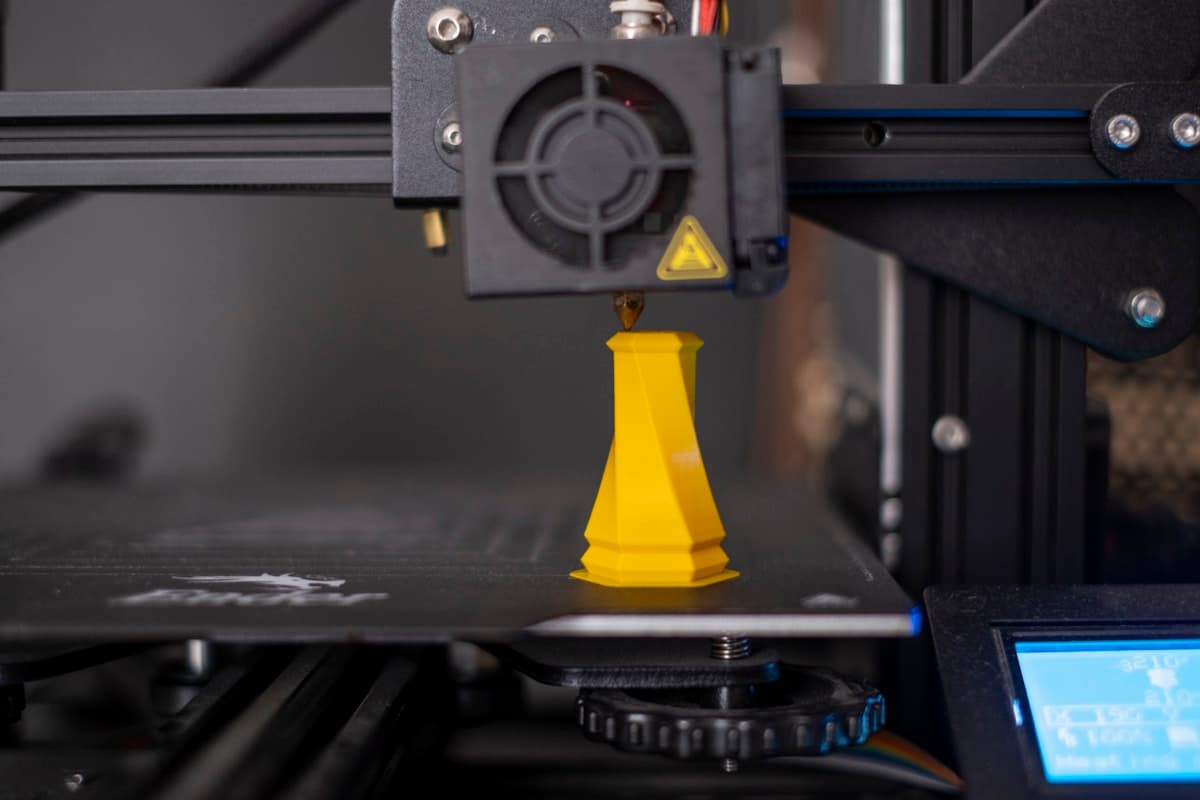
Hero image: open-frame FDM printer mid-job, yellow faceted part on the bed. Photographer unknown (legacy library asset).