Missouri's manufacturing economy runs deep — aerospace in St. Louis, automotive in Kansas City, agriculture and heavy equipment throughout the state — and 3D printing services in Missouri have grown to serve that industrial base directly. Local providers aren't general-purpose print shops; they understand program timelines, quality documentation requirements, and the cost-versus-lead-time calculus that drives engineering decisions across sectors.
Technology Capabilities Across Missouri's 3D Printing Landscape
Missouri service providers operate industrial additive manufacturing platforms tuned to aerospace, automotive, and medical device requirements. FDM (Fused Deposition Modeling) anchors most quick-turn prototype work, with Stratasys Fortus and F900 systems achieving build volumes up to 36×24×36 inches in engineering thermoplastics. Layer heights from 0.005 to 0.013 inches produce functional prototypes in ABS, polycarbonate, ULTEM 9085, and nylon 12 with tensile strengths reaching 9,500 psi — sufficient for fit-check assemblies, jigs, and ergonomic validation models.
SLA (Stereolithography) providers in St. Louis and Kansas City operate high-resolution systems from Formlabs, 3D Systems, and EnvisionTEC. These platforms achieve feature resolution to 0.002 inches with surface finishes to 0.0004-inch Ra after post-processing — suitable for aerospace concept models, medical device form factors, and consumer product aesthetics where appearance quality matters. Build envelopes range from 5×5×8 inches for small-part applications up to 20×20×24 inches for large housings and structural validation components.
SLS (Selective Laser Sintering) is well-represented across Missouri's industrial corridor. Support-free nylon construction enables complex brackets, ducting assemblies, and snap-fit enclosures that would require multi-piece machined designs in traditional manufacturing. EOS and HP Multi Jet Fusion systems produce PA12 nylon parts with wall thicknesses to 0.030 inches, tensile strength around 6,500–7,500 psi, and elongation at break of 15–20% — matching the functional assembly requirements of both aerospace and automotive validation programs.
Metal additive manufacturing serves Missouri's aerospace supplier base and defense prime contractors. DMLS (Direct Metal Laser Sintering) systems process 17-4 PH stainless steel, AlSi10Mg aluminum, Inconel 718, and Ti-6Al-4V titanium with densities exceeding 99.5%. Build volumes typically reach 10×10×12 inches with layer thicknesses of 0.0008–0.0016 inches. Several St. Louis-area providers maintain binder jetting capability for higher-volume metal part production at lower per-part cost than DMLS for geometries above 100 units.
Materials Selection and Performance Characteristics
| Material Category | Common Materials | Tensile Strength | Typical Cost | Lead Time |
|---|---|---|---|---|
| FDM Thermoplastics | ABS, Nylon 12, PC, ULTEM 9085 | 4,500–9,500 psi | $3–8/cu in | 2–5 days |
| SLA Resins | Standard, Tough, High Temp, Castable | 4,000–10,000 psi | $8–15/cu in | 3–5 days |
| SLS Nylon | PA12, Glass-filled PA12, FR Nylon | 6,500–7,500 psi | $10–20/cu in | 5–7 days |
| Metal Alloys | 17-4 SS, AlSi10Mg, Ti-6Al-4V, Inconel | 85,000–135,000 psi | $25–60/cu in | 2–4 weeks |
FDM material selection in Missouri centers on application-specific performance requirements. ULTEM 9085 satisfies FAR 25.853 flame, smoke, and toxicity requirements for aerospace interior components, with HDT of 153°C and tensile strength to 9,600 psi. Polycarbonate blends provide impact resistance to 10.0 ft-lb/in notched Izod for automotive underhood covers and electrical housings. Carbon fiber nylon composites achieve stiffness values to 9.0 Msi for structural checking fixtures that maintain dimensional stability across temperature swings on the manufacturing floor.
SLA resin libraries serve Missouri's validation and appearance model requirements. High-temperature resins with HDT of 238°C under 0.45 MPa load support short-run injection mold tooling inserts and fluid analysis models. Castable resins enable investment casting patterns with ash-free burnout for metal bracket prototypes requiring the same geometry as a machined part. Biocompatible resins in Class I, IIa, and IIb formulations serve Missouri's medical device development sector — particularly for dental surgical guides, prosthetic fit models, and implant trial components.
SLS powder materials address functional assembly requirements across Missouri's manufacturing base. Standard PA12 delivers balanced stiffness and impact resistance for enclosures and brackets. Glass-filled PA12 increases flexural modulus from 1,700 MPa to 2,600 MPa — preferred for sensor housings and dimensional gauges requiring stability across broad operating temperature ranges. Flame-retardant nylon meets UL94 V-0 for high-voltage enclosures and EV charging infrastructure components, a growing application in Missouri's expanding electric vehicle supply chain.
Precision Tolerances and Quality Control
Missouri 3D printing services hold dimensional tolerances aligned with industrial prototype requirements. FDM industrial systems achieve ±0.010 inches on features under 4 inches, tightening to ±0.005 inches on calibrated Stratasys equipment with temperature-stabilized build chambers. Secondary CNC machining on datum features achieves ±0.002 inches for press-fit bearing surfaces and precision locating features.
SLA dimensional accuracy reaches ±0.004 inches for features under 6 inches with controlled post-cure processes, tightening to ±0.002 inches on calibrated systems through resin-specific compensation algorithms. Linear shrinkage compensation of 0.1–0.3% is applied per resin chemistry, with nesting and orientation optimized to maintain flatness within 0.010 inches on reference surfaces used for dimensional layout.
SLS tolerances in competent Missouri bureaus achieve ±0.008–0.012 inches on critical features through powder quality programs and packing density management. Warpage is minimal due to uniform thermal distribution in PA12 builds, with flatness typically holding 0.020 inches over 12-inch spans — acceptable for most enclosure and bracket applications without secondary processing.
Metal DMLS parts undergo inspection protocols scaled to application. Standard aerospace prototype parts receive CMM inspection reports documenting GD&T callouts. CT scanning for internal porosity verification is available from St. Louis aerospace suppliers for flight-critical or safety-critical geometries. As-printed surface finishes run 400–800 Ra microinches, improving to 16–32 Ra after tumbling, vibratory finishing, or precision machining of bearing surfaces.
Industry Applications: Where Missouri's Additive Ecosystem Excels
Aerospace and defense drives significant additive manufacturing volume in St. Louis through Boeing's commercial and defense programs, McDonnell Douglas legacy facilities, and the dense network of aerospace Tier 1 and Tier 2 suppliers that has built up around that base. AS9100D-certified local providers produce non-structural composite tooling master models, conformal cooling insert prototypes, and structural component prototypes with full material certification and first article inspection documentation. ITAR-registered providers in St. Louis serve defense prime contractors on export-controlled programs — a capability that narrows the field significantly and rewards qualifying suppliers with stable, repeatable work.
Automotive and powertrain applications are concentrated in Kansas City along the I-70 corridor serving Ford's Kansas City Assembly Plant and the Tier 1 suppliers building F-150 and Transit commercial van components. Additive manufacturing use cases include checking fixtures for body panel dimensional verification, ergonomic assembly aids replacing shop-floor handmade fixtures, and quick-turn prototype brackets for design validation before tool release. A typical application: a Tier 1 supplier needs 15 SLS nylon bracket assemblies for climate system validation before tool release — a Kansas City bureau delivers in 6 days, eliminating a 10-week soft-tool cycle and avoiding $40,000 in tooling cost.
Medical devices represent a growing segment in Columbia (anchored by the University of Missouri Health System) and St. Louis (anchored by Washington University Medical Center and the biotech corridor on Lindell Boulevard). ISO 13485-capable providers serve orthopedic implant prototyping, surgical instrument development, and patient-specific device manufacturing. Biocompatible SLA resins and PA12 nylon enable functional prototypes that match production material properties closely enough for human-subject fit testing and pre-clinical validation work.
Consumer products and product development leverage Missouri's growing startup ecosystem. St. Louis has emerging design and manufacturing communities that support quick-turn SLA and FDM for concept validation, crowdfunding prototype builds, and appearance models before production investment. Kansas City's maker and design community supports similar work with a bias toward industrial and functional applications over consumer aesthetics.
Cost Structures and Pricing Benchmarks
Project-based quoting drives Missouri additive pricing, with complexity, material, and technology determining cost more than geography. A 4×3×2 inch prototype costs $120–250 in FDM ABS, $180–380 in SLA standard resin, or $220–440 in SLS nylon. Volume discounts apply at 10+ pieces, with per-part costs dropping 25–40% at quantities of 50–100 units.
Rush service premiums range from 50–100% for 24–48 hour delivery on FDM and SLA parts under 30 cubic inches. Missouri providers serving aerospace programs typically offer defined rush tiers with predictable pricing rather than ad-hoc surcharges — making program cost estimation more manageable across multiple engineering iterations.
Post-processing adds measurably to base part cost. Support removal and basic cleaning are typically included. Vapor smoothing for FDM cosmetic parts runs $30–80 per part. Painting with color matching to RAL or Pantone specifications adds $50–175 per part. CNC machining of datum surfaces and critical bore features runs $85–225 per hour for secondary operations, typically 0.5–1.5 hours per part depending on geometry complexity.
Selecting the Right Missouri Provider
Certification requirements should be your first filter for regulated applications. Aerospace programs need AS9100D and ITAR. Medical device work needs ISO 13485 and biocompatibility documentation. Defense programs may need NADCAP for specific process categories. Don't assume certification — ask to see the certificate and verify its expiration date and scope.
Equipment matters. A shop running five desktop FDM printers cannot match the build volume, material options, or dimensional consistency of an industrial Stratasys or EOS system. Ask for their equipment list — not just "we do SLS" but what platform, build volume, and what materials they run in regular production versus occasionally for special orders.
Program capacity matters on aerospace and automotive timelines where a missed build window means a delayed gate review. Shops operating 2–5 printers handle prototype work and small batches reliably. Mid-size operations running 10–25 machines across technologies absorb production runs to 500 units without impacting prototype turnaround. Large regional bureaus with 50+ systems offer lights-out production and weekend builds for critical path parts.
The 3D Prototyping Hub provider directory lists verified Missouri 3D printing services with technology capabilities, material options, and direct quote request submission. Filter by state, service type, and technology to find providers matched to your specific application requirements.
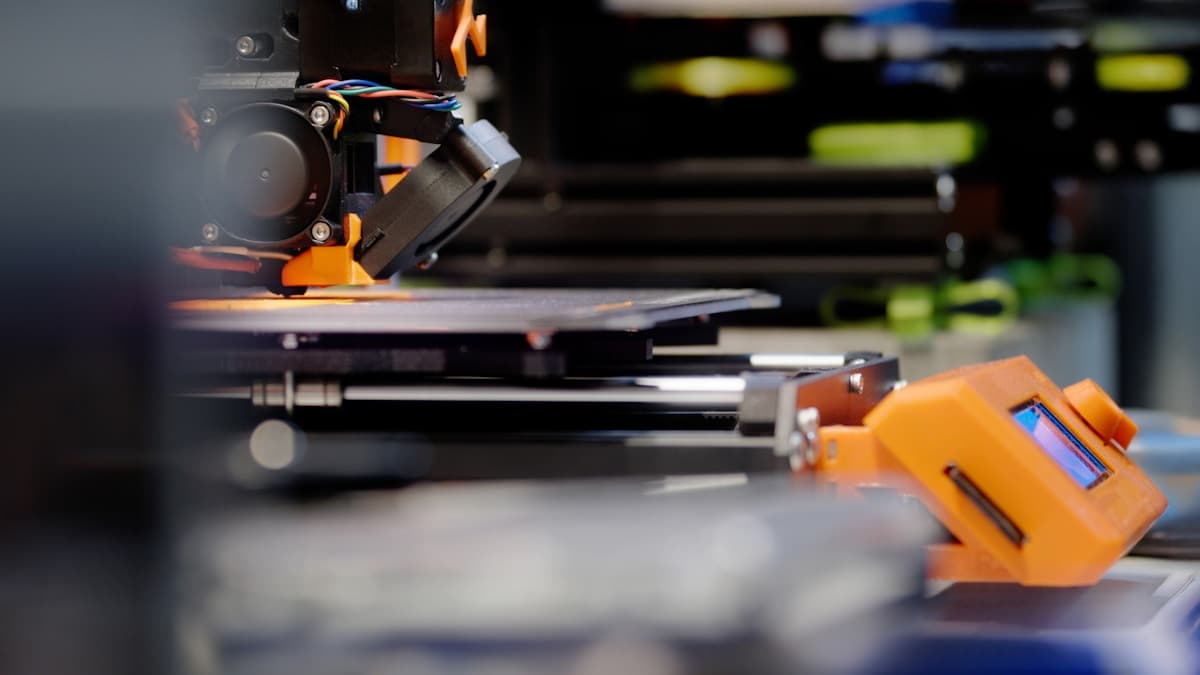
Photo by Jakub Żerdzicki / Unsplash