Denver's Front Range manufacturing corridor has become one of the country's most technically capable additive manufacturing markets, with 3D printing services in Denver, CO serving a dense concentration of aerospace, defense, medical device, and energy companies. From rapid overnight prototypes at downtown print shops to AS9100-certified metal additive manufacturing supporting satellite programs, Denver's provider ecosystem covers every production requirement.
Technology Capabilities Across Denver's 3D Printing Landscape
Denver service providers operate diverse additive manufacturing platforms suited to the region's engineering-intensive client base. FDM (Fused Deposition Modeling) anchors quick-turn prototyping across the Front Range, with industrial Stratasys Fortus and Ultimaker S-series systems achieving build volumes to 36×24×36 inches. Layer heights range from 0.005 to 0.013 inches, producing functional prototypes in engineering thermoplastics including ABS, ASA, nylon 12, PETG, and polycarbonate with tensile strengths reaching 9,500 psi. Carbon fiber composites add stiffness for structural brackets and drone components where weight-to-strength ratios are critical.
SLA (Stereolithography) providers in the Denver metro operate high-resolution resin systems from Formlabs, 3D Systems, and EnvisionTEC, delivering feature resolution to 0.002 inches with surface finishes as smooth as 0.0004-inch Ra after secondary sanding and polishing. Build envelopes span 5×5×8 inches for precision dental and jewelry applications up to 20×20×24 inches for large tooling masters and industrial housings. Dimensional accuracy holds ±0.005 inches across most geometries, tightening to ±0.002 inches on properly oriented, calibrated systems.
SLS (Selective Laser Sintering) capabilities focus on PA12 nylon powder, producing support-free parts that enable complex internal channels, assembled mechanisms, and thin-wall structures to 0.030 inches. Denver SLS bureaus achieve tensile strengths of 6,500-7,500 psi with elongation at break around 20-30%, suitable for snap fits and living hinges. Newer HP Multi Jet Fusion systems available at select providers deliver tighter tolerances (±0.008 inches) and faster turnaround on production nylon parts with isotropic mechanical properties.
Metal additive manufacturing serves Denver's aerospace and defense concentration directly. DMLS (Direct Metal Laser Sintering) systems process stainless steel, Inconel, titanium, and aluminum alloys with densities exceeding 99.5% after sintering and HIP cycling. Build chambers typically reach 10×10×12 inches with layer thicknesses of 0.0008-0.0016 inches, producing internal cooling channels and lattice structures impossible to achieve through conventional machining.
Materials Selection and Performance Characteristics
| Material Category | Common Materials | Tensile Strength | Typical Cost | Lead Time |
|---|---|---|---|---|
| FDM Thermoplastics | ABS, Nylon 12, PC, ULTEM 9085 | 4,500-9,500 psi | $3-8/cu in | 2-5 days |
| SLA Resins | Standard, Tough, High-Temp, Castable | 4,000-10,000 psi | $8-15/cu in | 3-5 days |
| SLS Nylon | PA12, PA11, Glass-Filled | 6,500-7,500 psi | $10-20/cu in | 5-7 days |
| Metal Alloys | 17-4 SS, Ti-6Al-4V, Inconel 718, AlSi10Mg | 80,000-135,000 psi | $25-50/cu in | 2-4 weeks |
FDM material selection in Denver is heavily influenced by aerospace and outdoor end-use requirements. ASA (Acrylonitrile Styrene Acrylate) offers UV stability for enclosures and brackets exposed to Colorado's intense high-altitude sunlight, maintaining color and structural properties through years of outdoor exposure. ULTEM 9085 meets FAA flame, smoke, and toxicity (FST) requirements for aircraft interior components, while polycarbonate handles impact loads and elevated temperatures for industrial housings. Carbon fiber composites achieve bending stiffness of 9.0 Msi, replacing machined aluminum in weight-critical fixtures and drone frames.
SLA resin libraries at Denver providers include high-temperature formulations reaching HDT of 238°C under 0.45 MPa load, supporting injection mold validation and vacuum forming tooling applications. Castable resins burn out cleanly for investment casting of aluminum and bronze parts through local foundry partnerships. Biocompatible resins meeting ISO 10993 and USP Class VI standards serve Denver's growing medical device sector for surgical guides, anatomical models, and device housing prototypes.
SLS materials emphasize nylon variants for Denver's defense and outdoor equipment clients. Standard PA12 delivers balanced stiffness and toughness for functional hardware. PA11 bio-based powder offers improved elongation at 40-50%, better suited to thin-wall assemblies requiring repeated flexing without fatigue failure. Glass-filled nylon increases stiffness by 50% and lowers thermal expansion, serving precision fixturing and gauges on the aerospace production floor.
Precision Tolerances and Quality Control Standards
Denver 3D printing services achieve dimensional tolerances calibrated to technology and geometry. FDM parts hold ±0.010 inches on features under 4 inches in typical shop environments, tightening to ±0.005 inches on temperature-controlled industrial systems with proper CAD compensation. Features requiring tighter tolerances—bearing bores, mating interfaces, and datum surfaces—receive secondary CNC machining to ±0.002 inches, with bearing surfaces achieving ±0.0005 inches.
SLA dimensional accuracy reaches ±0.004 inches for features under 6 inches when parts are properly oriented and supported, with experienced Denver providers achieving ±0.002 inches through systematic calibration and climate-controlled build environments. Post-cure shrinkage compensation algorithms account for 0.1-0.3% linear change depending on resin formulation, critical for master patterns used in downstream casting or molding operations.
SLS tolerances run ±0.012 inches (±0.3 mm) per industry standard, with process-optimized Denver bureaus achieving ±0.008 inches on critical features through powder quality monitoring and controlled packing density. Flatness holds 0.020 inches over 12-inch spans without support structures, and wall thickness uniformity reaches ±0.010 inches when oriented to minimize thermal gradients during cooling.
Metal 3D printed components undergo full inspection protocols at quality-certified Denver facilities. CT scanning detects internal porosity, ensuring density exceeds 99.7% throughout load-bearing cross-sections. CMM reports document GD&T callouts including positional tolerances, perpendicularity, and profile of a surface. As-printed surface finishes measure 400-800 Ra microinches, improving to 16-32 Ra after tumbling, shot peening, or manual finishing for functional sealing surfaces and aerodynamic profiles.
Industry-Specific Applications in Denver
Aerospace and defense drives significant volume across Denver's additive manufacturing providers. The Front Range aerospace corridor—anchored by Lockheed Martin Space, Raytheon Intelligence & Space, Ball Aerospace, and Sierra Nevada Corporation—generates continuous demand for rapid prototyping, tooling aids, and low-volume production components. Satellite bus brackets, waveguide assemblies, and thermal management components produced in DMLS titanium and Inconel eliminate complex machining setups and reduce lead time from 12 weeks to 3 weeks for first articles.
Energy sector applications leverage Denver's position as a hub for oil and gas companies operating across the Wattenberg and DJ Basin plays. Downhole tool components in 17-4 PH stainless steel withstand pressures to 15,000 psi and temperatures to 300°F. Printed valve bodies, sensor housings, and flow manifolds enable rapid field testing of new completion designs without waiting for conventional casting cycles measured in months.
Medical device prototyping serves Denver's life sciences cluster around the Anschutz Medical Campus and Children's Hospital Colorado. Surgical instrument prototypes in autoclavable ULTEM 1010 withstand 134°C steam sterilization cycles through hundreds of use cycles. Patient-specific anatomical models printed in PolyJet multi-material combine rigid bone-simulating materials (Shore D 85) with soft-tissue-mimicking elastomers (Shore A 27), enabling surgical rehearsal for complex procedures and reducing operative time.
Outdoor recreation and consumer products represent a unique Denver market segment. Sporting goods prototyping for ski, cycling, and climbing equipment companies requires materials tolerant of temperature cycling from -30°F to 100°F and UV exposure at high altitude. ASA and carbon fiber composites handle these environments, with several Denver providers specializing in consumer product development cycles from sketch to manufacturable design.
Cost Structures and Pricing Models
Project-based quoting is standard across Denver's provider base, with pricing driven by printed volume, material cost, technology overhead, and post-processing labor. A representative 4×3×2 inch engineering prototype costs $120-280 in FDM ABS, $175-400 in SLA standard resin, or $220-500 in SLS PA12 nylon. Metal prototypes in the same size range run $600-1,800 in 17-4 stainless steel depending on geometry complexity and required finishing.
Volume pricing applies starting at 10 identical pieces on most technologies, with per-part cost reductions of 20-40% at quantities of 50-100. SLS nylon production runs of 100-500 units achieve per-part economics competitive with low-volume injection molding while eliminating $8,000-20,000 tooling investment and 10-12 week tooling lead time. FDM and SLA volume pricing improves further, with some Denver providers quoting 100-piece runs at 50-60% below single-unit pricing through nested builds and shared setup.
Rush service premiums in Denver range from 50-100% for 24-48 hour turnaround on FDM and SLA parts under 30 cubic inches. Standard 5-7 day lead times avoid surcharges and allow proper build scheduling. Several shops offer flat-rate monthly contracts for engineering teams with recurring prototype needs, providing priority queue access and 15-25% below-market pricing in exchange for volume commitments.
Post-processing adds measurably to base printing costs but is often required for functional parts. Support removal and solvent cleaning typically include in SLA quotes. Painting with color-matching runs $50-150 per part depending on surface area and finish quality. Vapor smoothing for FDM parts costs $30-80 per piece, reducing roughness from 400 Ra to under 32 Ra. CNC machining of critical datum surfaces and threaded features adds $75-200 per hour with most operations requiring 0.5-2.0 hours per part.
Selecting the Right Denver Provider for Your Project
Technical alignment is the primary selection criterion. Providers serving aerospace programs maintain AS9100D certification with documented material traceability and first article inspection capability. Medical applications require ISO 13485 compliance and experience navigating FDA design control documentation. Defense programs involving controlled technical data require ITAR-registered facilities with vetted personnel and secure data handling—a meaningful differentiator among Denver's provider base given the region's defense concentration.
Capacity and technology match determine whether a provider can handle project volume and geometry requirements. Single-operator shops with 2-5 printers excel at prototype work and batches under 20 parts with close design-feedback loops. Mid-size Denver bureaus running 10-25 machines across multiple technologies handle production runs to 500 units with managed schedules. Larger regional manufacturers with 50+ systems offer lights-out production for high-volume orders and the redundancy to absorb machine downtime without delaying delivery.
Local advantage matters for iterative development work. Denver's provider density means same-day pickup is possible from multiple suppliers, enabling rapid design-print-test cycles that compress product development timelines. In-person DFM (Design for Manufacturability) review with a Denver provider's engineering team catches wall thickness violations, support access issues, and feature size limitations before builds start—saving both time and cost versus remote-only suppliers.
Finding the right match for your specific requirements—overnight prototype, functional testing parts, or production manufacturing—starts with comparing technology capabilities, quality certifications, and industry experience across the local market.
The 3D Prototyping Hub directory connects Denver engineers and product teams with verified local and national service providers, complete with technology specifications, material options, and contact information to get your project quoted today.
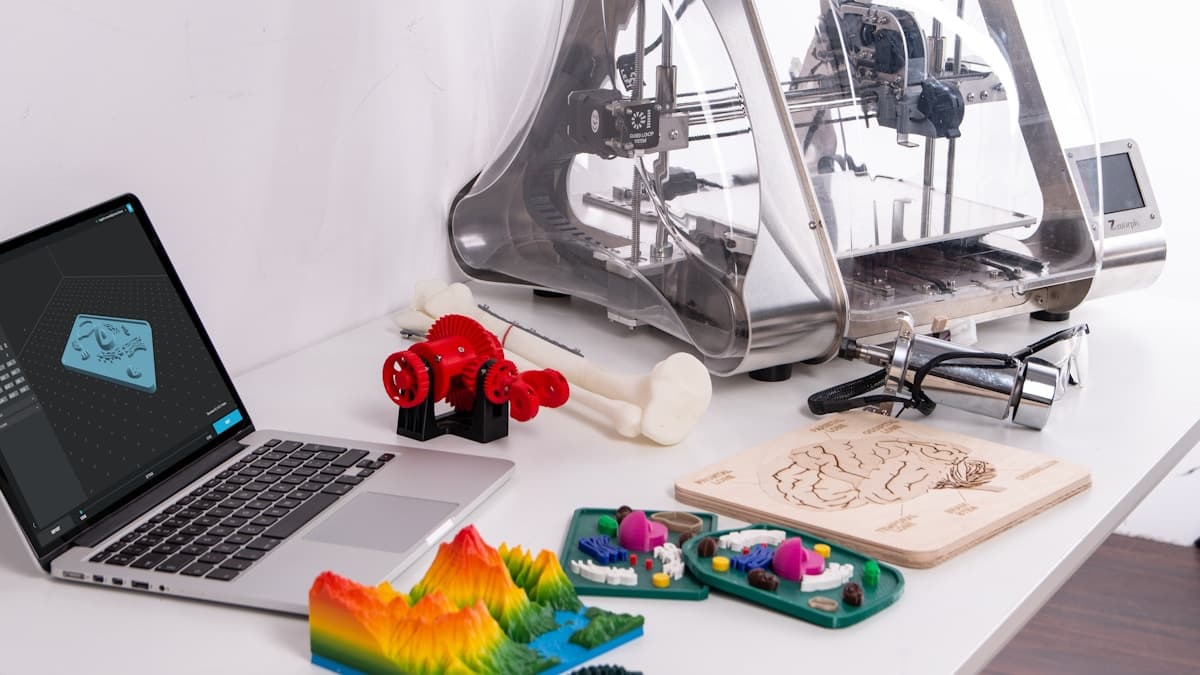
Hero photo by ZMorph All-in-One 3D Printers via Unsplash.